Risk factors for retear of arthroscopic rotator cuff repair using triple-row technique
Ryosuke Takahashi, Ryosuke Sagami, Yohei Harada, Yukihiro Kajita

TL;DR
This study finds that older patients with large tears and fatty infiltration are more likely to experience retears after a specific shoulder repair technique.
Contribution
Identifies risk factors for retear after triple-row arthroscopic rotator cuff repair, including age, tear size, and fatty infiltration.
Findings
11% of patients experienced retears after triple-row rotator cuff repair.
Patients with larger tears and fatty infiltration had worse outcomes and higher retear rates.
Fatty infiltration of the infraspinatus was an independent risk factor for retear.
Abstract
The triple-row (TR) technique enhances tendon-to-bone contact and repair integrity in arthroscopic rotator cuff repair (ARCR). However, limited studies have evaluated the clinical outcomes and risk factors for retears following this technique. This study aimed to compare clinical outcomes between retear and nonretear groups after ARCR using the TR technique and identify risk factors for retear. Patients who underwent ARCR using the TR technique with at least 24 months follow-up were enrolled and categorized into retear and nonretear groups. Clinical outcomes, including range of motion, visual analog scale for pain, Constant Shoulder (CS), and University of California Los Angeles (UCLA) score, were evaluated at 3, 6, and 24 months postoperatively. The retear rate and tendon integrity were assessed at 3, 6, and 24 months follow-up using magnetic resonance imaging, and risk factors for…
Genes, proteins, chemicals, diseases, species, mutations and cell lines named across the full text — each resolved to its canonical identifier and authoritative record.
Click any figure to enlarge with its caption.
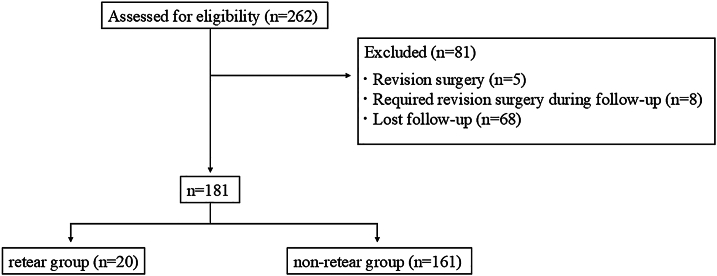 Figure 1
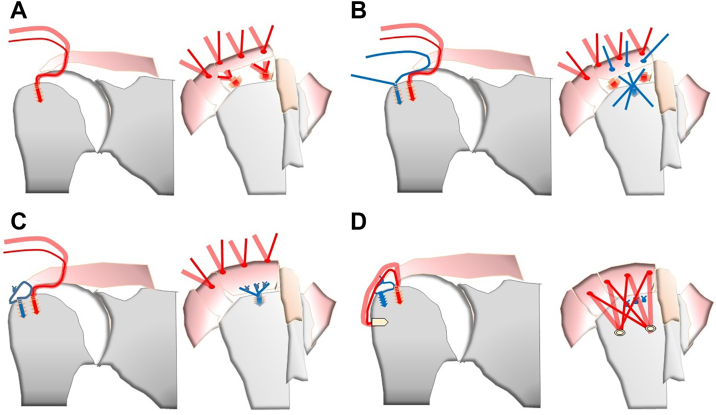 Figure 2
Peer Reviews
No public reviews on file for this paper yet. If you reviewed it on a platform where reviews are public (OpenReview, ICLR, NeurIPS, ICML), you can paste yours below so the community can read it here.
Videos
No videos yet. Explain this paper in a talk, walkthrough, or lecture? Add one.
Taxonomy
TopicsShoulder Injury and Treatment · Hip disorders and treatments · Total Knee Arthroplasty Outcomes