Mid-Infrared Spectroscopy for the Qualitative and Quantitative Analysis of the Wheat Proteome
Dedy L. Nadeak, Michael Wiederstein, Sabine Baumgartner, Elisabeth Reiter, Rudolf Krska, Stephan Freitag

TL;DR
Mid-infrared spectroscopy is shown to effectively analyze the protein structures and content in wheat, offering a new method for studying its proteome.
Contribution
The study demonstrates the use of ATR-MIR for analyzing wheat protein secondary structures and quantifying protein fractions.
Findings
Albumin and globulin fractions are primarily composed of α-helix structures.
MIR spectra of wheat protein fractions are significantly affected by sampling sites and variety.
Protein content quantification via the amide II band reveals significant differences across sampling sites.
Abstract
Wheat contributes 19% of protein in the global human diet. Mid-infrared spectroscopy (MIR) combined with attenuated total reflection (ATR) is an excellent analytical method for assessing the chemical composition of complex biological samples. In contrast to established techniques used for wheat protein analysis, we show that by using ATR-MIR the protein secondary structures of different fractions can be studied. We found that albumin and globulin fractions were primarily composed of α-helix, with proportions of 57.8% and 45.9%, respectively. Gliadins, meanwhile, contained 38.3% β-turn and 36.9% α-helix, while glutenins predominantly exhibited 44.8% β-turn secondary structures. In addition, we found that by using analysis of variance (ANOVA) simultaneous component analysis (ASCA), the obtained MIR spectra of the wheat protein fractions were significantly (p < 0.001) affected by the…
Genes, proteins, chemicals, diseases, species, mutations and cell lines named across the full text — each resolved to its canonical identifier and authoritative record.
Click any figure to enlarge with its caption.
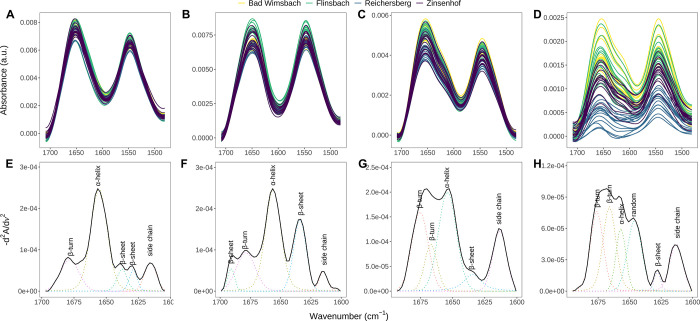 Figure 1
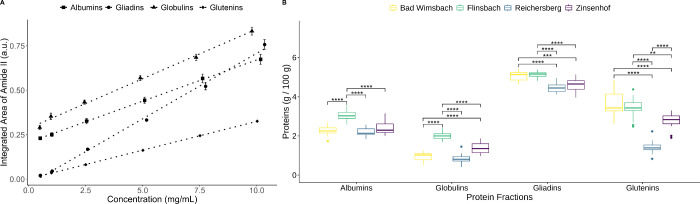 Figure 2
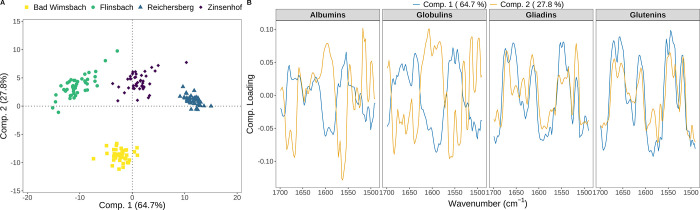 Figure 3
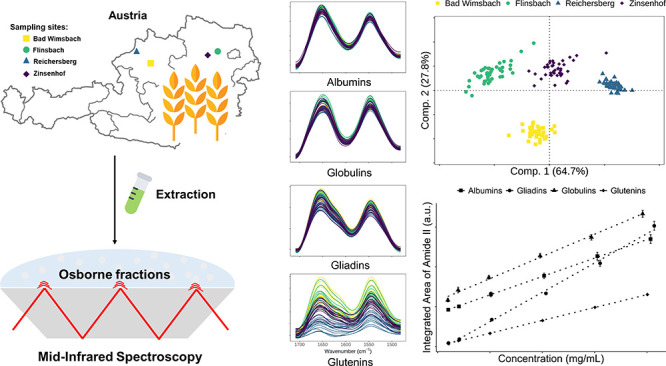 Figure 4
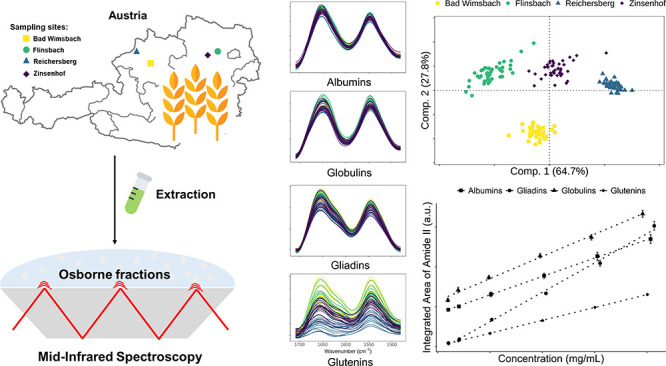 Figure 5
 Figure 6
 Figure 7
 Figure 8
 Figure 9
 Figure 10
Peer Reviews
No public reviews on file for this paper yet. If you reviewed it on a platform where reviews are public (OpenReview, ICLR, NeurIPS, ICML), you can paste yours below so the community can read it here.
Videos
No videos yet. Explain this paper in a talk, walkthrough, or lecture? Add one.
Taxonomy
TopicsSpectroscopy and Chemometric Analyses · Spectroscopy Techniques in Biomedical and Chemical Research · Advanced Proteomics Techniques and Applications