Racial disparities in HIV incidence and PrEP non-adherence among gay, bisexual and other Men who have Sex with Men (MSM) and transgender women using oral PrEP in Brazil: Results from the ImPrEP study
Lucilene Araujo Freitas, Carolina Coutinho, Debora Castanheira, Ronaldo Ismerio, Pedro Leite, Iuri C. Leite, Marcelo Cunha, Josias Freitas, Toni Araujo, Laylla Monteiro, Brenda Hoagland, Mayara S.T. Silva, Marcos Benedetti, Cristina Pimenta, Beatriz Grinsztejn

TL;DR
This study found higher HIV rates and lower PrEP adherence among Black and Pardo men who have sex with men and transgender women in Brazil, highlighting the role of structural racism in health disparities.
Contribution
The study reveals racial disparities in HIV incidence and PrEP non-adherence in Brazil, emphasizing the impact of structural inequities on health outcomes.
Findings
Black and Pardo participants had higher PrEP non-adherence compared to White participants.
HIV incidence was higher among Black participants with PrEP non-adherence compared to Pardo and White participants.
Structural racism and social inequities were identified as key factors affecting health outcomes in marginalized racial groups.
Abstract
Access to health services may affect PrEP uptake, adherence, and persistance, especially among persons affected by structural inequities. We assessed the HIV incidence and factors associated with PrEP non-adherence among men who have sex with men (MSM) and transgender women in Brazil, focusing on potential racial disparities. ImPrEP was a prospective, single-arm, open-label, PrEP implementation study that enrolled 9509 MSM and transgender women in Brazil, Mexico and Peru (February 2018 ‒ June 2021). Participants received oral PrEP with tenofovir disoproxil fumarate and emtricitabine at the enrollment visit and quarterly thereafter. This analysis was restricted to data from 14 HIV/STI clinics in 11 cities from Brazil. We calculated the HIV incidence per 100 person-years using the Poisson model according to race. We used adjusted logistic regression models to identify factors associated…
Genes, proteins, chemicals, diseases, species, mutations and cell lines named across the full text — each resolved to its canonical identifier and authoritative record.
Click any figure to enlarge with its caption.
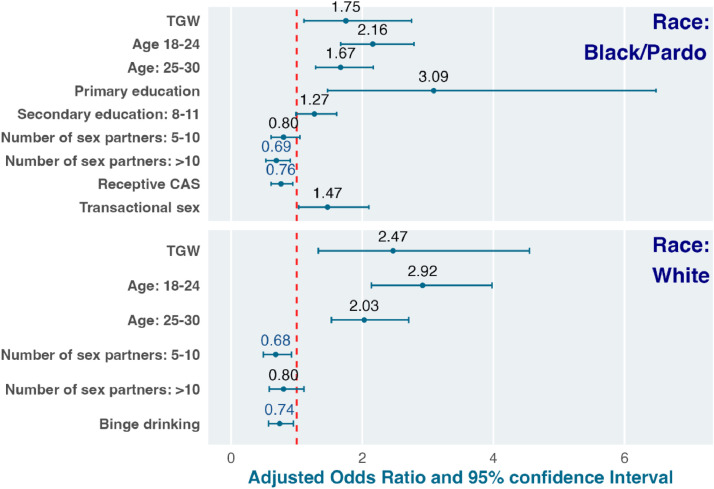 Figure 1
Peer Reviews
No public reviews on file for this paper yet. If you reviewed it on a platform where reviews are public (OpenReview, ICLR, NeurIPS, ICML), you can paste yours below so the community can read it here.
Videos
No videos yet. Explain this paper in a talk, walkthrough, or lecture? Add one.
Taxonomy
TopicsHIV/AIDS Research and Interventions · LGBTQ Health, Identity, and Policy · Sex work and related issues