Metagenomic next-generation sequencing in diagnosing rhino-orbital-cerebral mucormycosis presenting as cerebral Infarction: a case series and diagnostic analysis of seven patients
Fei Yang, Chenglin Yang, Hongqiang Li, Xiaojuan Zhang, Xianfei Ding, Shuguang Zhang

TL;DR
This study shows how metagenomic sequencing can help diagnose a rare fungal infection that mimics a brain stroke, especially in diabetic patients.
Contribution
This is the first case series to demonstrate the use of metagenomic next-generation sequencing for early diagnosis of ROCM presenting as cerebral infarction.
Findings
All seven patients with ROCM presented with cerebral infarction confirmed by MRI.
mNGS detected Rhizopus species in cerebrospinal fluid, confirming ROCM diagnosis.
Despite treatment, the mortality rate was 85.7%, highlighting the need for early diagnosis.
Abstract
Rhino-orbital-cerebral mucormycosis (ROCM) is a rare, rapidly progressive, and fatal invasive fungal infection. This case series is the first to systematically characterize ROCM presenting primarily as cerebral infarction on imaging and highlights the value of metagenomic next-generation sequencing (mNGS) in the early diagnosis of such critical and atypical cases. All seven patients had diabetes mellitus, with six concurrently presenting with ketoacidosis. Universal clinical features included fever and a fixed, dilated pupil. Most patients exhibited facial swelling (6/7, 85.7%) and visual impairment (5/7, 71.4%). Cerebral infarction was confirmed by head magnetic resonance imaging (MRI) in all individuals. The diagnosis was confirmed in all cases by the detection of Rhizopus species sequences via mNGS of cerebrospinal fluid (CSF). Six patients received treatment with amphotericin B…
Genes, proteins, chemicals, diseases, species, mutations and cell lines named across the full text — each resolved to its canonical identifier and authoritative record.
Click any figure to enlarge with its caption.
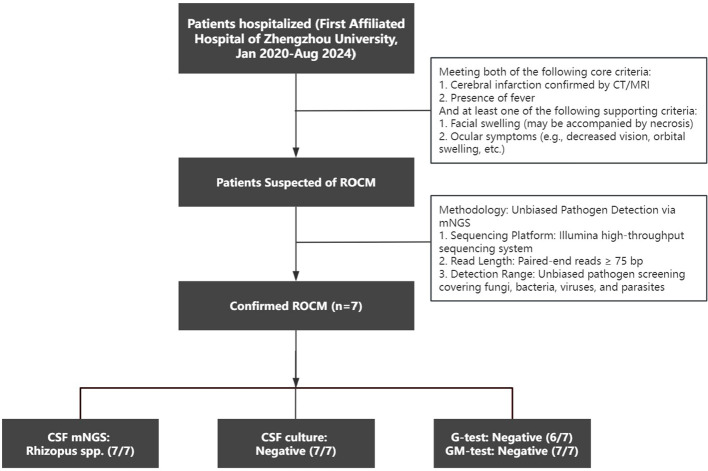 Figure 1
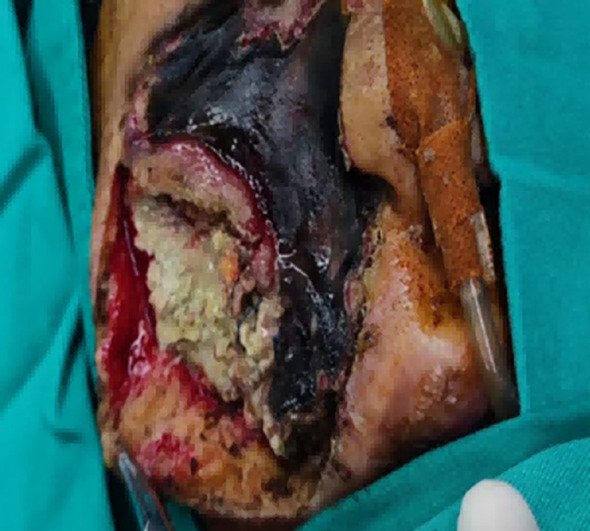 Figure 2
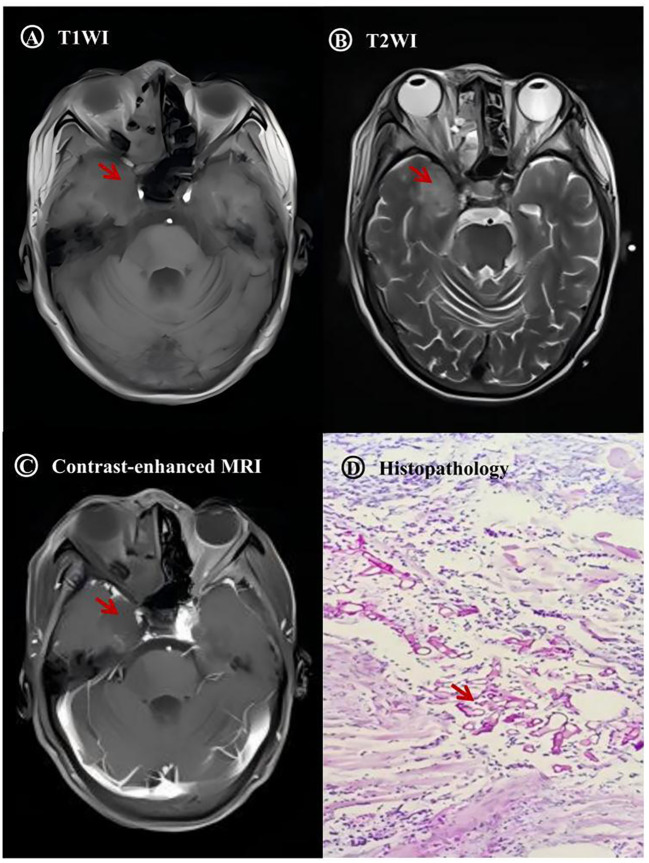 Figure 3
Peer Reviews
No public reviews on file for this paper yet. If you reviewed it on a platform where reviews are public (OpenReview, ICLR, NeurIPS, ICML), you can paste yours below so the community can read it here.
Videos
No videos yet. Explain this paper in a talk, walkthrough, or lecture? Add one.
Taxonomy
TopicsAntifungal resistance and susceptibility · Fungal Infections and Studies · Actinomycetales infections and treatment