Epigenetic silencing is a barrier to editing the X chromosome using the SEC-based CRISPR/Cas9 knock-in protocol in C. elegans
Ryka Iyer, Simon Ferreria, Laahya Guvvala, Hugh Borden, Aariv Arora, Rebecca Shirsat, Ryan Doonan

TL;DR
Scientists found that editing the X chromosome in C. elegans using a CRISPR method is blocked by epigenetic silencing, but they developed a workaround using RNAi to temporarily reduce this silencing.
Contribution
The study identifies epigenetic silencing as a barrier to SEC-based CRISPR/Cas9 knock-in on the X chromosome and proposes a PRC2 RNAi-based solution.
Findings
SEC-based CRISPR/Cas9 knock-in fails on the X chromosome due to epigenetic silencing in primordial germ cells.
PRC2 RNAi temporarily reduces silencing, enabling successful SEC floxing on the X chromosome.
The workaround preserves germ line development while allowing X chromosome tagging.
Abstract
Self-excising-cassette (SEC)-based CRISPR/Cas9 knock-in is widely used for generating endogenous fluorescent protein tags in C. elegans . Here, we report a lack of success targeting the X chromosome using this method. CRISPR/Cas9 works as intended, but subsequent floxing of the SEC is blocked. Given that the X chromosome is epigenetically silenced in primordial germ cells (PGCs), this is a logical result. To circumvent this barrier, we suppressed polycomb repressive complex 2 (PRC2) with RNAi to transiently and reversibly reduce silencing in the PGCs, creating a brief window where the X chromosome is amenable to floxing without compromising germ line development. Overall, our results reveal a previously unrecognized limitation of SEC-based CRISPR/Cas9 knock-in and identify a reliable workaround for tagging proteins encoded on the X chromosome.
Genes, proteins, chemicals, diseases, species, mutations and cell lines named across the full text — each resolved to its canonical identifier and authoritative record.
Click any figure to enlarge with its caption.
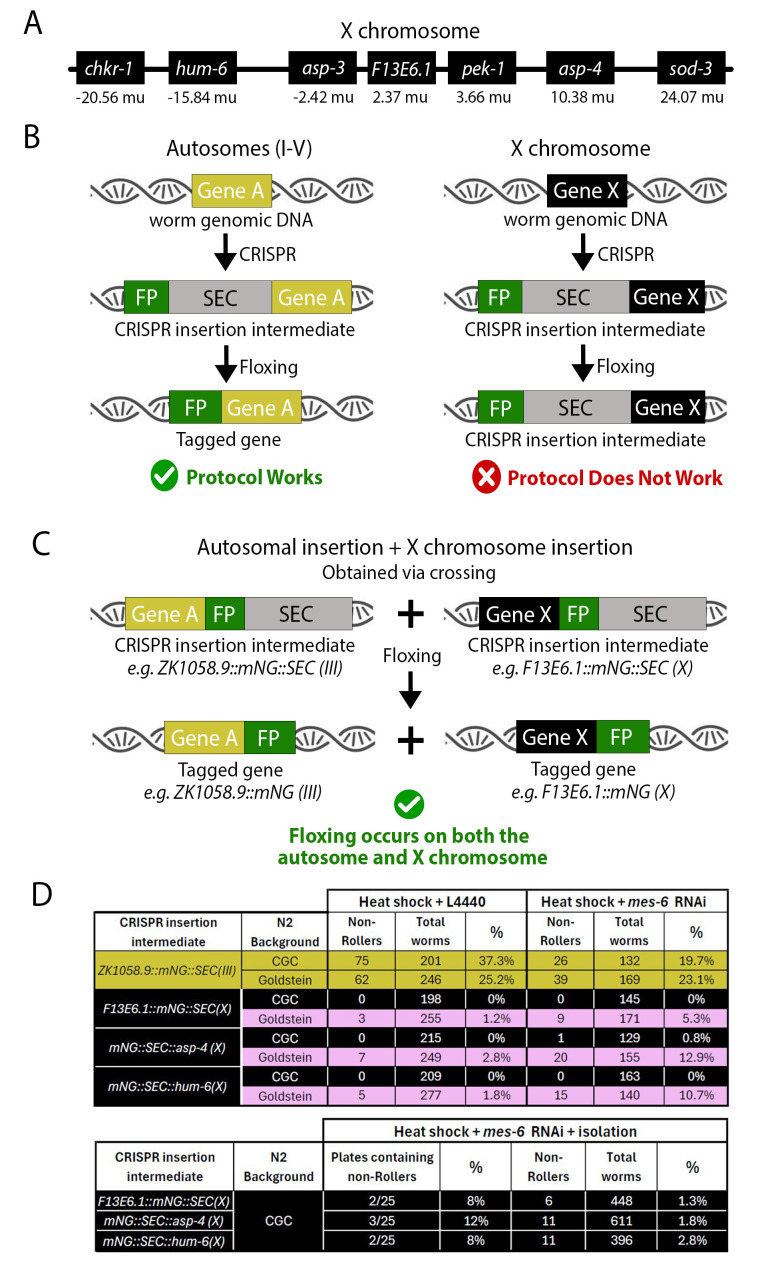 Figure 1
Peer Reviews
No public reviews on file for this paper yet. If you reviewed it on a platform where reviews are public (OpenReview, ICLR, NeurIPS, ICML), you can paste yours below so the community can read it here.
Videos
No videos yet. Explain this paper in a talk, walkthrough, or lecture? Add one.
Taxonomy
TopicsGenetics, Aging, and Longevity in Model Organisms · CRISPR and Genetic Engineering · Genetic Neurodegenerative Diseases