MEP glia share molecular features with oligodendrocytes while maintaining a distinct hybrid signature
Tessa C Dallo, Laura Fontenas

TL;DR
MEP glia have a unique mix of traits similar to oligodendrocytes but maintain a distinct identity in the spinal cord and peripheral nerves.
Contribution
The study identifies specific molecular markers that distinguish MEP glia from oligodendrocytes.
Findings
MEP glia express olig2 and nkx2.2a but not olig1 and plp1b.
MEP glia show a hybrid identity with features of oligodendrocytes and Schwann cells.
Findings clarify the molecular signature of MEP glia.
Abstract
Motor Exit Point (MEP) glia are spinal cord-derived glial cells that myelinate peripheral motor axons, bridging the central and peripheral nervous systems. They have a hybrid profile, sharing features with oligodendrocytes and Schwann cells. Yet, significant gaps remain in our understanding of complex MEP glial lineage and identity. MEP glia express neural tube and canonical oligodendrocyte lineage markers olig2 and nkx2.2a , as well as the neural crest marker foxd3 . Here, we show that the oligodendrocyte markers olig1 and plp1b are not expressed in MEP glia. These findings refine the molecular signature of MEP glia, enhancing their peripheral identity.
Genes, proteins, chemicals, diseases, species, mutations and cell lines named across the full text — each resolved to its canonical identifier and authoritative record.
Click any figure to enlarge with its caption.
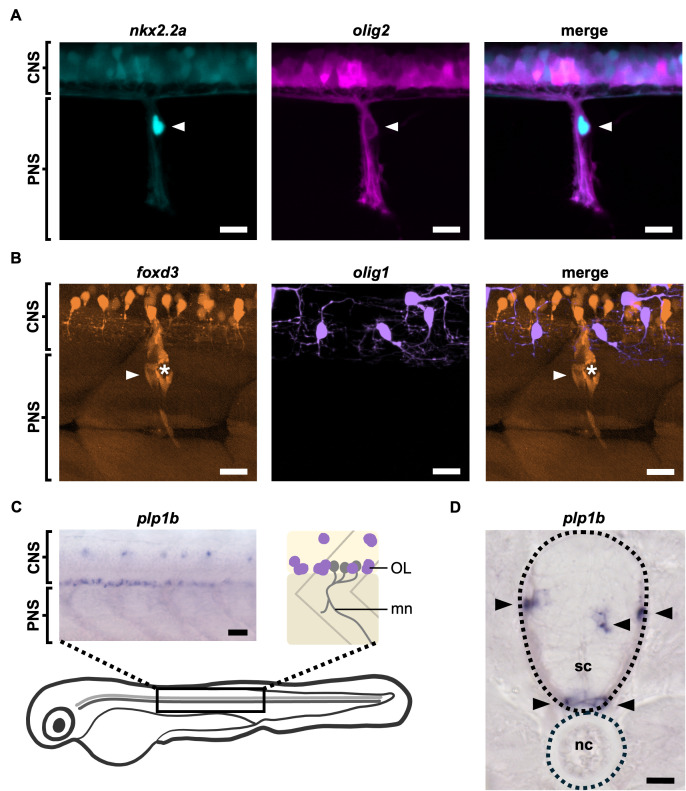 Figure 1
Peer Reviews
No public reviews on file for this paper yet. If you reviewed it on a platform where reviews are public (OpenReview, ICLR, NeurIPS, ICML), you can paste yours below so the community can read it here.
Videos
No videos yet. Explain this paper in a talk, walkthrough, or lecture? Add one.
Taxonomy
TopicsNeurogenesis and neuroplasticity mechanisms · Nerve injury and regeneration · Glioma Diagnosis and Treatment