Efficient RFLP-based Protocol for Routine Authentication of Drosophila
Melika Ghasemi Shiran, Nick P. Bailey, Lauren McCann, Natalia Rivera-Rincón, Emma Saurette, Laurie S. Stevison

TL;DR
This paper introduces a cost-effective and reliable method using RFLPs to authenticate Drosophila strains, ensuring genetic purity for research.
Contribution
A novel SNP-based RFLP protocol is introduced for efficient and reproducible strain authentication in Drosophila.
Findings
The protocol combines SNP identification with RFLP validation for strain authentication.
It is effective for long-term stock maintenance and adaptable across laboratories.
Applied to DGRP Drosophila melanogaster, ensuring genetic resource integrity.
Abstract
Authentication of strains is important for preventing genetic contamination before any experiment, which can compromise reproducibility and lead to misleading results. Here, we developed an approach that combines computational single nucleotide polymorphism (SNP) identification with molecular validation using restriction fragment length polymorphisms (RFLPs). This workflow enables rapid and precise confirmation of strains in an inexpensive, reproducible, and easily adaptable way for long-term stock maintenance across laboratories. We apply this protocol to Drosophila melanogaster from the Drosophila Genome Resource Panel (DGRP), which are commonly used in fruit fly research, providing a reliable context for ensuring the integrity of Drosophila genetic resources.
Genes, proteins, chemicals, diseases, species, mutations and cell lines named across the full text — each resolved to its canonical identifier and authoritative record.
Click any figure to enlarge with its caption.
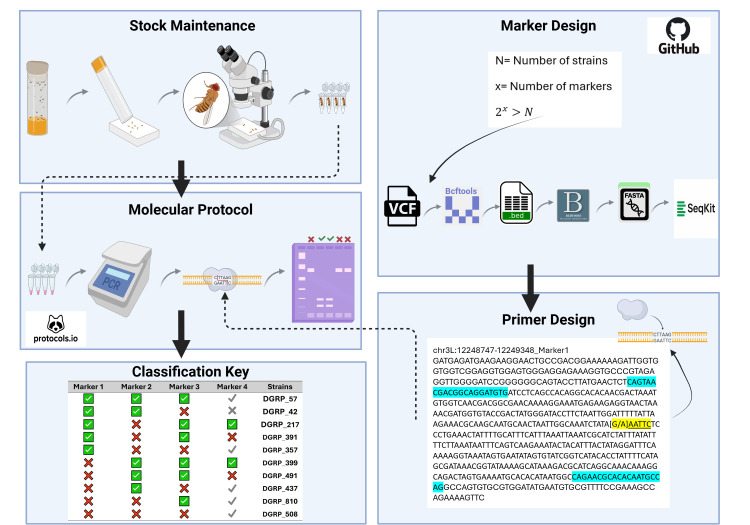 Figure 1
Peer Reviews
No public reviews on file for this paper yet. If you reviewed it on a platform where reviews are public (OpenReview, ICLR, NeurIPS, ICML), you can paste yours below so the community can read it here.
Videos
No videos yet. Explain this paper in a talk, walkthrough, or lecture? Add one.
Taxonomy
TopicsGenetic diversity and population structure · Insect behavior and control techniques · Neurobiology and Insect Physiology Research