Myocardial Infarction in Conduction System Pacing: Trust the ECG or Rely on Algorithms?
Elena Crisman, Alexandra‐Maria Neagoe, Andreas Haeberlin, Jonas Häner, Bruno Schnegg

TL;DR
A patient with a pacemaker had a heart attack, and the ECG was still useful for diagnosis despite the pacemaker.
Contribution
Demonstrates that ECG can accurately detect heart attacks in patients with conduction system pacing.
Findings
STEMI was diagnosed using ECG in a patient with a CSP pacemaker.
Physiological activation preserved by CSP allows accurate ischemia localization.
Coronary angiography confirmed ECG findings of a large diagonal branch occlusion.
Abstract
A 66‐year‐old male patient with a conduction system pacing (CSP) pacemaker, implanted after a pace‐and‐ablate strategy for persistent, poorly rate‐controlled atrial fibrillation, presented to the outpatient clinic with worsening dyspnea. Laboratory findings and ECG were indicative of an anterolateral ST‐segment elevation myocardial infarction (STEMI), confirmed by coronary angiography showing occlusion of a large diagonal branch. STEMI diagnosis in paced patients is often challenging due to altered ventricular activation. However, this case demonstrates that surface ECG remains interpretable with CSP, which preserves physiological activation, allowing accurate localization of ischemia even in the presence of a pacemaker.
Genes, proteins, chemicals, diseases, species, mutations and cell lines named across the full text — each resolved to its canonical identifier and authoritative record.
Click any figure to enlarge with its caption.
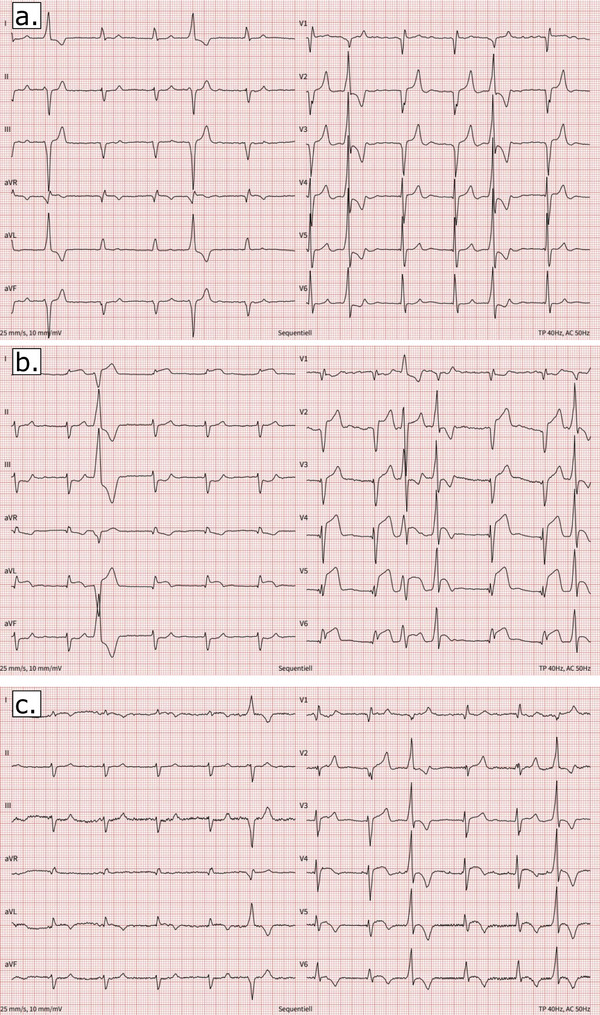 Figure 1
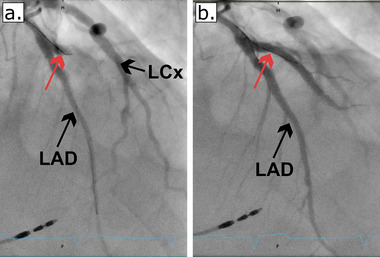 Figure 2
Peer Reviews
No public reviews on file for this paper yet. If you reviewed it on a platform where reviews are public (OpenReview, ICLR, NeurIPS, ICML), you can paste yours below so the community can read it here.
Videos
No videos yet. Explain this paper in a talk, walkthrough, or lecture? Add one.
Taxonomy
TopicsCardiac pacing and defibrillation studies · ECG Monitoring and Analysis · Cardiac Arrhythmias and Treatments