Variables associated with clinical outcomes and switching from unilateral to bitemporal electroconvulsive therapy: a retrospective study
Erika Sordo, Louise Fuet, Federica Porpiglia, Marwa Zrelli, Mickaël Amagat, Pierre De Maricourt, Raphaël Gaillard, Sarah Smadja, Fabien Vinckier, Caroline Schimpf, Françoise Tomberli, Aurélien Mazeraud, Philippe Domenech, Moussa A. Chalah

TL;DR
This study examines factors influencing outcomes in electroconvulsive therapy, focusing on when and why patients switch from unilateral to bitemporal ECT.
Contribution
The study identifies clinical variables associated with the need to switch from unilateral to bitemporal ECT and their impact on treatment outcomes.
Findings
18% of patients switched from unilateral to bitemporal ECT, with remission rates increasing from 40% to 55%.
Patients requiring switching had more prior manic episodes and higher antipsychotic use.
Clozapine use and ECT charge increased during bitemporal sessions in the switched subgroup.
Abstract
Electroconvulsive therapy (ECT) remains the most effective treatment for many patients with severe and/or resistant psychiatric disorders. Right unilateral (RUL) ECT, particularly when administered with titration and ultrabrief pulses, provides cognitive advantages compared with bitemporal (BT) ECT without compromising efficacy. However, some patients fail to improve and require switching to BT ECT. The present study aims to evaluate variables associated with efficacy and tolerability during RUL ECT and, when needed, after switching to BT ECT, aiming to identify factors linked to better outcomes with each placement. A retrospective review was conducted on 58 adult inpatients treated with RUL ECT. Patients without improvement after 4–6 sessions could be switched to BT ECT. Demographic, clinical, pharmacological, and electric seizure-related data were collected. Treatment response was…
Genes, proteins, chemicals, diseases, species, mutations and cell lines named across the full text — each resolved to its canonical identifier and authoritative record.
Click any figure to enlarge with its caption.
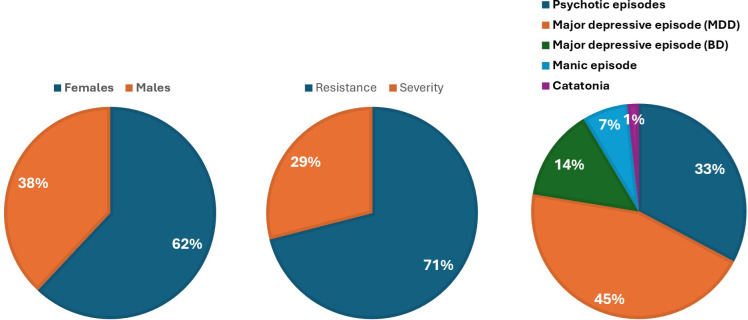 Figure 1
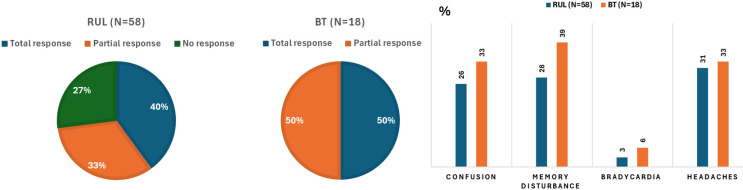 Figure 2
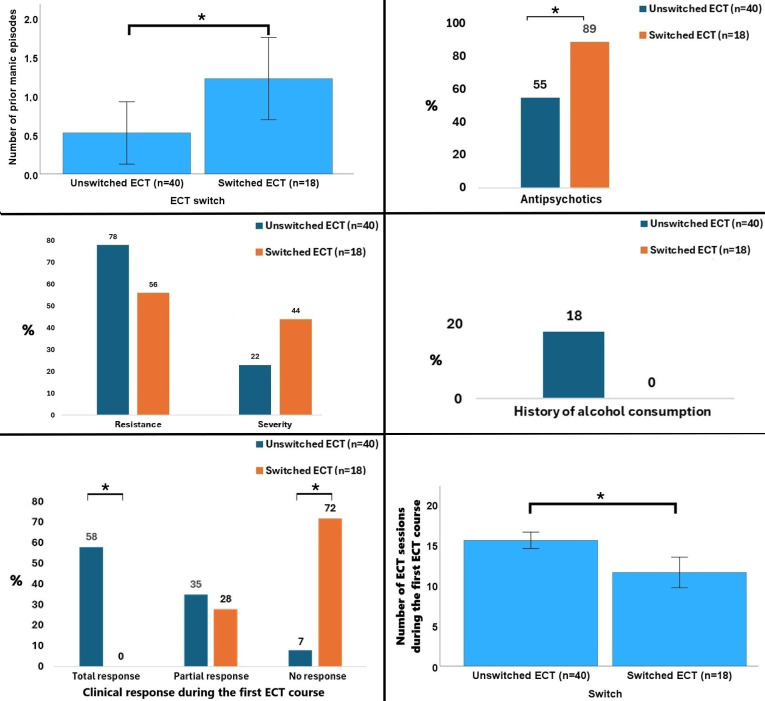 Figure 3
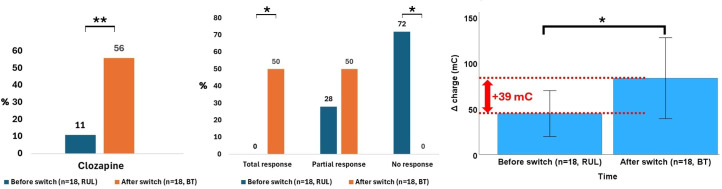 Figure 4
Peer Reviews
No public reviews on file for this paper yet. If you reviewed it on a platform where reviews are public (OpenReview, ICLR, NeurIPS, ICML), you can paste yours below so the community can read it here.
Videos
No videos yet. Explain this paper in a talk, walkthrough, or lecture? Add one.
Taxonomy
TopicsElectroconvulsive Therapy Studies · Treatment of Major Depression · Healthcare Decision-Making and Restraints