Substitution of free halide ions unlocks responsive photoluminescence switching in manganese-based metal halides
Sisi Li, Kaitong Luo, Yali Zhou, Junhao Wang, Zhen Zhang, Zhao-Qing Liu, Yibo Chen

TL;DR
Changing free halide ions in a manganese-based material enables it to switch light colors in response to heat or water, useful for sensing and encryption.
Contribution
Replacing Cl− with Br− in a metal halide compound introduces stimuli-responsive photoluminescence switching.
Findings
Br− substitution weakens hydrogen bonding, allowing water molecules to escape under heat.
Structural reorganization after water loss causes a reversible red-to-green photoluminescence switch.
Halide/polymer films show practical use in temperature sensing and encryption.
Abstract
Stimuli-responsive organic-inorganic metal halides hold great promise for emerging information-related applications. In this work, replacing the free halide ion Cl− with Br− in C5H11N3(MnCl3·H2O)X (where C5H11N32+ represents histamine cation, X represents free halide ions) converts the non-responsive hybrid C5H11N3(MnCl3·H2O)Cl into a stimuli-responsive C5H11N3(MnCl3·H2O)Br. The latter exhibits reversible photoluminescence color switching between red and green upon thermal or water exposure. Extensive experimental and theoretical analyses reveal that the responsive property primarily stems from weakened hydrogen bonding surrounding H2O molecules after Br− substitution, which facilitates the initial escape of H2O molecules under heating. Subsequent structural reorganization and coordination transformation then induce the change in photoluminescence. Furthermore, the fabricated…
Genes, proteins, chemicals, diseases, species, mutations and cell lines named across the full text — each resolved to its canonical identifier and authoritative record.
Click any figure to enlarge with its caption.
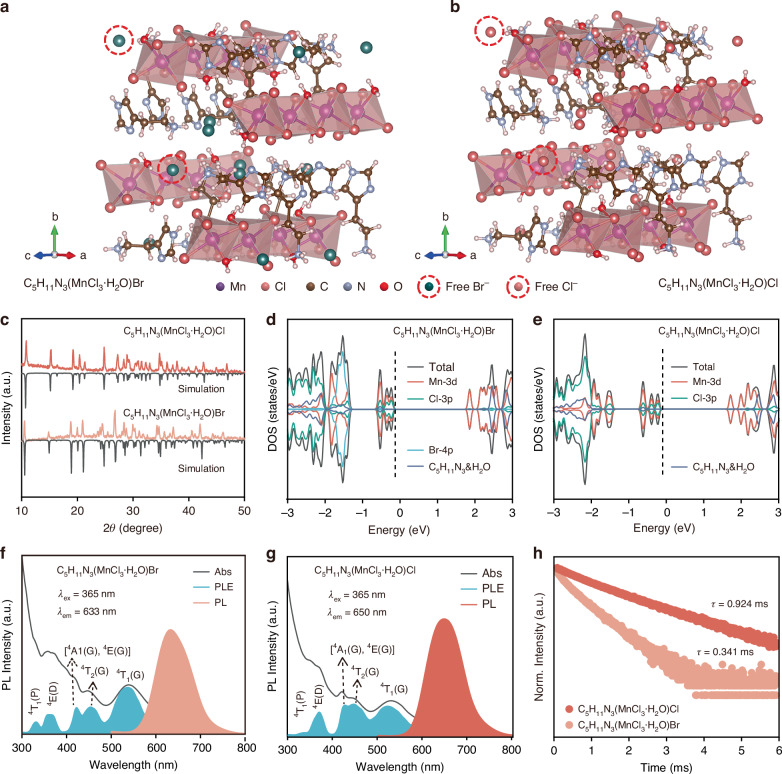 Figure 1
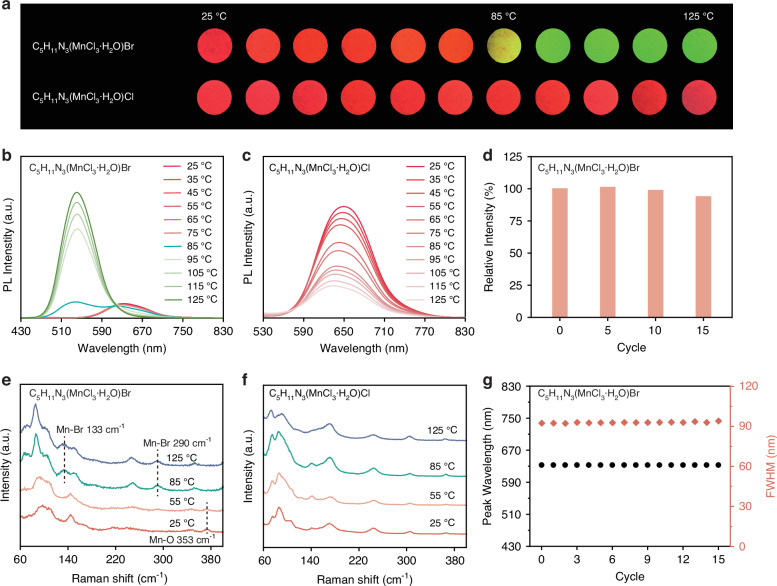 Figure 2
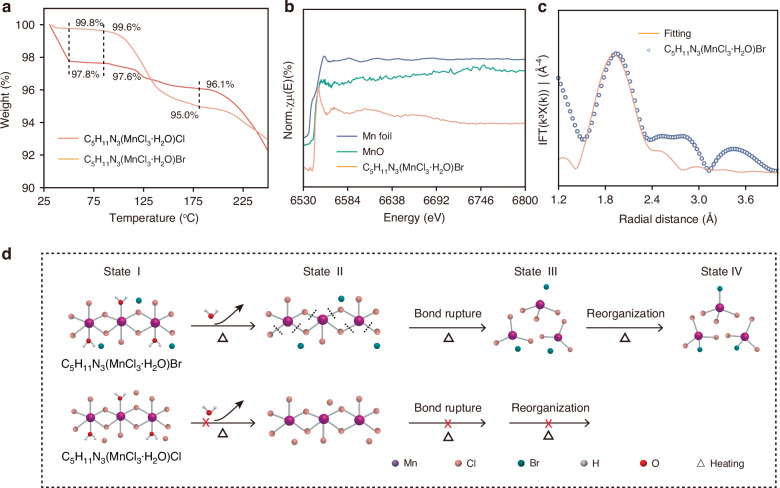 Figure 3
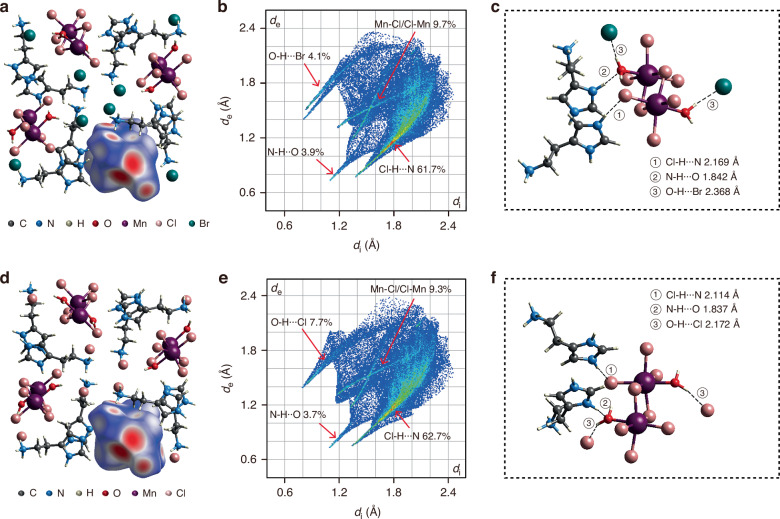 Figure 4
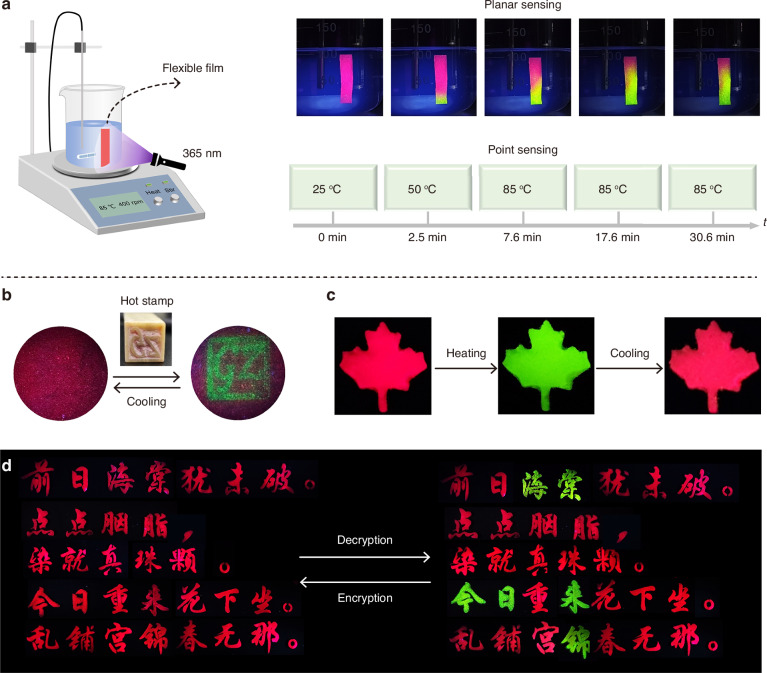 Figure 5
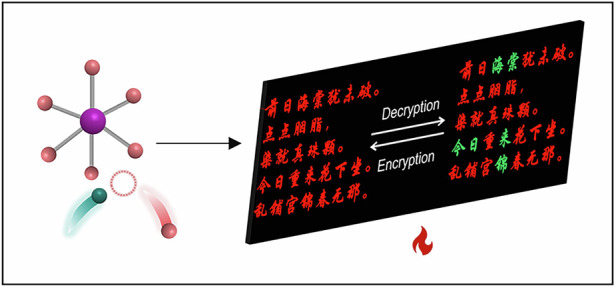 Figure 6
Peer Reviews
No public reviews on file for this paper yet. If you reviewed it on a platform where reviews are public (OpenReview, ICLR, NeurIPS, ICML), you can paste yours below so the community can read it here.
Videos
No videos yet. Explain this paper in a talk, walkthrough, or lecture? Add one.
Taxonomy
TopicsPerovskite Materials and Applications · Metal-Organic Frameworks: Synthesis and Applications · Luminescence Properties of Advanced Materials