Quantum advantage for learning shallow neural networks with natural data distributions
Laura Lewis, Dar Gilboa, Jarrod R. McClean

TL;DR
This paper shows a quantum algorithm can learn certain neural networks more efficiently than classical methods, especially with non-uniform data distributions.
Contribution
The paper introduces a quantum algorithm for learning periodic neurons with non-uniform data and proves exponential quantum advantage over classical algorithms.
Findings
Quantum algorithm efficiently learns periodic neurons over non-uniform distributions.
Problem is hard for classical gradient-based and SQ algorithms.
Establishes exponential quantum advantage in this learning regime.
Abstract
Without large quantum computers to empirically evaluate performance, theoretical frameworks such as the quantum statistical query (QSQ) are a primary tool to study quantum algorithms for learning classical functions and search for quantum advantage in machine learning tasks. However, we only understand quantum advantage in this model at two extremes: either exponential advantages for uniform input distributions or no advantage for arbitrary distributions. Our work helps close the gap between these two regimes by designing an efficient quantum algorithm for learning periodic neurons in the QSQ model over a variety of non-uniform distributions and the first explicit treatment of real-valued functions. We prove that this problem is hard not only for classical gradient-based algorithms, which are the workhorses of machine learning, but also for a more general class of SQ algorithms,…
Genes, proteins, chemicals, diseases, species, mutations and cell lines named across the full text — each resolved to its canonical identifier and authoritative record.
Click any figure to enlarge with its caption.
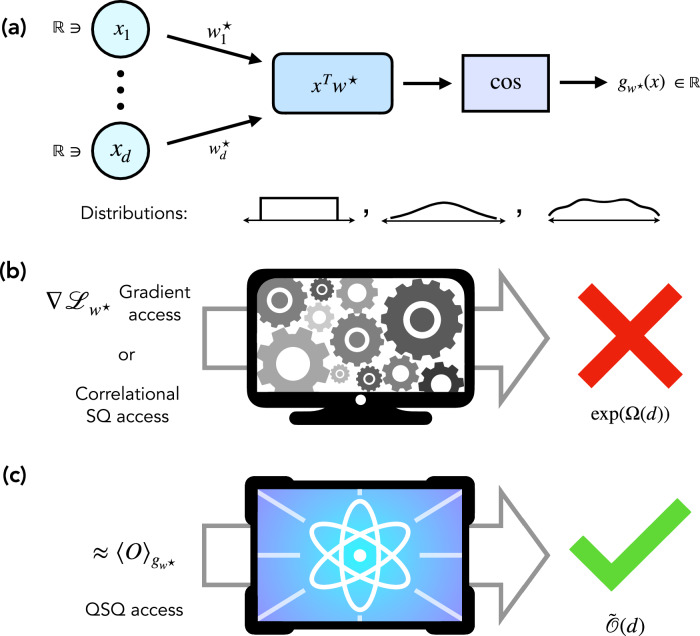 Figure 1
Peer Reviews
No public reviews on file for this paper yet. If you reviewed it on a platform where reviews are public (OpenReview, ICLR, NeurIPS, ICML), you can paste yours below so the community can read it here.
Videos
No videos yet. Explain this paper in a talk, walkthrough, or lecture? Add one.
Taxonomy
TopicsQuantum Computing Algorithms and Architecture · Quantum many-body systems · Quantum Information and Cryptography