Noninvasive biventricular pressure-strain-volume loop-derived myocardial work analysis in competitive athletes
Andrea Ferencz, Ádám Szijártó, Tímea Katalin Turschl, Zsuzsanna Ladányi, Bálint Károly Lakatos, Márton Tokodi, Máté Tolvaj, Márk Zámodics, Máté Babity, Regina Benkő, Orsolya Kiss, Emese Csulak, Nóra Sydó, Csongor Meskó, Hajnalka Vágó, Béla Merkely, Attila Kovács, Alexandra Fábián

TL;DR
This study introduces a new noninvasive method to assess heart function in athletes, revealing enhanced biventricular performance and linking it to higher exercise capacity.
Contribution
A novel 3D echocardiography-derived method for quantifying biventricular systolic function less affected by loading conditions in athletes.
Findings
Athletes showed significantly higher LV and RV volume-adjusted myocardial work indices compared to sedentary controls.
RV GWIV was the strongest independent predictor of peak exercise capacity among echocardiographic parameters.
Biventricular global longitudinal strain and ejection fractions were lower in athletes compared to controls.
Abstract
Intense exercise imposes hemodynamic load on the heart, and while morphological remodeling is well-characterized, assessment of exercise-induced functional changes, like enhanced contractility, remains challenging. We aimed to introduce a novel 3D echocardiography (3DE)-derived method for noninvasive quantification of biventricular systolic function, less dependent on loading conditions in competitive athletes, and to explore the relationship with peak exercise capacity. We enrolled 260 athletes and 24 sedentary volunteers. All subjects underwent 3DE to measure left (LV) and right ventricular (RV) volumes and ejection fractions (EF). Biventricular global longitudinal strain (GLS) tracings and noninvasively estimated pressure curves were concatenated and further adjusted to instantaneous volumes to create pressure-strain-volume loops and derive volume-adjusted myocardial work (MW)…
Genes, proteins, chemicals, diseases, species, mutations and cell lines named across the full text — each resolved to its canonical identifier and authoritative record.
Click any figure to enlarge with its caption.
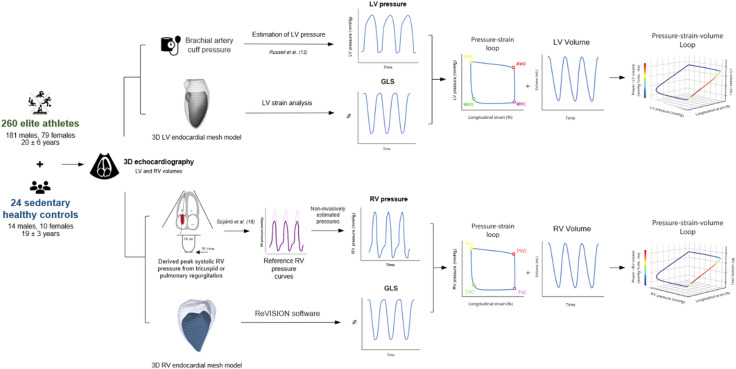 Figure 1
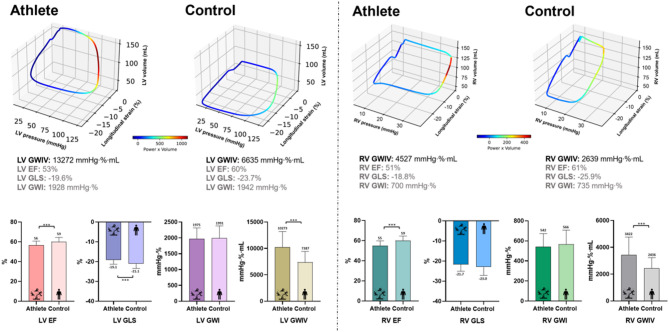 Figure 2
Peer Reviews
No public reviews on file for this paper yet. If you reviewed it on a platform where reviews are public (OpenReview, ICLR, NeurIPS, ICML), you can paste yours below so the community can read it here.
Videos
No videos yet. Explain this paper in a talk, walkthrough, or lecture? Add one.
Taxonomy
TopicsCardiovascular Function and Risk Factors · Cardiovascular Effects of Exercise · Pulmonary Hypertension Research and Treatments