Covalent ferrocene conjugation as an intramolecular strategy for photostability in fluorescein
Gilbert K. Kosgei, P. U. Ashvin Iresh Fernando, Harley R. Mcalexander, Afrachanna D. Butler

TL;DR
This paper introduces a new method to make fluorescent dyes more resistant to fading by linking them to a redox-active compound called ferrocene.
Contribution
The study presents a novel intramolecular photostabilization strategy using covalent ferrocene conjugation to enhance fluorescence durability.
Findings
The Fc–FITC conjugate showed an 11-fold increase in photobleaching half-life compared to FITC.
The conjugate retained 94% of its initial fluorescence after 60 minutes of irradiation, versus 52% for FITC.
The PET mechanism was confirmed to suppress the formation of the destructive triplet state.
Abstract
Photobleaching severely limits the utility and long-term reliability of fluorescence-based measurements. To address this long-standing limitation, we synthesized a conjugate that covalently links fluorescein isothiocyanate (FITC) to ferrocene (Fc), a redox-active metallocene. Our two-step synthesis involved reduction of ferrocene methylene azide followed by formation of a stable thiourea linkage. Photophysical characterization confirmed highly efficient intramolecular quenching, evidenced by an 81.5% reduction in quantum yield (Φ) and a shortened lifetime (τ = 3.2 ns vs. 4.1 ns for FITC). The Fc–FITC conjugate exhibited an 11-fold increase in photobleaching half-life (693 vs. 63 min for FITC), retaining 94% of its initial fluorescence after 60 min of constant 23 mW/cm2 irradiation, compared to only 52% for FITC. Direct singlet oxygen (1O2) quantification using Singlet Oxygen Sensor…
Genes, proteins, chemicals, diseases, species, mutations and cell lines named across the full text — each resolved to its canonical identifier and authoritative record.
Click any figure to enlarge with its caption.
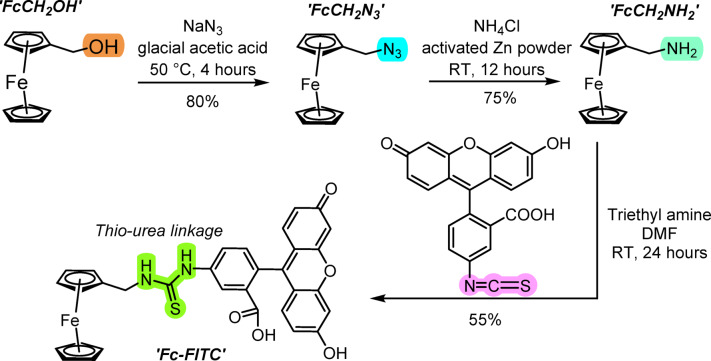 Figure 1
 Figure 2
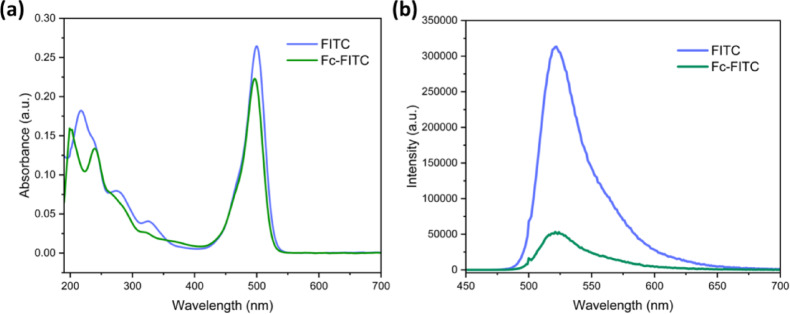 Figure 3
 Figure 4
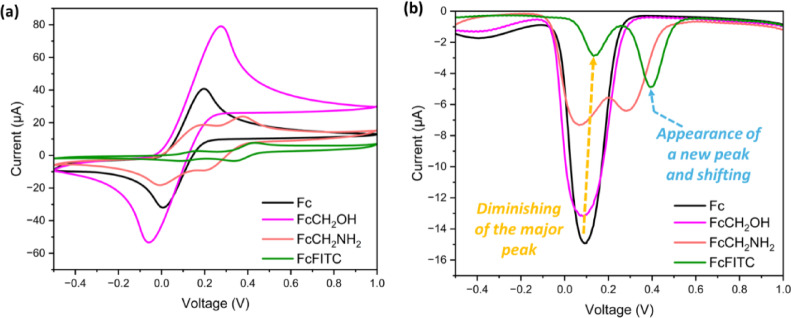 Figure 5
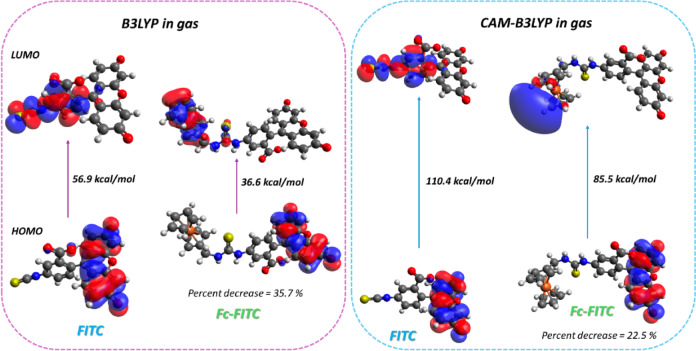 Figure 6
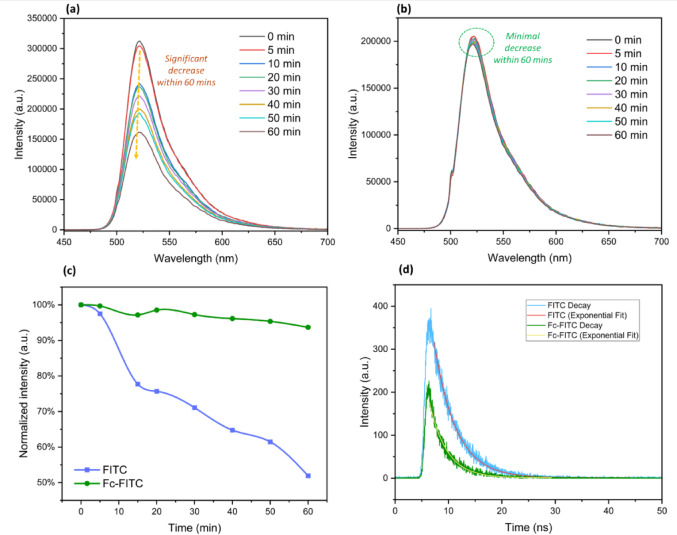 Figure 7
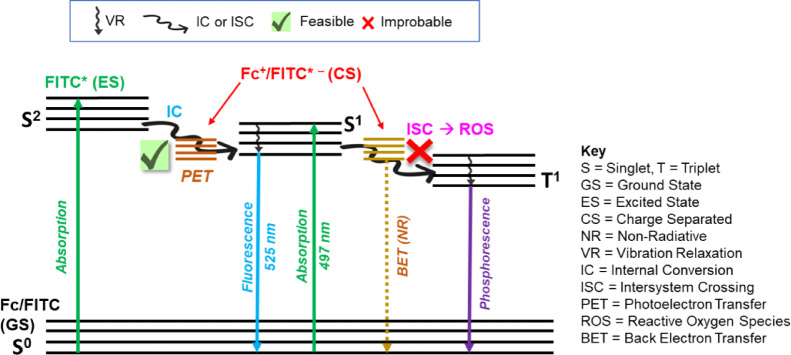 Figure 8
Peer Reviews
No public reviews on file for this paper yet. If you reviewed it on a platform where reviews are public (OpenReview, ICLR, NeurIPS, ICML), you can paste yours below so the community can read it here.
Videos
No videos yet. Explain this paper in a talk, walkthrough, or lecture? Add one.
Taxonomy
TopicsPhotochromic and Fluorescence Chemistry · Molecular Sensors and Ion Detection · Luminescence and Fluorescent Materials