Risk factors for diastasis recti abdominis and its correlation with pelvic organ prolapse among postpartum women in southwest China: a retrospective case-control study
Dehua Wan, Ling Guo, Shuwen Cheng, Ling Ren, Taizhou Qin, Xueping Zhang, Huarong Wang, Zhongyan Zheng, Xiaoqin Gan, Tianjiao Liu, Yonghong Lin

TL;DR
This study finds that diastasis recti abdominis is common in postpartum women in southwest China and is linked to factors like high birth weight and multiple pregnancies.
Contribution
The study provides new insights into DRA risk factors and its correlation with pelvic organ prolapse in a large Chinese postpartum population.
Findings
High neonatal birth weight (≥3.5 kg) is an independent risk factor for DRA.
Multiparous women are more than twice as likely to develop DRA compared to nulliparous women.
Vaginal delivery and moderate pelvic floor muscle strength are protective against DRA.
Abstract
Diastasis recti abdominis (DRA) is a prevalent postpartum condition characterized by separation of the rectus abdominis muscles. It has been linked to lumbopelvic pain, pelvic floor dysfunction, and urinary incontinence. However, large-scale epidemiological data from Chinese populations and study investigating its relationship with pelvic organ prolapse (POP) are limited. This is a retrospective case-control study which analyzed 4,426 women at 6th week postpartum at Chengdu Women's and Children's Central Hospital between January 2019 and January 2025. DRA was diagnosed by ultrasonography, and POP was staged using the POP-Q system. Maternal, obstetric, and pelvic floor variables were collected. Independent risk factors of DRA were identified through ordinal logistic regression analyses. Spearman correlation was used to examine the relationship between DRA severity and POP stage. A…
Genes, proteins, chemicals, diseases, species, mutations and cell lines named across the full text — each resolved to its canonical identifier and authoritative record.
Click any figure to enlarge with its caption.
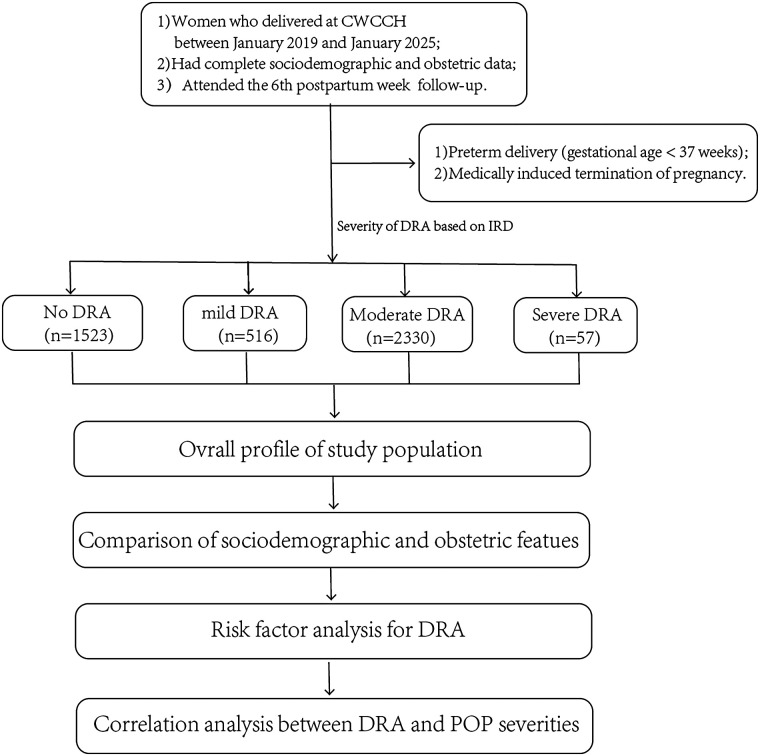 Figure 1
Peer Reviews
No public reviews on file for this paper yet. If you reviewed it on a platform where reviews are public (OpenReview, ICLR, NeurIPS, ICML), you can paste yours below so the community can read it here.
Videos
No videos yet. Explain this paper in a talk, walkthrough, or lecture? Add one.
Taxonomy
TopicsPelvic floor disorders treatments · Hernia repair and management · Preterm Birth and Chorioamnionitis