Diagnosis of rejection following heart transplantation: diving into the future
Shaline Rao, Syed Zain Ali, Arushi Singh, Mittal Rana, Mohamed Moussa, Kinza Ahmed, Stephanie Golob, Lauren Cusumano, Alana Harrington, Andrew Wang, Sanjay Chandrasekhar, Amit Alam

TL;DR
This paper reviews current and emerging non-invasive methods for detecting heart transplant rejection and highlights the need for multi-modal approaches to improve diagnosis.
Contribution
The paper emphasizes the limitations of existing non-invasive rejection detection methods and advocates for future research into multi-modal diagnostic strategies.
Findings
Current non-invasive methods for diagnosing heart transplant rejection lack sufficient sensitivity or specificity.
Emerging techniques like donor-derived cell-free DNA and gene expression profiling show promise but are not yet sufficient alone.
A multi-modal approach combining non-invasive diagnostics and personalized medicine is recommended for future research.
Abstract
Since the standardization of the grading system for pathologic diagnosis of antibody-mediated and acute cellular rejection, endomyocardial biopsy has remained the gold-standard. However, biopsies are invasive, costly, and limited by sampling error. As such, adjuvant non-invasive methods including cardiac biomarkers, imaging including cardiac magnetic resonance and echocardiography, and donor-specific antibodies and non-HLA antibodies have been traditionally used. However, all these techniques are limited by either sensitivity or specificity. More recently, there has been a shift to other contemporary non-biopsy surrogate markers for rejection surveillance including donor-derived cell free DNA, gene expression profiling, and messenger RNA and micro-RNA in tissue. Herein we review the methods currently utilized to diagnose rejection and their limitations. We find that while there have…
Genes, proteins, chemicals, diseases, species, mutations and cell lines named across the full text — each resolved to its canonical identifier and authoritative record.
Click any figure to enlarge with its caption.
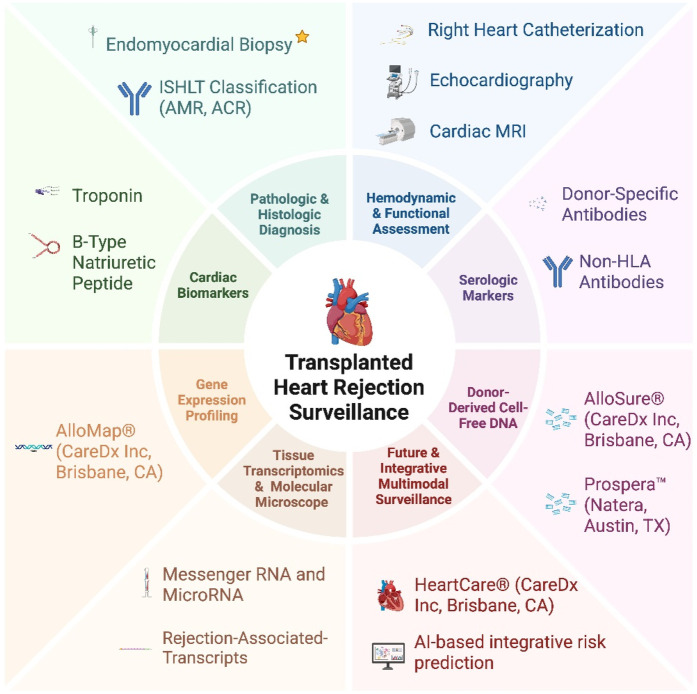 Figure 1
Peer Reviews
No public reviews on file for this paper yet. If you reviewed it on a platform where reviews are public (OpenReview, ICLR, NeurIPS, ICML), you can paste yours below so the community can read it here.
Videos
No videos yet. Explain this paper in a talk, walkthrough, or lecture? Add one.
Taxonomy
TopicsTransplantation: Methods and Outcomes · Renal Transplantation Outcomes and Treatments · Organ and Tissue Transplantation Research