The association of biological age and its trajectory with incident heart failure: a cohort study from China
Yuhao Hu, Huayu Sun, Chenrui Zhu, Jing Hu, Jintao Tao, Bo Li, Qianxun Cai, Yutong Wu, Shuohua Chen, Shouling wu, Yuntao Wu

TL;DR
This study shows that people with accelerated biological aging have a higher risk of developing heart failure compared to those with normal aging.
Contribution
The study introduces a clinical-parameter-based biological age model and examines its trajectory associations with incident heart failure in a large Chinese cohort.
Findings
Accelerated biological aging is linked to a 30% higher risk of heart failure.
Individuals with a high-stable biological aging trajectory face the highest heart failure risk.
A high-descending trajectory is associated with a significantly lower heart failure risk.
Abstract
Research on biological age focused on the optimization and upgrading of aging clocks, which can now prospectively predict a variety of diseases. The biological age (BA) based on clinical parameters has shown predictive value for cardiovascular disease. However, evidence linking BA and its trajectories with heart failure (HF) remained limited. This study aimed to construct a clinical-parameter-based BA and to investigate its association, along with BA trajectories, with incident heart failure. This study utilized data from the Kailuan Study, which included 76,908 Chinese adults who underwent their first health examination between 2006 and 2007. A deep neural network model was employed to estimate BA based on 32 clinical indicators. Participants were stratified into three groups-decelerated aging, accelerated aging, and normal aging-according to their baseline BA values. Six distinct…
Genes, proteins, chemicals, diseases, species, mutations and cell lines named across the full text — each resolved to its canonical identifier and authoritative record.
Click any figure to enlarge with its caption.
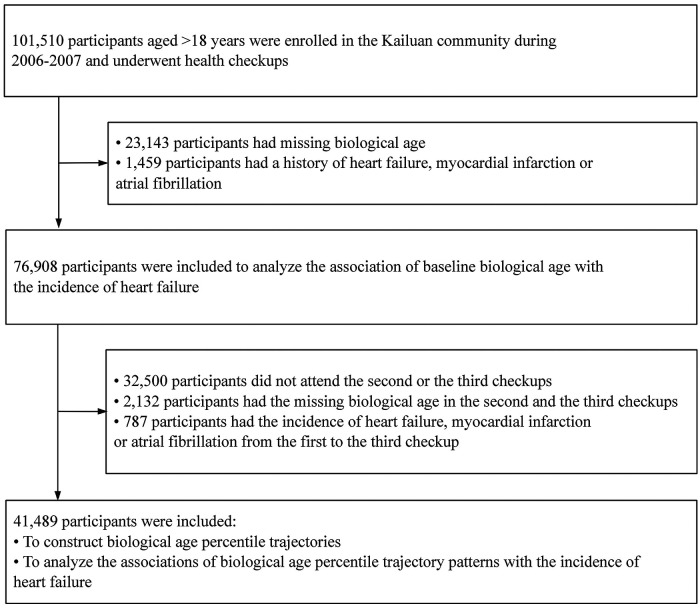 Figure 1
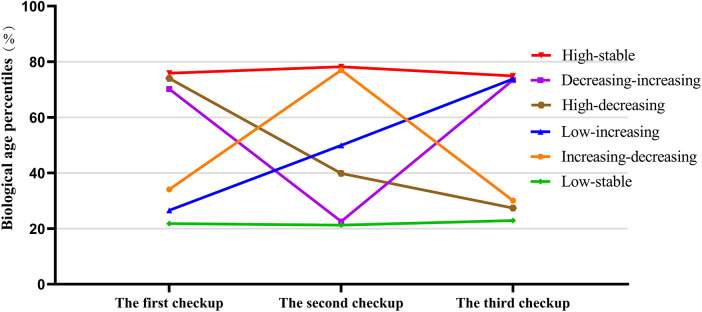 Figure 2
Peer Reviews
No public reviews on file for this paper yet. If you reviewed it on a platform where reviews are public (OpenReview, ICLR, NeurIPS, ICML), you can paste yours below so the community can read it here.
Videos
No videos yet. Explain this paper in a talk, walkthrough, or lecture? Add one.
Taxonomy
TopicsGenetics, Aging, and Longevity in Model Organisms · Frailty in Older Adults · Chronic Disease Management Strategies