Exploring the role of agentic AI in fostering self-efficacy, autonomy support, and self-learning motivation in higher education
Jehad Alqurni

TL;DR
This study explores how students' perception of AI's agency and usability affects their motivation and self-learning behavior in higher education.
Contribution
The study integrates TAM, SCT, and SDT to model how AI's perceived autonomy and usability influence self-directed learning motivation.
Findings
Perceived AI agency significantly predicts usefulness, ease of use, and autonomy support.
Ease of use enhances AI-enabled self-efficacy, which in turn impacts self-learning motivation.
Usefulness and trust in AI do not directly influence self-efficacy, highlighting cultural and contextual factors.
Abstract
Rapid adoption of Artificial Intelligence (AI) in learning has revolutionized learners’ engagement but comprehension of psychological and technological drivers of successful AI-enabled learning remains scarce. This research investigates how students’ perceived agency of AI, usefulness, ease of use, trust, autonomy supporting, and self-efficacy collectively impact students’ self-learning behavior and motivation. Based on Technology Acceptance Model (TAM), Social Cognitive Theory (SCT), and Self-Determination Theory (SDT) theories, our research model predicts an integrated model of motivational and behavioral processes underlying AI adoption in learning settings. We adopted and followed a quantitative research design with a structured questionnaire administered among 280 higher education students in Saudi Arabia. We applied Structural Equation Modeling (SEM) using SmartPLS 4 to analyze…
Click any figure to enlarge with its caption.
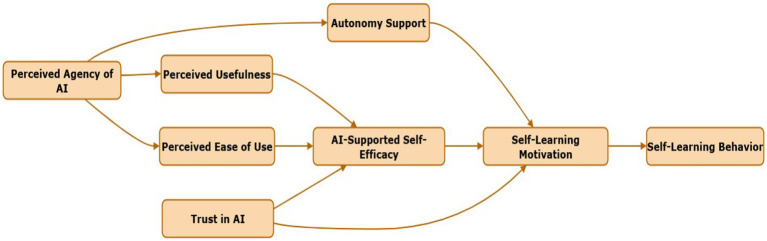 Figure 1
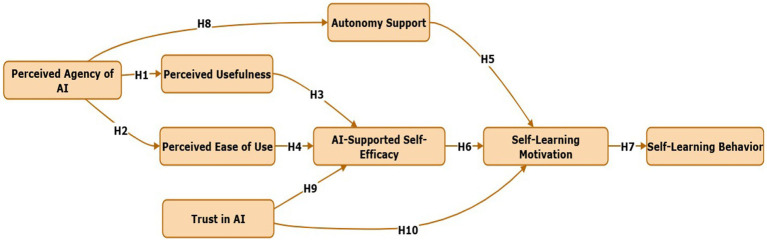 Figure 2
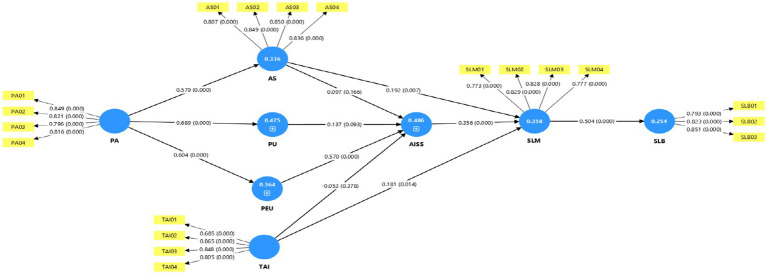 Figure 3
Peer Reviews
No public reviews on file for this paper yet. If you reviewed it on a platform where reviews are public (OpenReview, ICLR, NeurIPS, ICML), you can paste yours below so the community can read it here.
Videos
No videos yet. Explain this paper in a talk, walkthrough, or lecture? Add one.
Taxonomy
TopicsTechnology Adoption and User Behaviour · Motivation and Self-Concept in Sports · Technostress in Professional Settings