Effects of remimazolam vs. an etomidate–propofol mixture on postoperative cognitive function in elderly female patients undergoing radical mastectomy for breast cancer: a randomized controlled trial
Wenzhe Shen, Lili Li, Ziyi Zhang, Minghong Liu, Jun Shi

TL;DR
This study compares remimazolam and an etomidate–propofol mixture for anesthesia in elderly women undergoing breast cancer surgery, finding remimazolam better for cognitive function and recovery.
Contribution
The study introduces remimazolam as a superior anesthetic option for preserving cognitive function in elderly female breast cancer patients.
Findings
Remimazolam showed better hemodynamic stability and faster recovery times compared to the etomidate–propofol mixture.
Patients receiving remimazolam had significantly higher cognitive scores post-surgery.
Remimazolam was associated with fewer adverse events compared to the etomidate–propofol mixture.
Abstract
This study aimed to evaluate remimazolam’s anesthetic efficacy and impact on postoperative cognitive function in breast cancer patients undergoing radical mastectomy. A total of 80 patients were randomized into two groups: Group R (remimazolam, n = 40) and Group EP (etomidate–propofol mixture, n = 40). Mean arterial pressure (MAP) and heart rate (HR) were recorded at T₀ (pre-induction), T₁ (post-intubation), T₂ (1 h intraoperation), and T₃ (post-extubation). Pain, measured using the visual analog scale (VAS), was assessed upon awakening and at PACU discharge. Cognitive function, measured using the Mini-Mental State Examination/Montreal Cognitive Assessment (MMSE/MoCA), was evaluated on postoperative days 1 and 3. Recovery times and adverse events were also compared between groups. Baseline characteristics were comparable between groups (p > 0.05). At T₁, HR was lower in Group R than…
Genes, proteins, chemicals, diseases, species, mutations and cell lines named across the full text — each resolved to its canonical identifier and authoritative record.
Click any figure to enlarge with its caption.
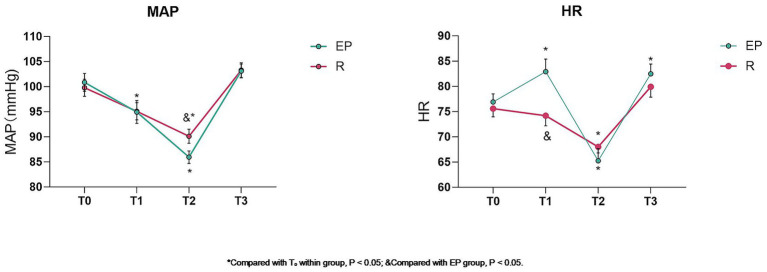 Figure 1
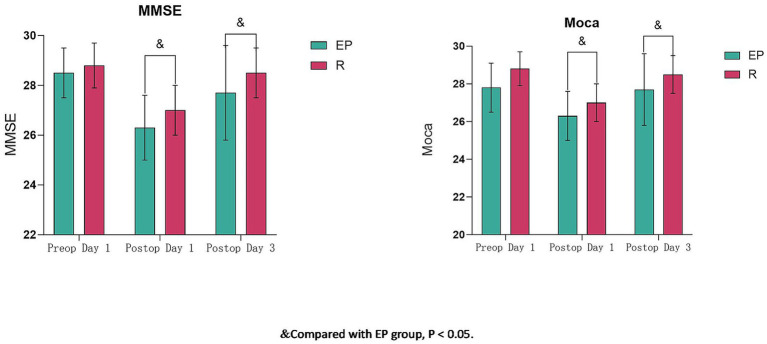 Figure 2
Peer Reviews
No public reviews on file for this paper yet. If you reviewed it on a platform where reviews are public (OpenReview, ICLR, NeurIPS, ICML), you can paste yours below so the community can read it here.
Videos
No videos yet. Explain this paper in a talk, walkthrough, or lecture? Add one.
Taxonomy
TopicsIntensive Care Unit Cognitive Disorders · Cancer, Stress, Anesthesia, and Immune Response · Cancer-related cognitive impairment studies