Development of a rapid, simple multiplex PCR-dipstick assay for the detection of Neisseria meningitidis serogroups in clinical isolates
Miho Matsuba, Samiratu Mahazu, Ken Shimuta, Anthony Ablordey, Hideyuki Takahashi, Ryoichi Saito

TL;DR
A new rapid and simple test was developed to detect and identify six major types of Neisseria meningitidis in clinical samples, which can help manage meningococcal disease in resource-limited areas.
Contribution
A novel multiplex PCR-dipstick assay was developed for rapid and accurate detection of six Neisseria meningitidis serogroups.
Findings
The assay successfully identified all tested N. meningitidis strains and differentiated six serogroups.
The detection limit was 4.1 × 10⁴ genome copies and 5.3–266 CFU per reaction with 100% sensitivity and specificity.
The test is suitable for use in resource-limited settings and high endemic regions like West Africa.
Abstract
The rapid identification and serogrouping of Neisseria meningitidis are crucial for effectively managing invasive meningococcal disease (IMD) patients and their close contacts, particularly in developing countries with limited laboratory resources. We developed a simple multiplex polymerase chain reaction (PCR)-dipstick DNA chromatography (mPCR-dipstick) assay for detecting six major serogroups (A, B, C, W, Y, and X) prevalent worldwide. The assay performance, sensitivity, and specificity were evaluated using 116 unencapsulated and encapsulated N. meningitidis, 29 other Neisseria spp., and 11 non-Neisseria spp. strains. The mPCR-dipstick assay successfully identified all unencapsulated and encapsulated N. meningitidis strains and accurately differentiated the six major serogroups. The detection limit was 4.1 × 10⁴ genome copies and 5.3–266 colony-forming units (CFU) per reaction,…
Genes, proteins, chemicals, diseases, species, mutations and cell lines named across the full text — each resolved to its canonical identifier and authoritative record.
Click any figure to enlarge with its caption.
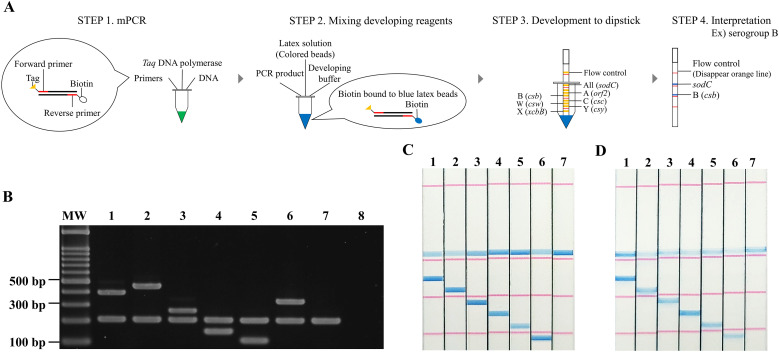 Figure 1
Peer Reviews
No public reviews on file for this paper yet. If you reviewed it on a platform where reviews are public (OpenReview, ICLR, NeurIPS, ICML), you can paste yours below so the community can read it here.
Videos
No videos yet. Explain this paper in a talk, walkthrough, or lecture? Add one.
Taxonomy
TopicsBacterial Infections and Vaccines · Pneumonia and Respiratory Infections · Reproductive tract infections research