A rare case of mosaic partial tetrasomy 18p presenting with oligomenorrhea and intellectual disability: a case report
Guosheng Deng, Weiwu Liu, Yuqing Lai, Jinjie Pan, Yanyan Chen, Jujie Song, Donghua Zhang, Xiafei Liang, Sisi Ning, Yinghong Lu, Yunning Liang, Derong Li

TL;DR
This paper reports a rare case of a 17-year-old girl with mosaic tetrasomy 18p, a chromosomal disorder, who presented with irregular menstrual cycles and intellectual disability.
Contribution
This is the first reported case of mosaic tetrasomy 18p in a 17-year-old female, highlighting novel clinical features like palm without fingerprints and oligomenorrhea.
Findings
The patient had a chromosomal karyotype of 47,XX,+i(18)(p10)[85]/46,XX[15], indicating a mosaic duplication of 18p.
Oligomenorrhea, distinctive physical features, and intellectual disability were associated with the chromosomal duplication.
Combined use of G-banding, C-banding, and CNV-seq helped confirm the diagnosis and identify a 14.86 Mb duplication on 18p.
Abstract
Tetrasomy 18p syndrome is an extremely rare chromosomal disorder that is often the result of an additional isochromosome for the short arm of chromosome 18. Most cases result from de novo mutations, although familial cases have also been reported. In this article, we report for the first time a case of a 17-year-old female patient with mosaic tetrasomy 18p. This study aimed to investigate the genetic and clinical characteristics of patients with tetrasomy 18p and to enhance the understanding of tetrasomy 18p. A female patient presenting with oligomenorrhea, distinctive physical features, and intellectual disability underwent chromosomal karyotype analysis via G-, C-, and N-banding techniques. Upon the detection of abnormal results, high-throughput genomic copy number variation sequencing (CNV-seq) was performed to establish a definitive diagnosis. Additionally, chromosomal karyotype…
Genes, proteins, chemicals, diseases, species, mutations and cell lines named across the full text — each resolved to its canonical identifier and authoritative record.
Click any figure to enlarge with its caption.
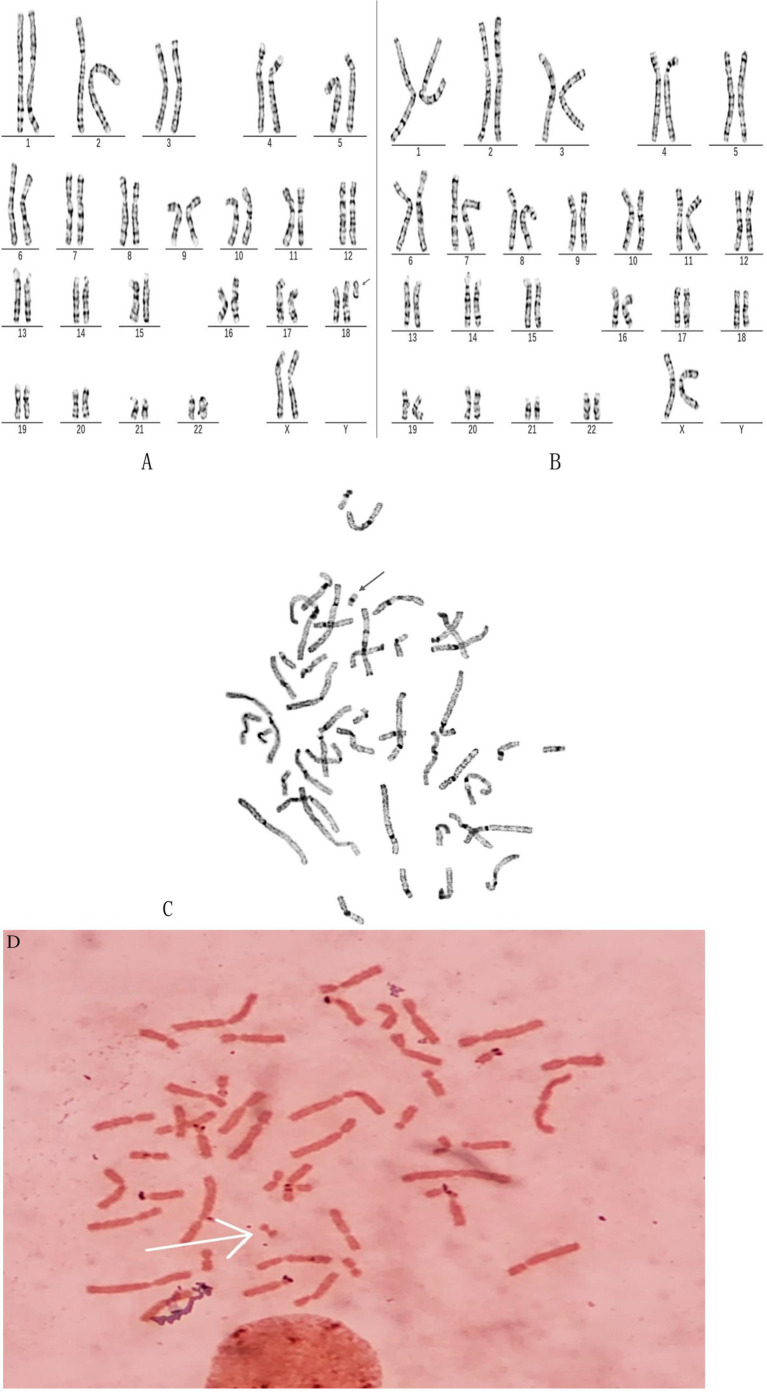 Figure 1
 Figure 2
Peer Reviews
No public reviews on file for this paper yet. If you reviewed it on a platform where reviews are public (OpenReview, ICLR, NeurIPS, ICML), you can paste yours below so the community can read it here.
Videos
No videos yet. Explain this paper in a talk, walkthrough, or lecture? Add one.
Taxonomy
TopicsGenomic variations and chromosomal abnormalities · Chromosomal and Genetic Variations · Genomics and Chromatin Dynamics