IoMT–Fog–Cloud-based AI frameworks for chronic disease diagnosis: updated comparative analysis with recent AI-IoMT models (2020–2025)
Kitsakorn Locharoenrat

TL;DR
This paper reviews AI frameworks combining IoMT, Fog, and Cloud computing for diagnosing chronic diseases like diabetes and cardiovascular disease, comparing performance and system efficiency.
Contribution
The paper provides an updated comparative analysis of AI-IoMT models from 2020–2025, emphasizing both diagnostic accuracy and network quality-of-service.
Findings
Diabetes-focused AI models report accuracy around 95%–96%, while some cardiovascular models show >99% accuracy in controlled settings.
Placing preprocessing and inference at the Fog layer reduces latency but may increase energy consumption with multi-Fog setups.
The paper organizes 14 metrics into diagnostic performance and system/network QoS for reproducible comparisons and design recommendations.
Abstract
Chronic diseases such as diabetes and cardiovascular disease require frequent monitoring and timely clinical feedback to prevent complications. Internet of Medical Things (IoMT) systems increasingly combine near-patient sensing with Fog and Cloud computing so that time-critical preprocessing and inference can run close to the patient while compute-intensive training and population-level analytics remain in the Cloud. This review synthesizes primary studies published between 2020 and 2025 that implement AI-enabled IoMT, with an emphasis on systems that report both diagnostic performance and network quality-of-service (QoS). Following PRISMA 2020, we screened database records and included 14 primary studies; we focus the joint performance–QoS synthesis on six IoMT–Fog–Cloud frameworks for diabetes and cardiovascular disease and compare them with two recent multi-disease AI-IoMT models…
Genes, proteins, chemicals, diseases, species, mutations and cell lines named across the full text — each resolved to its canonical identifier and authoritative record.
Click any figure to enlarge with its caption.
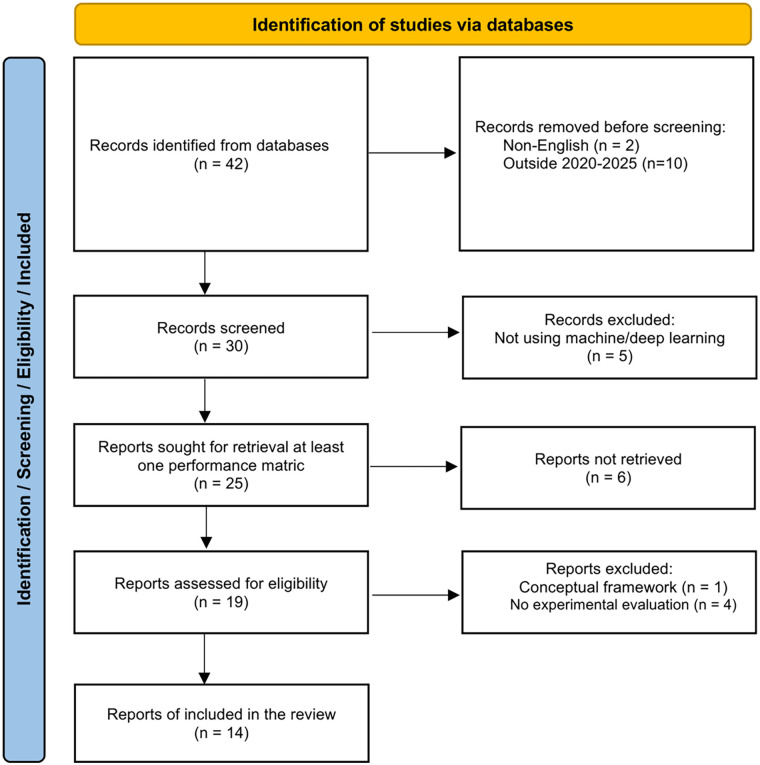 Figure 1
Peer Reviews
No public reviews on file for this paper yet. If you reviewed it on a platform where reviews are public (OpenReview, ICLR, NeurIPS, ICML), you can paste yours below so the community can read it here.
Videos
No videos yet. Explain this paper in a talk, walkthrough, or lecture? Add one.
Taxonomy
TopicsIoT and Edge/Fog Computing · Artificial Intelligence in Healthcare · Wireless Body Area Networks