Streptococcus dysgalactiae as a cause of peripartum infections - a population-based cohort study with phylogenetic analysis of hospital clusters
Matilda Dooley, Erik Senneby, Omar Sigurvin Gunnarsson, Anja Carblom, Ann-Cathrine Petersson, Magnus Rasmussen

TL;DR
This study examines how often Streptococcus dysgalactiae causes infections after childbirth and finds that while serious cases are rare, the infections are common and can spread in hospitals.
Contribution
The study provides population-based evidence on S. dysgalactiae peripartum infections and uses phylogenetic analysis to assess hospital cluster outbreaks.
Findings
S. dysgalactiae peripartum infections affect about 1 in 1000 births.
Hospital clusters of these infections are rare, but whole genome sequencing is recommended to confirm relatedness.
The most common emm-type identified was stG62647.
Abstract
We aimed to investigate the incidence and clinical features of Streptococcus dysgalactiae peripartum infections (SDPI), and to investigate the distribution of emm-types in relation to disease severity and the genetic relatedness of isolates from hospital clusters. Patients with growth of S. dysgalactiae in a genital or wound culture, collected between January 2014 and September 2020 at departments for gynecology and obstetrics, were identified. For inclusion, patients had to be pregnant, or given birth, or undergone an abortion within 42 days prior to debut of symptoms. All isolates had previously been emm-typed. A cluster was defined as two or more patients with S. dysgalactiae of the same emm-type admitted to the same hospital within a 30-day period. The cluster isolates were subjected to whole genome sequencing (WGS). The final study cohort comprised 130 patients. The incidence of…
Genes, proteins, chemicals, diseases, species, mutations and cell lines named across the full text — each resolved to its canonical identifier and authoritative record.
Click any figure to enlarge with its caption.
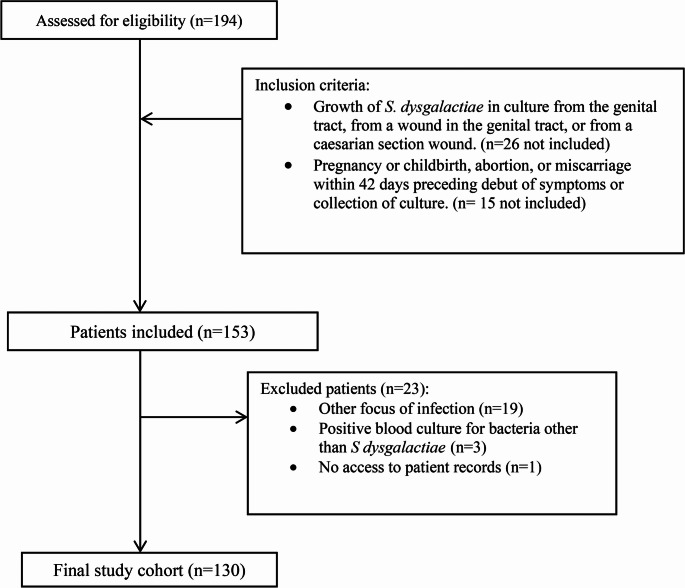 Figure 1
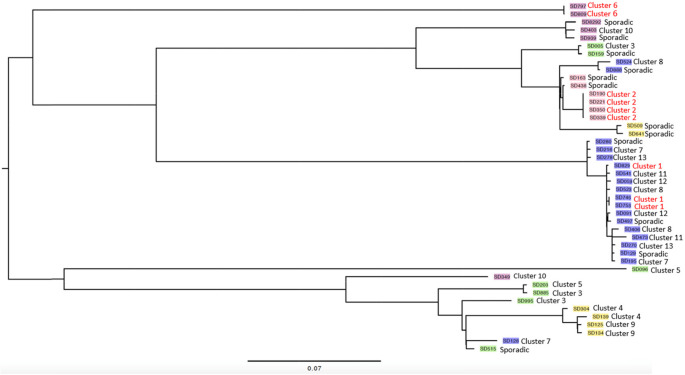 Figure 2
Peer Reviews
No public reviews on file for this paper yet. If you reviewed it on a platform where reviews are public (OpenReview, ICLR, NeurIPS, ICML), you can paste yours below so the community can read it here.
Videos
No videos yet. Explain this paper in a talk, walkthrough, or lecture? Add one.
Taxonomy
TopicsStreptococcal Infections and Treatments · Neonatal and Maternal Infections · Anorectal Disease Treatments and Outcomes