CaRinDB: an integrated database of common cancer mutations and residue interaction network parameters
Daniela Coelho Batista Guedes Pereira, João Vitor Ferreira Cavalcante, Laise Florentino Cavalcanti, Raul Maia Falcão, Jorge Estefano Santana de Souza, Rodrigo Juliani Siqueira Dalmolin, Thaís Gaudencio do Rêgo, Serghei Mangul, Gustavo Antônio de Souza, Patrick Terrematte

TL;DR
CaRinDB is a new database that combines cancer mutation data with structural information to help researchers understand how mutations affect protein interactions.
Contribution
CaRinDB is the first database to integrate cancer mutation data with residue interaction network parameters and functional predictions.
Findings
CaRinDB combines mutation data, functional predictions, and structural parameters from PDB and AlphaFold.
The database provides a web portal for visualizing and analyzing cancer-associated mutations and their structural impacts.
CaRinDB supports the development of AI tools through its compiled and processed data.
Abstract
Predicting the impact of missense mutations on protein structure and function is a fundamental challenge for cancer research and clinical applications. Despite all the computational advances and, more recently, the use of artificial intelligence (AI), assessing the functional consequences of residue substitutions remains a challenging task. Proteins have complex three-dimensional structures, where the maintenance of their functionality depends on chemical interactions between amino acid residues. Single substitutions can affect these interactions, leading to more profound structural changes that are difficult to visualize. Here, we present CaRinDB, a database that integrates cancer-associated missense mutation data, functional predictions, molecular features, allelic frequencies, and residue interaction network (RIN) parameters derived from Protein Data Bank structures and AlphaFold…
Genes, proteins, chemicals, diseases, species, mutations and cell lines named across the full text — each resolved to its canonical identifier and authoritative record.
Click any figure to enlarge with its caption.
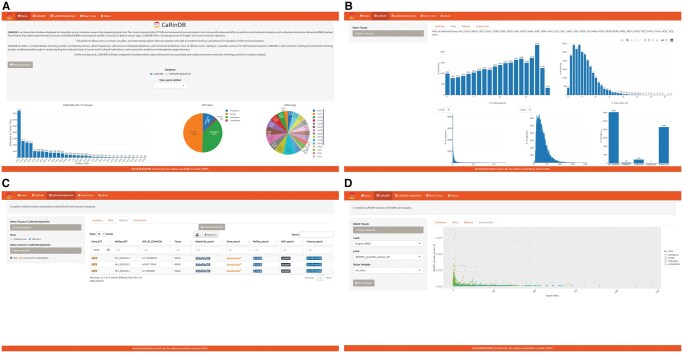 Figure 1
Peer Reviews
No public reviews on file for this paper yet. If you reviewed it on a platform where reviews are public (OpenReview, ICLR, NeurIPS, ICML), you can paste yours below so the community can read it here.
Videos
No videos yet. Explain this paper in a talk, walkthrough, or lecture? Add one.
Taxonomy
TopicsBioinformatics and Genomic Networks · Computational Drug Discovery Methods · Protein Structure and Dynamics