Edoxaban for stroke prevention in Chinese patients with atrial fibrillation: 1-year follow-up of the ETNA-AF-China study
Xueyuan Guo, Juan Du, Yuehui Yin, Heng Qi, Zhisheng Jia, Xiaojun Ji, Yuqing Zhang, Xue Liang, Bing Deng, Jieyun Liu, Juan Ma, Cangsang Song, Huifang Feng, Suxin Luo, Jingfeng Wang, Yongqi Xiao, Lun Li, Junyou Cui, Zheng Huang, Xiang Cheng, Yuan Yi, Mengqi Liu, Cathy Chen

TL;DR
This study shows that edoxaban is effective and safe for preventing stroke in Chinese patients with atrial fibrillation over one year.
Contribution
The study provides new real-world evidence on the safety and effectiveness of edoxaban in a large Chinese atrial fibrillation population.
Findings
Edoxaban showed low rates of stroke and major bleeding in Chinese patients with atrial fibrillation.
Most patients continued using edoxaban after one year without switching or discontinuing.
Risk factors for all-cause death included lower BMI, permanent AF, history of major bleeding, and frailty.
Abstract
Non–vitamin K antagonist oral anticoagulants (NOACs) are the first-line therapy to prevent ischaemic stroke in patients with atrial fibrillation (AF). However, studies on the effectiveness and safety of edoxaban for Chinese patients with AF, are limited. We report the 1-year interim follow-up data on edoxaban use in Chinese patients with AF from the ETNA-AF-China (NCT04747496), a multicentre, prospective, observational study conducted in 89 centres across the Chinese Mainland, enrolling 5,001 patients with a total of 2-year follow-up. No adjustment for multiple testing was made; therefore, all P values must be interpreted in an exploratory or descriptive manner. Overall, 4,877 patients (60 mg edoxaban: 54.3%; 30 mg edoxaban: 45.7%) completed 1-year follow-up (mean age ± standard deviation: 70.3 ± 9.5 years; mean CHA2DS2-VASc score: 2.9 ± 1.4: mean HAS-BLED score: 1.8 ± 1.0). All-cause…
Genes, proteins, chemicals, diseases, species, mutations and cell lines named across the full text — each resolved to its canonical identifier and authoritative record.
Click any figure to enlarge with its caption.
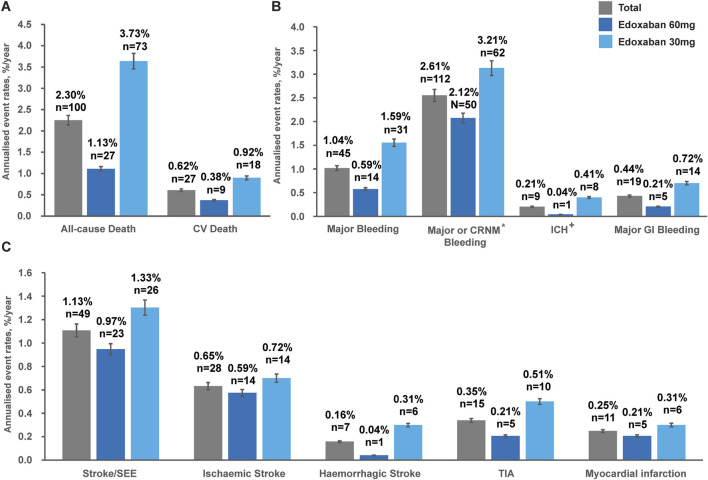 Figure 1
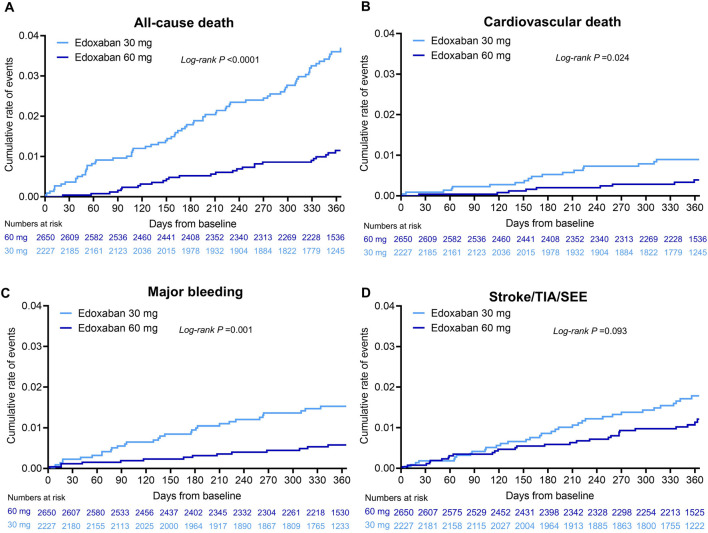 Figure 2
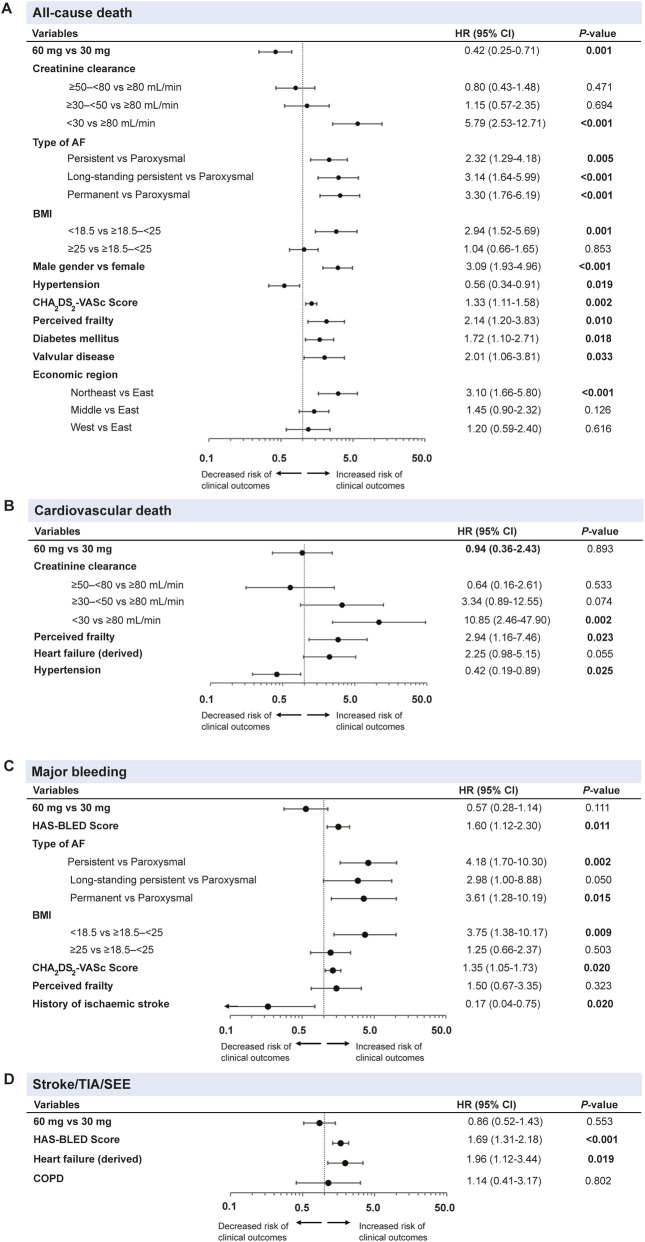 Figure 3
Peer Reviews
No public reviews on file for this paper yet. If you reviewed it on a platform where reviews are public (OpenReview, ICLR, NeurIPS, ICML), you can paste yours below so the community can read it here.
Videos
No videos yet. Explain this paper in a talk, walkthrough, or lecture? Add one.
Taxonomy
TopicsAtrial Fibrillation Management and Outcomes · Acute Ischemic Stroke Management · Intracerebral and Subarachnoid Hemorrhage Research