Altered frequency architecture of spontaneous brain activity in asymptomatic carotid stenosis: a wavelet-based resting-state fMRI study
Wei Xue, Zongyuan Qin, Xiaoli Zhong, Liangliang An, Hanming Shi, Haifeng Wang, Jinjun Wang, Lei Gao, Yang Zhao

TL;DR
This study uses wavelet-based fMRI to show how brain activity frequencies change in people with asymptomatic carotid stenosis, affecting cognitive function.
Contribution
The study introduces a wavelet-based approach to reveal altered cross-frequency coupling in the default mode network in asymptomatic carotid stenosis.
Findings
Healthy controls show a spatial frequency gradient from lower to higher frequencies in the DMN.
SACS patients show decreased wavelet-ALFF in the anteromedial and posteromedial DMN at different frequencies.
Abnormal cross-frequency coupling in the DMN is linked to cognitive impairment in SACS patients.
Abstract
The intrinsic brain activity measured by resting-state fMRI (rs-fMRI) consists of synchronized neural oscillations across a broad range of low frequencies. Although previous studies have linked frequency-specific changes to cognitive function and impairment, the alterations of these frequency-specific spatiotemporal patterns in chronic occlusive cerebrovascular disease remain unclear. In this study, we investigated the cross-frequency structure underlying cognitive impairment in patients with severe asymptomatic carotid stenosis (SACS) using wavelet-transformed amplitude of low-frequency fluctuation (wavelet-ALFF) of rs-fMRI. We found that, in healthy controls, frequency-specific wavelet-ALFF exhibited a spatial distribution from lower to higher frequencies, aligned with the functional hierarchy extending from the default mode network (DMN) to primary somatomotor and subcortical…
Genes, proteins, chemicals, diseases, species, mutations and cell lines named across the full text — each resolved to its canonical identifier and authoritative record.
Click any figure to enlarge with its caption.
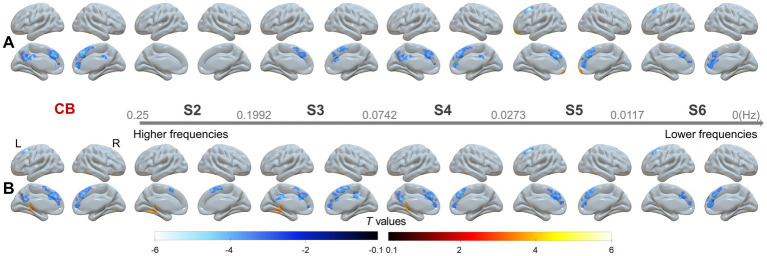 Figure 1
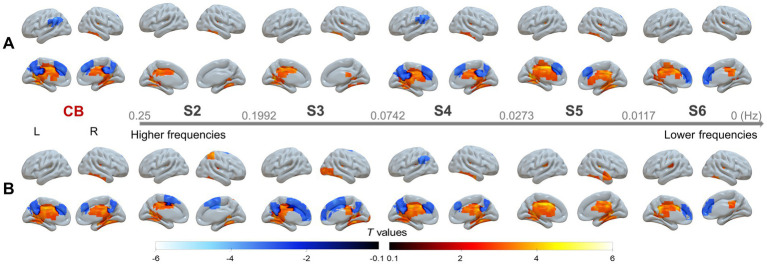 Figure 2
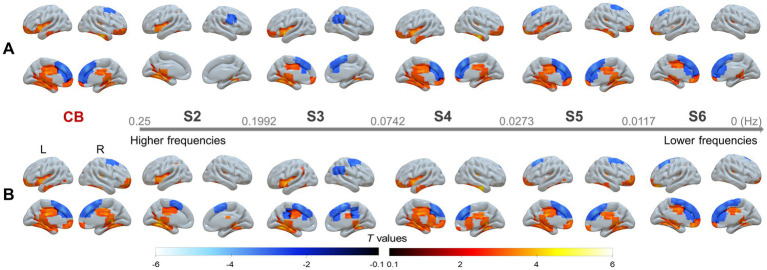 Figure 3
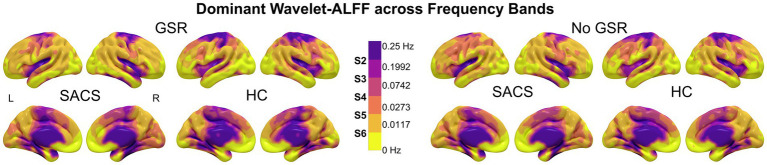 Figure 4
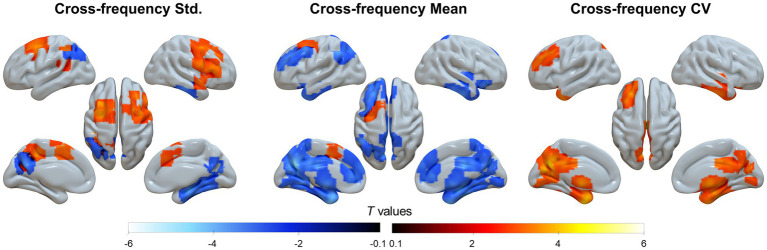 Figure 5
 Figure 6
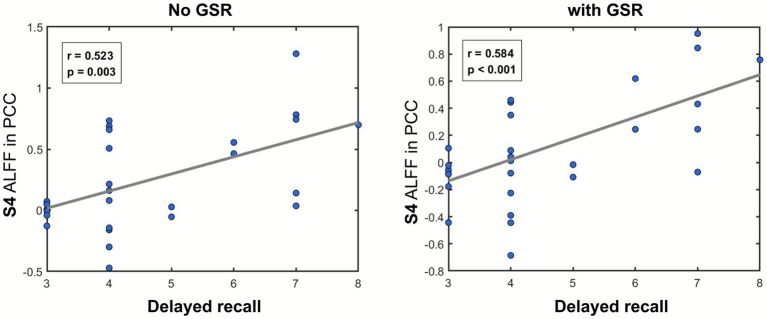 Figure 7
Peer Reviews
No public reviews on file for this paper yet. If you reviewed it on a platform where reviews are public (OpenReview, ICLR, NeurIPS, ICML), you can paste yours below so the community can read it here.
Videos
No videos yet. Explain this paper in a talk, walkthrough, or lecture? Add one.
Taxonomy
TopicsFunctional Brain Connectivity Studies · Neural dynamics and brain function · EEG and Brain-Computer Interfaces