Modulation of host inflammatory pathways by Pseudomonas aeruginosa extracellular vesicles in cystic fibrosis: impact of pulmonary exacerbation and elexacaftor-tezacaftor-ivacaftor treatment
Marianna Said, Aszia Burrell, Brennan Harmon, Kylie I. Krohmaly, Marina Mazur, George M. Solomon, Andrea Hahn

TL;DR
This study explores how Pseudomonas aeruginosa extracellular vesicles affect inflammation in cystic fibrosis patients during lung exacerbations and how treatment with elexacaftor-tezacaftor-ivacaftor reduces this inflammation.
Contribution
The study reveals that Pseudomonas aeruginosa extracellular vesicles during pulmonary exacerbations induce inflammation, which is mitigated by elexacaftor-tezacaftor-ivacaftor treatment.
Findings
Pseudomonas aeruginosa extracellular vesicles from pulmonary exacerbations induced reduced cytokine production in bronchial epithelial cells when treated with elexacaftor-tezacaftor-ivacaftor.
RNA sequencing suggested the S-100 family pathway may be a relevant inflammation marker in cystic fibrosis.
Extracellular vesicles from Pseudomonas aeruginosa triggered inflammation in bronchial epithelial cells, which was reduced by the treatment.
Abstract
Pseudomonas aeruginosa is a prevalent pathogen in persons with cystic fibrosis (pwCF), frequently causing chronic infections. These infections are often associated with episodic pulmonary exacerbations (PEx), yet the mechanisms linking changes in P. aeruginosa to these PEx remain poorly understood. It is unknown whether virulence changes in P. aeruginosa extracellular vesicles (EVs) contribute to PEx. We hypothesized that P. aeruginosa EVs from PEx will elicit increased inflammation response compared to Pa EVs from clinical stability in an in vitro cell culture model. P. aeruginosa EVs were isolated from the sputum of pwCF collected at PEx and the immediately preceding clinical stability period. P. aeruginosa EVs or MEM control were applied apically to primary human bronchial epithelial (HBE) cells at air-liquid interface in the presence or absence of elexacaftor/tezacaftor/ivacaftor…
Genes, proteins, chemicals, diseases, species, mutations and cell lines named across the full text — each resolved to its canonical identifier and authoritative record.
Click any figure to enlarge with its caption.
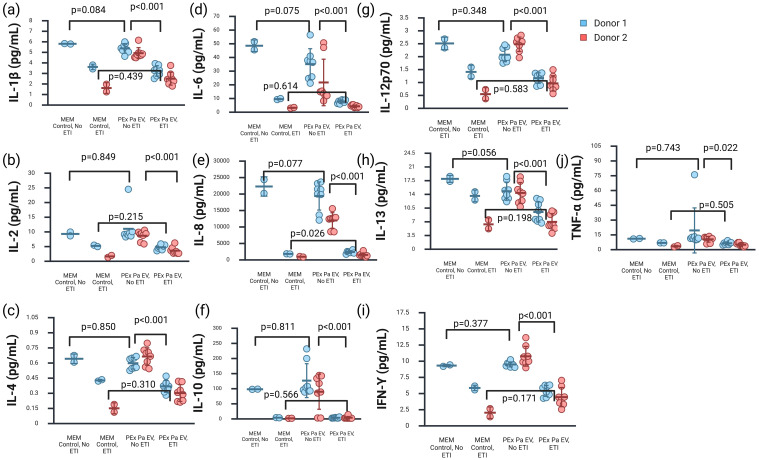 Figure 1
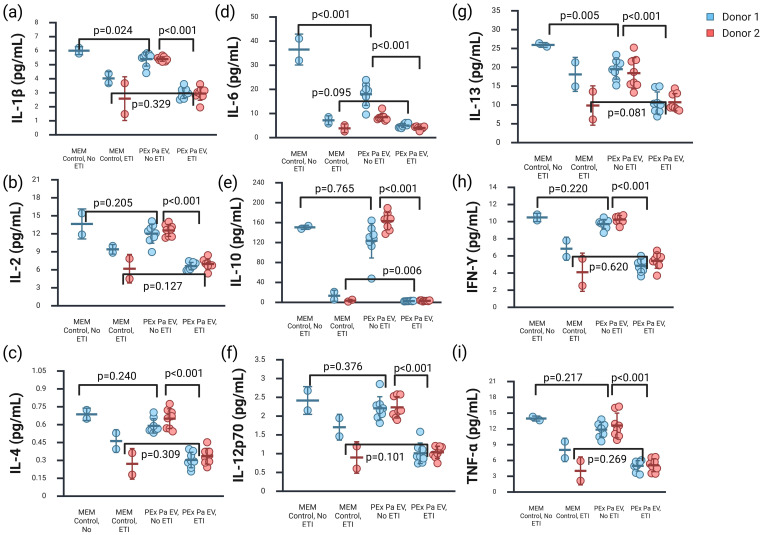 Figure 2
Peer Reviews
No public reviews on file for this paper yet. If you reviewed it on a platform where reviews are public (OpenReview, ICLR, NeurIPS, ICML), you can paste yours below so the community can read it here.
Videos
No videos yet. Explain this paper in a talk, walkthrough, or lecture? Add one.
Taxonomy
TopicsCystic Fibrosis Research Advances · Bacterial biofilms and quorum sensing · Bacterial Infections and Vaccines