A recursive enzymatic competition network capable of multitask molecular information processing
Souvik Ghosh, Mathieu G. Baltussen, Anna C. Knox, Rianne Haije, Quentin Duez, Anastasia T. Tsitsimeli, Man Him Chak, Jonathon E. Beves, Wilhelm T. S. Huck

TL;DR
Researchers designed a complex enzymatic network that can process multiple types of information, like temperature and light, similar to how living cells function.
Contribution
A scalable enzymatic network using recursive competition for multitask information processing is introduced.
Findings
The network can act as a temperature sensor with 1.3 °C accuracy between 25 °C and 55 °C.
It performs decision-making and tuning tasks akin to neurological systems.
The system can interface with optical systems through sensitivity to light pulses.
Abstract
Living cells understand their environment by combining, integrating and interpreting chemical and physical stimuli. Despite considerable advances in the design of enzymatic reaction networks that mimic hallmarks of living systems, these approaches lack the complexity to fully capture biological information processing. Here we introduce a scalable approach to design complex enzymatic reaction networks capable of reservoir computation based on recursive competition of substrates. This protease-based network can perform a broad range of classification tasks based on peptide and physicochemical inputs and can simultaneously perform an extensive set of discrete and continuous information processing tasks. The enzymatic reservoir can act as a temperature sensor from 25 °C to 55 °C with 1.3 °C accuracy, and performs decision-making, activation and tuning tasks common to neurological systems.…
Genes, proteins, chemicals, diseases, species, mutations and cell lines named across the full text — each resolved to its canonical identifier and authoritative record.
Click any figure to enlarge with its caption.
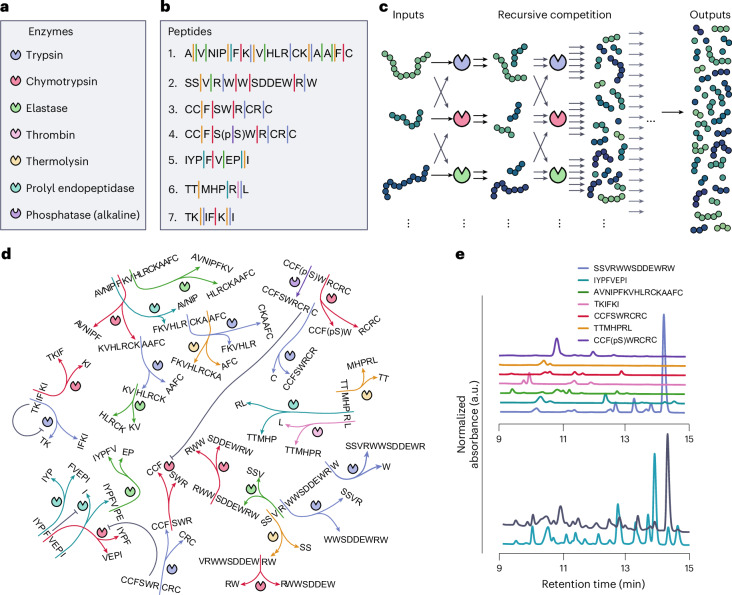 Figure 1
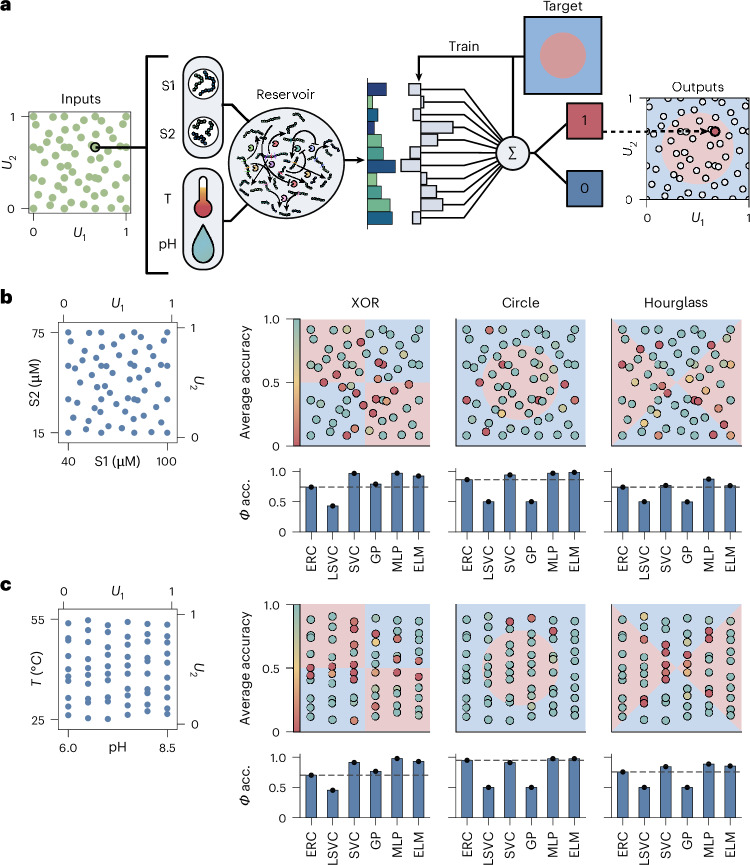 Figure 2
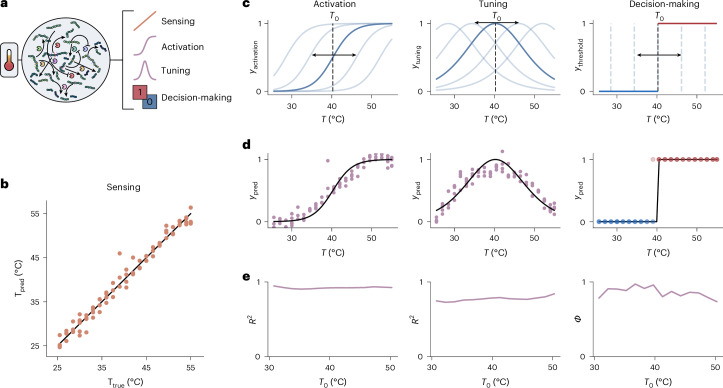 Figure 3
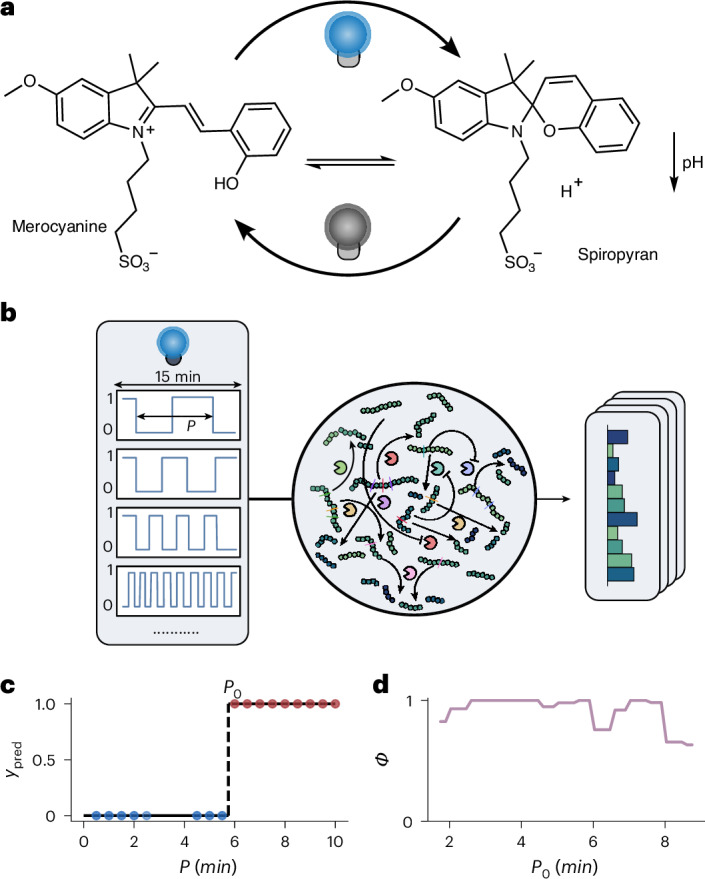 Figure 4
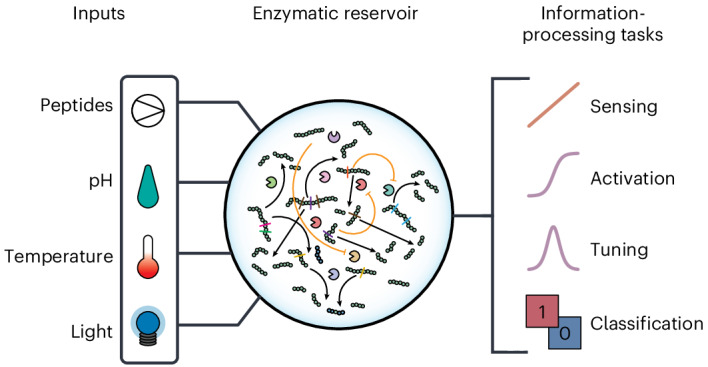 Figure 5
Peer Reviews
No public reviews on file for this paper yet. If you reviewed it on a platform where reviews are public (OpenReview, ICLR, NeurIPS, ICML), you can paste yours below so the community can read it here.
Videos
No videos yet. Explain this paper in a talk, walkthrough, or lecture? Add one.
Taxonomy
TopicsPhotoreceptor and optogenetics research · Receptor Mechanisms and Signaling · Neural Networks and Reservoir Computing