Efficacy and Safety of Remimazolam Compared to Midazolam for Sedation During Endoscopic Ultrasonography: A Single‐Center Retrospective Cohort Study
Haruka Toyonaga, Makoto Masaki, Hajime Yamazaki, Arata Oka, Yoshiki Matsuno, Hidetoshi Nakata, Shoji Takayama, Tatsuya Nakagawa, Takuya Takayama, Masahiro Orino, Hironao Matsumoto, Kimi Sumimoto, Masahiro Takeo, Norimasa Fukata, Takeshi Yamashina, Masaaki Shimatani

TL;DR
Remimazolam provides faster recovery and better sedation success than midazolam for endoscopic ultrasonography in outpatients.
Contribution
First comparison of remimazolam and midazolam for sedation in pancreatobiliary endoscopic ultrasonography.
Findings
Remimazolam showed significantly higher rapid recovery rates compared to midazolam.
Sedation success was higher with remimazolam, with shorter recovery times and less flumazenil use.
Hypoxemia occurred slightly more with remimazolam but was mild and reversible.
Abstract
Remimazolam is a novel ultra–short‐acting benzodiazepine that may offer advantages over conventional sedatives in endoscopic procedures. Evidence for its use in pancreatobiliary endoscopic ultrasonography (EUS) is limited. We compared the efficacy and safety of remimazolam and midazolam in outpatient pancreatobiliary EUS. This retrospective study included outpatients undergoing diagnostic pancreatobiliary EUS between July 2024 and July 2025. Patients received either remimazolam (initial 0.2 mg/kg, top‐up 0.1 mg/kg [high‐risk patients: 0.16 mg/kg, 0.08 mg/kg]) or midazolam. The target sedation depth was Modified Observer's Assessment of Alertness/Sedation ≤3, procedures were performed without supplemental oxygen, and pentazocine was co‐administered. The primary outcome was rapid recovery (meeting all criteria: modified Aldrete score ≥6 at 5 min, ≥9 at 30 min, ambulation ≥3 m at 30 min).…
Genes, proteins, chemicals, diseases, species, mutations and cell lines named across the full text — each resolved to its canonical identifier and authoritative record.
Click any figure to enlarge with its caption.
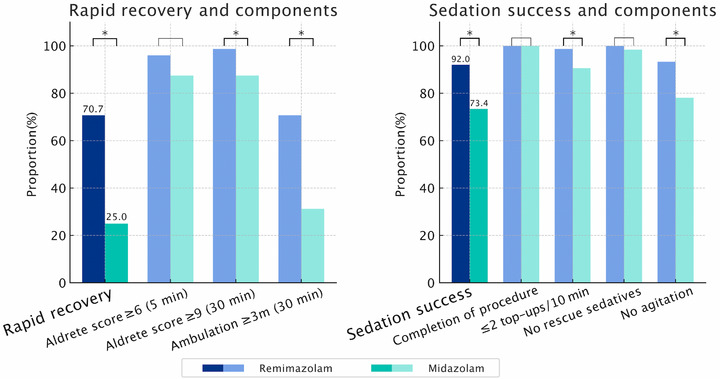 Figure 1
Peer Reviews
No public reviews on file for this paper yet. If you reviewed it on a platform where reviews are public (OpenReview, ICLR, NeurIPS, ICML), you can paste yours below so the community can read it here.
Videos
No videos yet. Explain this paper in a talk, walkthrough, or lecture? Add one.
Taxonomy
TopicsAnesthesia and Sedative Agents · Gallbladder and Bile Duct Disorders · Pancreatic and Hepatic Oncology Research