Clinical Progression Modes of Crizotinib Failure and Subsequent Management of Advanced Non‐Small Cell Lung Cancer With ROS1 Rearrangement
Quan‐Quan Tan, Yu‐Qing Chen, Yu‐Er Gao, Ke‐Jun Liu, Zi‐Ji Mao, Ming‐Ying Zheng, Jun‐Wei Su, Jiao Yang, Qing‐Yun Gao, Hua‐Jun Chen, Jin‐Ji Yang

TL;DR
This study examines how non-small cell lung cancer patients with ROS1 rearrangements progress after crizotinib treatment and identifies patterns that influence survival and treatment options.
Contribution
The study identifies distinct progression modes after crizotinib failure in ROS1-rearranged NSCLC and links them to survival outcomes and resistance mechanisms.
Findings
Patients with gradual/local progression had significantly better survival outcomes compared to those with dramatic progression.
Chemotherapy after crizotinib failure in dramatic progression cases provided better survival than other therapies.
ROS1 kinase domain mutations were more common in dramatic progression, while bypass pathways were linked to gradual progression.
Abstract
Crizotinib is the classic first‐line treatment for ROS1‐rearranged NSCLC. However, data on the clinical progression modes and recommended options for subsequent treatments after crizotinib treatment failure are limited. Twenty‐eight patients were categorized into dramatic or gradual/local progression groups. We analyzed the clinical characteristics, survival outcomes, and potential resistance mechanisms in different progression modes. The median progression‐free survival (mPFS) in the dramatic and gradual/local progression groups was 8.0 and 22.0 months, respectively (p < 0.001). The median overall survival (mOS) was 14.2 and 90.3 months in the dramatic progression and gradual/local progression groups, respectively (p < 0.001). Among patients with dramatic progression after crizotinib failure, significant differences were shown in median post‐progression overall survival (mpOS) (7.1…
Genes, proteins, chemicals, diseases, species, mutations and cell lines named across the full text — each resolved to its canonical identifier and authoritative record.
Click any figure to enlarge with its caption.
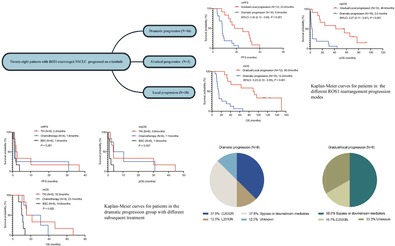 Figure 1
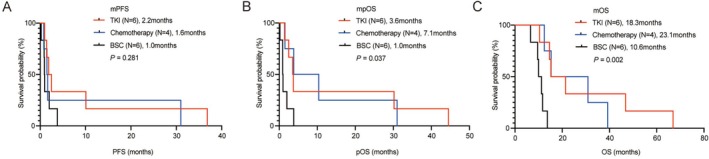 Figure 2
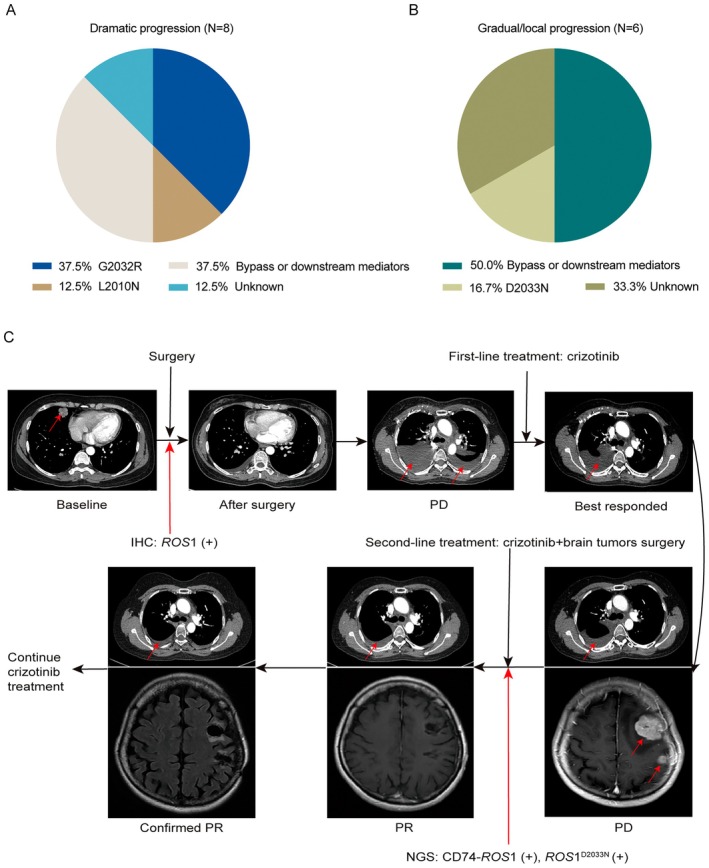 Figure 3
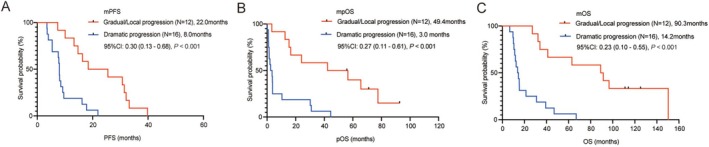 Figure 4
Peer Reviews
No public reviews on file for this paper yet. If you reviewed it on a platform where reviews are public (OpenReview, ICLR, NeurIPS, ICML), you can paste yours below so the community can read it here.
Videos
No videos yet. Explain this paper in a talk, walkthrough, or lecture? Add one.
Taxonomy
TopicsLung Cancer Treatments and Mutations · Lung Cancer Research Studies · Lung Cancer Diagnosis and Treatment