Development and Implementation of Novel Virtual Triage and Exploration of Attitudes Towards the Potential Use of Artificial Intelligence in the Irritable Bowel Syndrome (IBS) Dietetic Pathway
Emma Stennett, Katerina Belogianni, Miranda Lomer

TL;DR
A new virtual triage system for IBS patients was developed, reducing waiting times and clinician workload, while attitudes toward AI in healthcare were generally positive but cautious.
Contribution
A novel semi-automated virtual triage system was developed and implemented in the IBS dietetic pathway, with evaluation of its impact and attitudes toward AI use.
Findings
Virtual triage reduced waiting times from 56.6 to 17.5 days and increased clinical capacity from 400 to 1000 appointments/year.
Clinician time per triage decreased from 20 to 11 minutes per patient.
Attitudes toward AI were mixed, with themes of potential benefits, concerns, and criteria for application.
Abstract
Dietary management is integral to the irritable bowel syndrome (IBS) pathway. Triage facilitates the decision‐making process for the right dietetic intervention; however, telephone triage is time intensive. Digital advances provide an opportunity to target waiting times and clinical capacity. The aim of this work was to develop and implement a novel semi‐automation virtual triage, assess its impact in the IBS pathway and to investigate attitudes towards the use of artificial intelligence (AI) in triage and dietetic healthcare. The Consolidated Framework for Implementation Research (CFIR) provided a structure to develop and implement virtual triage into the IBS pathway. A digital triage questionnaire was developed using experience‐based co‐design. The efficacy of virtual triage was compared with telephone triage for waiting times from referral to triage, clinicians' time taken to triage…
Genes, proteins, chemicals, diseases, species, mutations and cell lines named across the full text — each resolved to its canonical identifier and authoritative record.
Click any figure to enlarge with its caption.
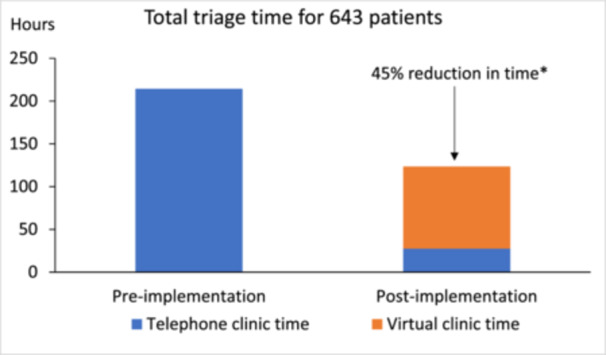 Figure 1
 Figure 2
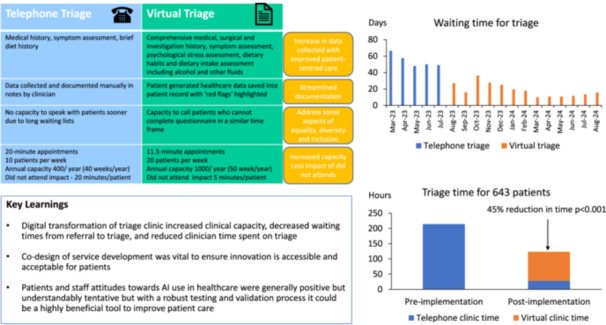 Figure 3
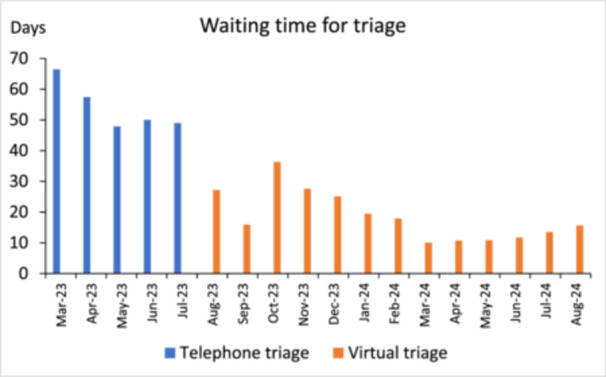 Figure 4
Peer Reviews
No public reviews on file for this paper yet. If you reviewed it on a platform where reviews are public (OpenReview, ICLR, NeurIPS, ICML), you can paste yours below so the community can read it here.
Videos
No videos yet. Explain this paper in a talk, walkthrough, or lecture? Add one.
Taxonomy
TopicsGastrointestinal motility and disorders · Artificial Intelligence in Healthcare and Education · Colorectal Cancer Screening and Detection