Surveillance Service of Yellow Fever in Non-Human Primates in the Federal District, Brazil, 2008-2022
Gabriela Rodrigues de Toledo Costa, Pedro Henrique de Oliveira Passos, Davi Emanuel Ribeiro de Sousa, Isabel Luana de Macêdo, Daniel Garkauskas Ramos, Karina Ribeiro Leite Jardim Cavalcante, Alessandro Pecego Martins Romano, Arnaldo Jorge Martins, Livia Medeiros Neves Casseb

TL;DR
This study analyzes yellow fever surveillance in non-human primates in Brazil's Federal District from 2008 to 2022, highlighting its role in early detection and prevention.
Contribution
The study provides a 15-year retrospective analysis of yellow fever surveillance in non-human primates in Brazil's Federal District.
Findings
20 yellow fever-positive outbreaks were confirmed between 2008 and 2020, affecting 27 non-human primates.
Surveillance coverage expanded, with 96.7% of NHP deaths sampled for yellow fever testing.
Conclusive diagnoses increased by 60% in the last 5 years, with trauma and infectious diseases as leading causes of death.
Abstract
Surveillance of non-human primate (NHP) deaths is vital for the early detection of yellow fever (YF) and prevention of its spread to the human population. This study assessed the YF surveillance system for NHPs in the Brazilian Federal District (FD) from 2008 to 2022. A retrospective analysis of the aggregated data from 15 years of outbreak surveillance involving NHP deaths was conducted. The analyzed variables included spatiotemporal distribution, species, sex, age, sample collection, cause of death, and YF test results. In total, 1,175 outbreaks involving 1,353 NHP deaths were recorded, averaging 1.35 animals per outbreak, in urban and peri-urban areas. Twenty YF-positive outbreaks were confirmed in 2008, 2015, and 2020, affecting 27 animals, mainly adult Callithrix spp., with an overall YF positivity rate of 2%. Surveillance coverage expanded across all administrative regions of…
Genes, proteins, chemicals, diseases, species, mutations and cell lines named across the full text — each resolved to its canonical identifier and authoritative record.
Click any figure to enlarge with its caption.
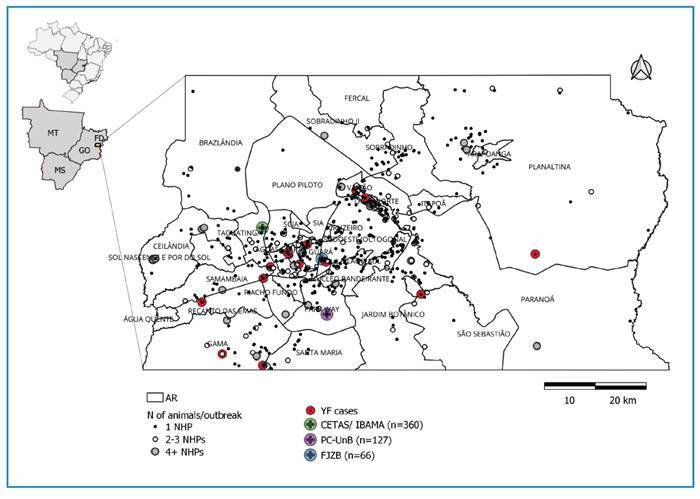 Figure 1
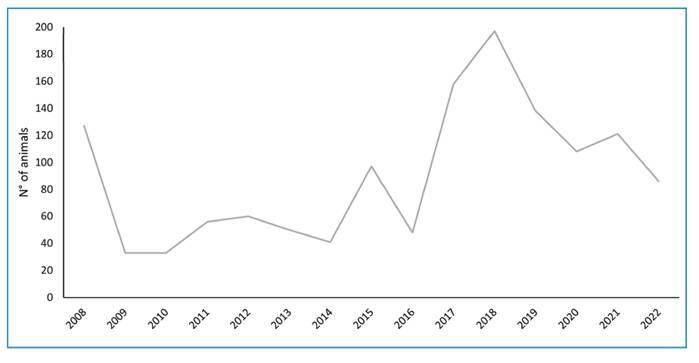 Figure 2
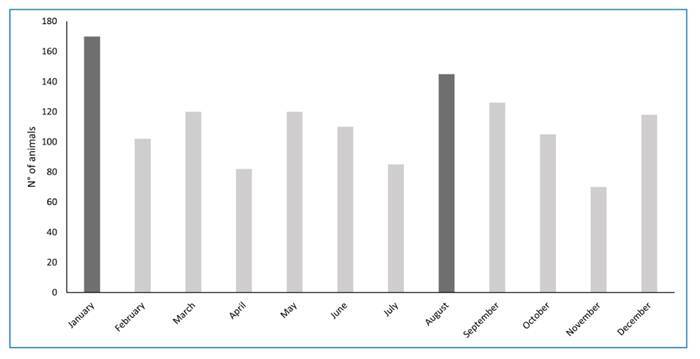 Figure 3
Peer Reviews
No public reviews on file for this paper yet. If you reviewed it on a platform where reviews are public (OpenReview, ICLR, NeurIPS, ICML), you can paste yours below so the community can read it here.
Videos
No videos yet. Explain this paper in a talk, walkthrough, or lecture? Add one.
Taxonomy
TopicsMosquito-borne diseases and control · Zoonotic diseases and public health · Rabies epidemiology and control