Third‐Generation Narrow‐Band Imaging Versus White‐Light Imaging for the Detection of Early Gastric Cancer: A Randomized Controlled Study
Yukihisa Fujinaga, Hitoshi Mori, Masayoshi Takami, Hiroyuki Masuda, Jun‐ichi Hanatani, Satoshi Iwai, Shohei Asada, Akihiko Shibamoto, Yuki Tsuji, Koh Kitagawa, Norihisa Nishimura, Shinya Sato, Kosuke Kaji, Tadashi Namisaki, Akira Mitoro, Hitoshi Yoshiji

TL;DR
A study compared third-generation narrow-band imaging and white-light imaging for detecting early gastric cancer, finding no significant advantage for the newer imaging method.
Contribution
This is the first randomized controlled study comparing third-generation narrow-band imaging and white-light imaging for early gastric cancer detection.
Findings
Third-generation narrow-band imaging was not superior to white-light imaging in detecting early gastric cancer.
The missed lesion rate was 0% in the initial 3G-NBI group compared to 5.6% in the initial WLI group.
Improved white-light imaging quality may explain the lack of advantage for third-generation narrow-band imaging.
Abstract
The endoscopic system EVIS X1 with improved image quality has been introduced into clinical practice. We examined whether third‐generation narrow‐band imaging (3G‐NBI) is more effective than white‐light imaging (WLI) for detecting early gastric cancer (EGC). Our study, performed at a single center, had a parallel‐group, open‐label, two‐arm, randomized, controlled design. Patients who had undergone endoscopic submucosal dissection for EGC were randomly assigned to a group undergoing 3G‐NBI after initial WLI (initial WLI group) or a group undergoing WLI after initial 3G‐NBI (initial 3G‐NBI group). The primary endpoint was the EGC detection rate of the two methods. The secondary endpoints were as follows: proportions of EGC detected and missed lesions, positive predictive value (PPV) for EGC diagnosis, and observation time for WLI and 3G‐NBI. The EGC detection rate was 9.0% (17/188) in…
Genes, proteins, chemicals, diseases, species, mutations and cell lines named across the full text — each resolved to its canonical identifier and authoritative record.
Click any figure to enlarge with its caption.
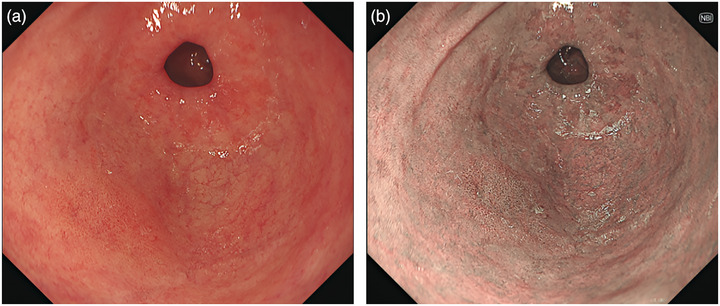 Figure 1
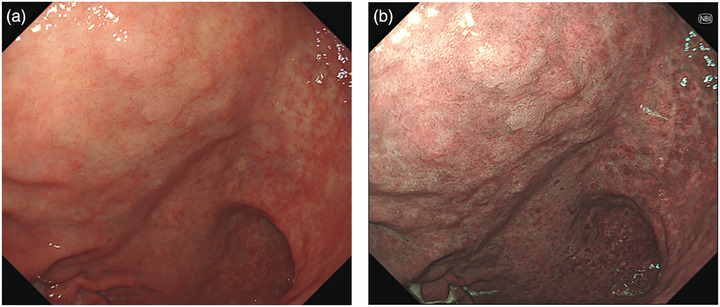 Figure 2
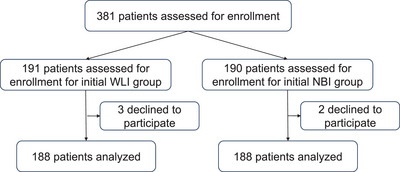 Figure 3
Peer Reviews
No public reviews on file for this paper yet. If you reviewed it on a platform where reviews are public (OpenReview, ICLR, NeurIPS, ICML), you can paste yours below so the community can read it here.
Videos
No videos yet. Explain this paper in a talk, walkthrough, or lecture? Add one.
Taxonomy
TopicsGastric Cancer Management and Outcomes · Esophageal Cancer Research and Treatment · Colorectal Cancer Screening and Detection