Defining frailty using a modified Fried’s Frailty Phenotype in a Southern African context
E. I. Y. Madela, C. L. Gregson, F. Paruk, A. J. Burton, R. Patel, H. Wilson, F. Habana, A. M. Manyara, B. Mbanjwa, L. Gates, C. Grundy, K. A. Ward, B. Cassim

TL;DR
This study adapts the Fried’s Frailty Phenotype to better identify frailty in a Southern African population by adjusting criteria for local conditions.
Contribution
The study proposes region-specific modifications to the Fried’s Frailty Phenotype for improved frailty diagnosis in Southern Africa.
Findings
Using the lowest quintile of BMI missed 15.2% of overweight and obese participants who reported weight loss.
Grip strength correlated better with age than BMI, leading to the use of sex-specific thresholds for grip strength.
The modified SDOC threshold identified slow walking speed in 85.8% of participants, indicating non-differentiality.
Abstract
Frailty leads to disability, morbidity, and mortality in older persons. The Fried’s Frailty Phenotype (FFP), derived in the American Cardiovascular Health Study (CHS), is widely used around the world to define frailty, but lacks adaptation in African populations. To derive a modified FFP definition which best identifies frailty in a Southern African context. A population-based cross-sectional study of adults aged ≥40 years collected data from questionnaires and physical assessments. Original CHS, population-dependent, European Working Group on Sarcopenia in Older People2 (EWGSOP2) and Sarcopenia Definitions and Outcomes Consortium (SDOC) and independent thresholds were all applied to the five FFP criteria (weight loss, exhaustion, low physical activity [PA], low grip strength [GS] and slow walking speed [WS]) to assess non-differentiality, internal consistency, and plausibility. The…
Genes, proteins, chemicals, diseases, species, mutations and cell lines named across the full text — each resolved to its canonical identifier and authoritative record.
Click any figure to enlarge with its caption.
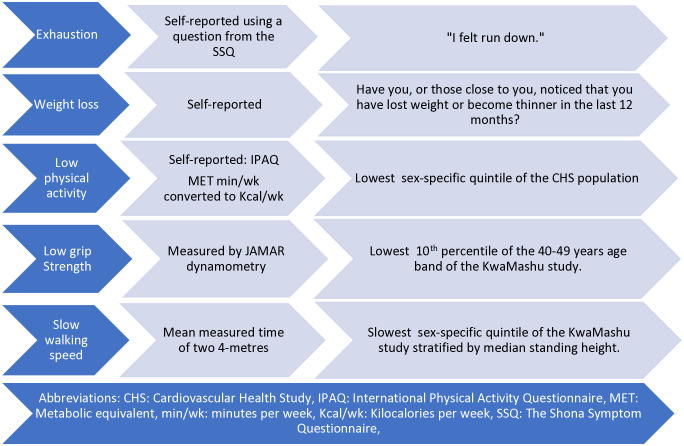 Figure 1
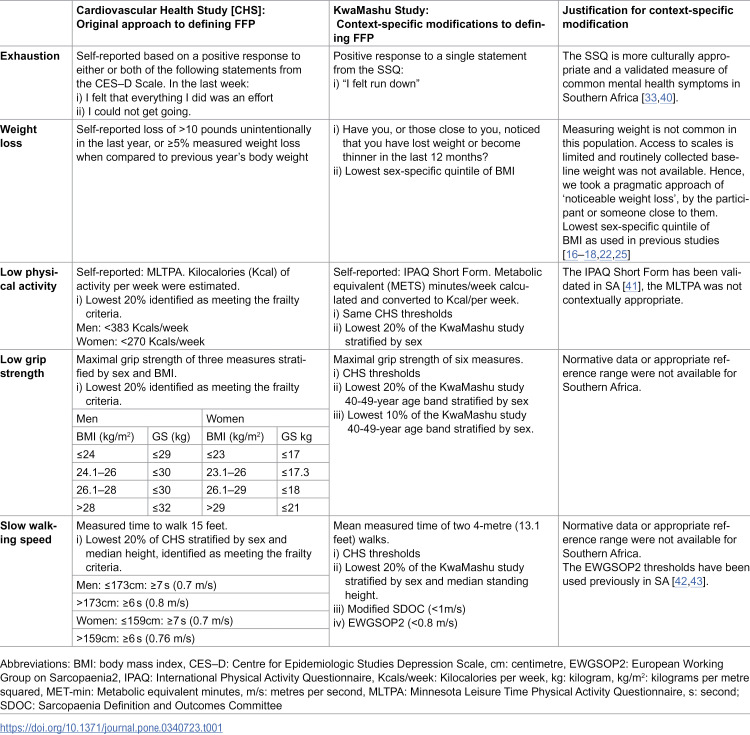 Figure 2
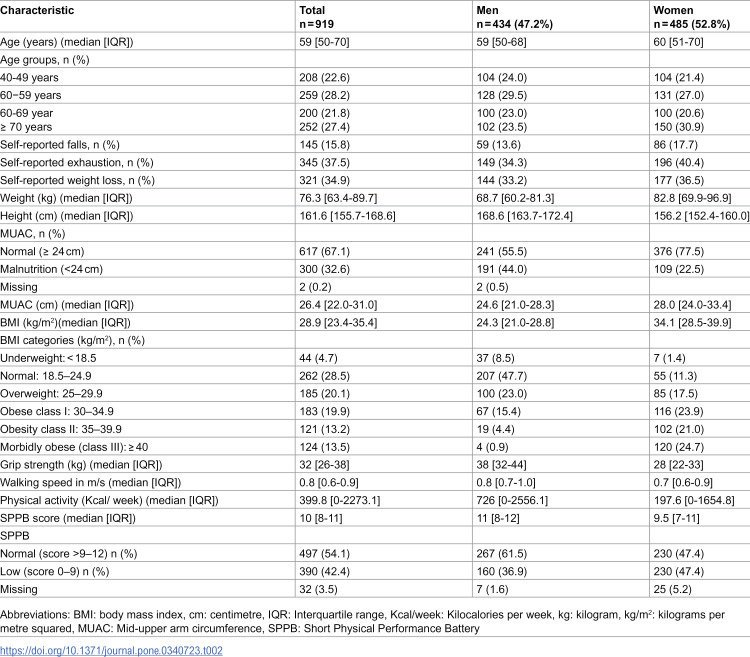 Figure 3
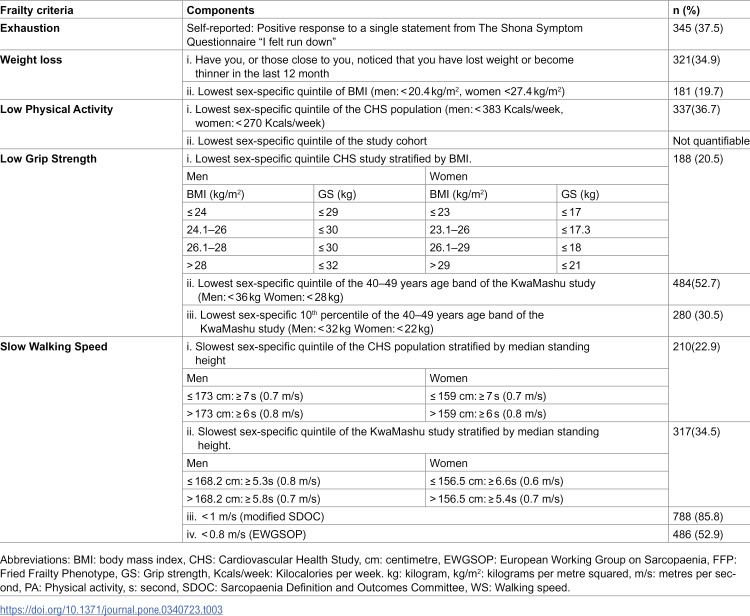 Figure 4
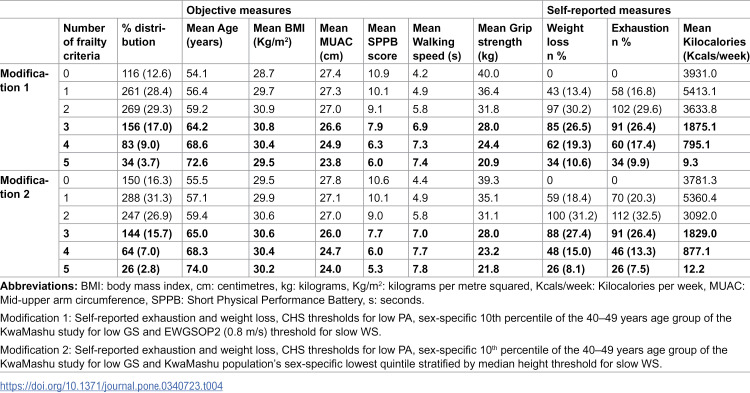 Figure 5
Peer Reviews
No public reviews on file for this paper yet. If you reviewed it on a platform where reviews are public (OpenReview, ICLR, NeurIPS, ICML), you can paste yours below so the community can read it here.
Videos
No videos yet. Explain this paper in a talk, walkthrough, or lecture? Add one.
Taxonomy
TopicsFrailty in Older Adults · Nutrition and Health in Aging · Body Composition Measurement Techniques