Blended Learning Compared With Face-to-Face Learning Among Family Medicine Residents: Randomized Controlled Trial
Pierre-Yves Meunier, Sophie Schlatter, Juliette Macabrey, Frédéric Zorzi, Thomas Colleony, Rémy Boussageon, Hubert Maisonneuve, Marion Lamort-Bouché

TL;DR
Blended learning is as effective as traditional face-to-face learning for training family medicine residents in France.
Contribution
This study provides evidence that blended learning can maintain educational quality while addressing teacher shortages.
Findings
Blended and traditional courses showed no significant difference in knowledge and skill self-assessment.
Residents in blended courses had slightly higher knowledge self-assessment, but the difference was not educationally meaningful.
Blended learning can support socioconstructivist teaching without harming academic outcomes.
Abstract
The medical education of French family medicine residents involves active, socioconstructivist-inspired small-group courses useful for skill acquisition. This is challenged by the increasing gap between the growing number of residents and the limited number of teachers. Blended courses have the potential to address this issue by reducing the duration of face-to-face sessions while preserving small-group courses. This study aimed to compare the effects of blended vs traditional, face-to-face, active, socioconstructivist learning on the acquisition of knowledge and skills by family medicine residents. We conducted a randomized controlled trial to compare a blended course and a traditional course. The blended course involved 2.5 hours of asynchronous e-learning and a 3-hour face-to-face session. The traditional course involved 5.5 hours of face-to-face teaching. Both courses were…
Genes, proteins, chemicals, diseases, species, mutations and cell lines named across the full text — each resolved to its canonical identifier and authoritative record.
Click any figure to enlarge with its caption.
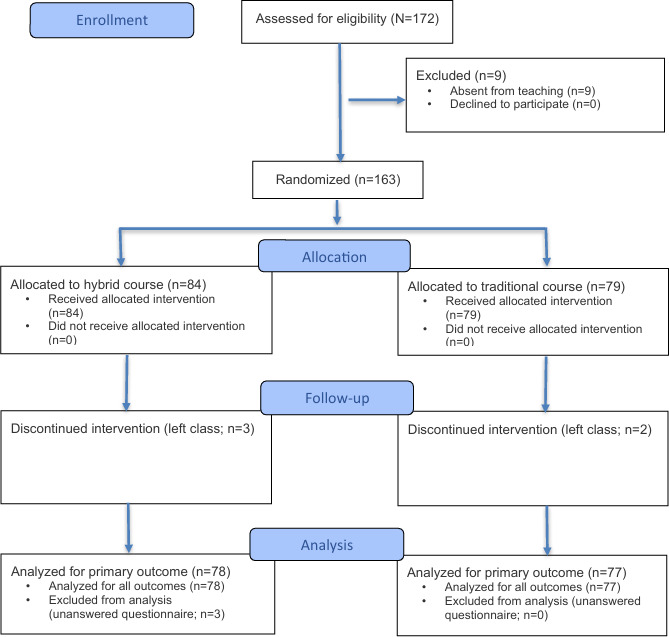 Figure 1
Peer Reviews
No public reviews on file for this paper yet. If you reviewed it on a platform where reviews are public (OpenReview, ICLR, NeurIPS, ICML), you can paste yours below so the community can read it here.
Videos
No videos yet. Explain this paper in a talk, walkthrough, or lecture? Add one.
Taxonomy
TopicsInnovations in Medical Education · Innovative Teaching Methods · COVID-19 and Mental Health