Patatin‐domain‐containing (phospho)lipases under control: Mammalian co‐regulators and pathogenic activation mechanisms
Noopur Dubey, Lina Riegler‐Berket, Monika Oberer

TL;DR
This paper reviews the structure and function of patatin-like phospholipases, focusing on how they are activated through protein interactions and their roles in health and disease.
Contribution
The paper identifies conserved structural elements (D-segment and regulatory segment) that modulate enzyme activity through co-activation mechanisms.
Findings
Structural analysis reveals conserved segments that modulate active-site architecture in patatin-like phospholipases.
Protein–protein interactions and conformational changes are critical for enzyme activation and regulation.
PNPLA proteins show diverse biological roles and regulatory mechanisms across species.
Abstract
Patatin‐like phospholipase (PNPLA) domain‐containing proteins are essential enzymes involved in lipid metabolism, membrane remodeling, and signaling pathways across various organisms. This review focuses on the structural and functional characteristics of four selected PNPLA proteins from different organisms with experimental 3D structures or biochemical data on protein–protein interactions that facilitate their co‐activation mechanism, namely VipD, ExoU, PNPLA9, and PNPLA2 (also known as ATGL). VipD and ExoU, phospholipases from Legionella pneumophila and Pseudomonas aeruginosa, respectively, are multidomain proteins and utilize distinct mechanisms for host cell interaction and pathogenesis. VipD binds to Rab proteins, underscoring the critical role of Rab5 in upregulating its enzymatic activity and contributing to the pathogenicity. ExoU requires ubiquitin for activation and exhibits…
Genes, proteins, chemicals, diseases, species, mutations and cell lines named across the full text — each resolved to its canonical identifier and authoritative record.
Click any figure to enlarge with its caption.
 Figure 1
 Figure 2
 Figure 3
 Figure 4
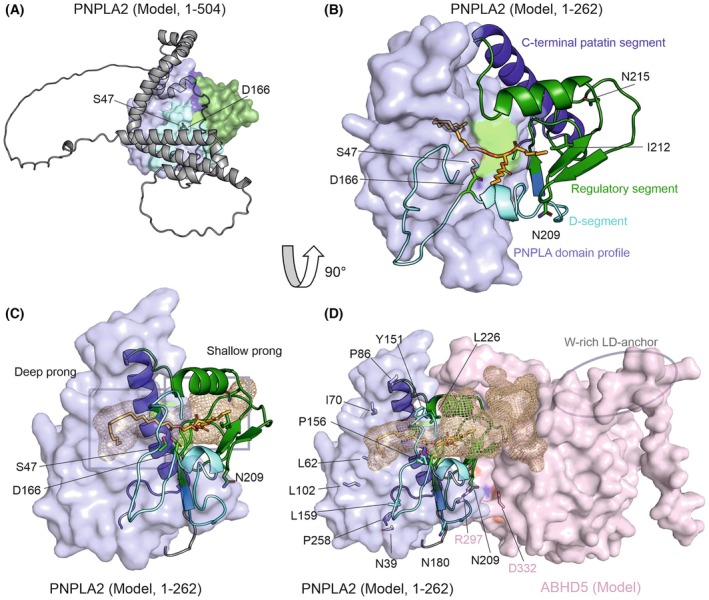 Figure 5
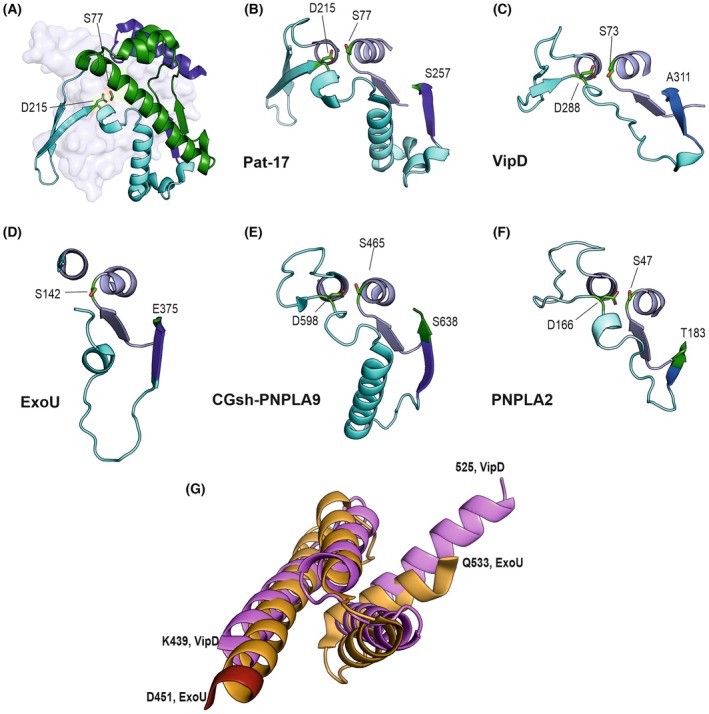 Figure 6
Peer Reviews
No public reviews on file for this paper yet. If you reviewed it on a platform where reviews are public (OpenReview, ICLR, NeurIPS, ICML), you can paste yours below so the community can read it here.
Videos
No videos yet. Explain this paper in a talk, walkthrough, or lecture? Add one.
Taxonomy
TopicsLegionella and Acanthamoeba research · Yersinia bacterium, plague, ectoparasites research · Cellular transport and secretion