Introgressed mitochondrial fragments from archaic hominins alter nuclear genome function in modern humans
Qiong Zhu, Jinning Zhang, Weichen Zhou, Shen-Ao Liang, Shengmiao Wang, Xinyu Cai, Fuyuan Li, Jin Li, Guojie Zhang, Huijuan Feng, Qiaomei Fu, Joshua M. Akey, Feng Zhang, Li Jin, Shuhua Xu, Hong-Xiang Zheng, Lu Chen

TL;DR
Ancient human DNA fragments from mitochondria can influence modern human genome function, affecting gene regulation and chromatin structure.
Contribution
Identifies archaic mitochondrial DNA segments in modern humans that modulate gene expression and chromatin structure.
Findings
Introgressed NUMTs modulate gene expression, including up-regulating the immune-related gene RASGRP3.
NUMTs reshape three-dimensional chromatin structure at loci such as SCD5 and HNRNPD.
Five NUMTs were identified as introduced into modern humans via archaic hominin introgression.
Abstract
Archaic introgression introduced functionally relevant variants into modern humans, yet small-scale insertions remain understudied. Here, we leverage 2519 modern human genomes and four high-coverage archaic hominin genomes to systematically characterize nuclear mitochondrial DNA segments (NUMTs). We uncover 483 polymorphic NUMTs across globally diverse human populations and 10 in archaic genomes. By combining overlap with Neanderthal-derived and Denisovan-derived haplotypes, phylogenetic analyses, insertion time estimates, and haplotype colocalization, we identify five NUMTs introduced into modern humans via archaic hominin introgression. Functional analyses reveal that introgressed NUMTs can modulate gene expression, including allele-specific up-regulation of the immune-related gene RASGRP3, and reshape three-dimensional chromatin structure at loci such as SCD5 and HNRNPD. These…
Genes, proteins, chemicals, diseases, species, mutations and cell lines named across the full text — each resolved to its canonical identifier and authoritative record.
Click any figure to enlarge with its caption.
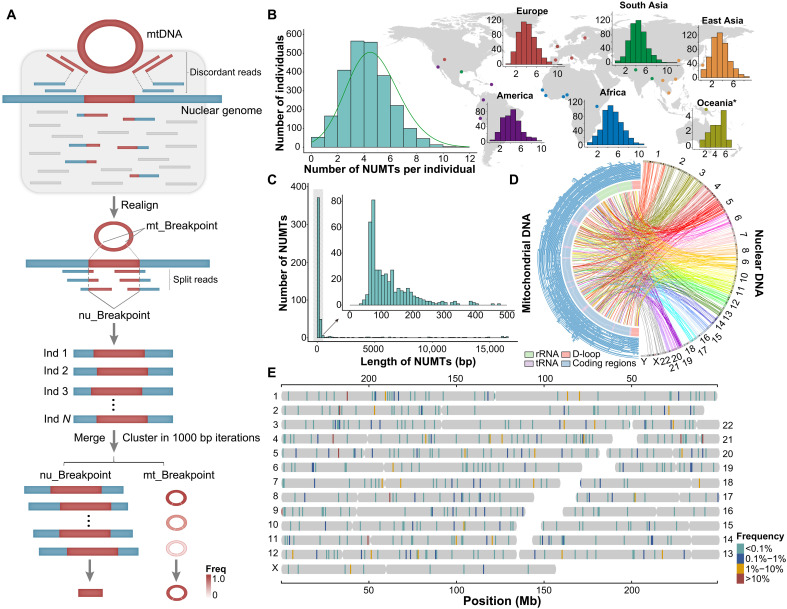 Figure 1
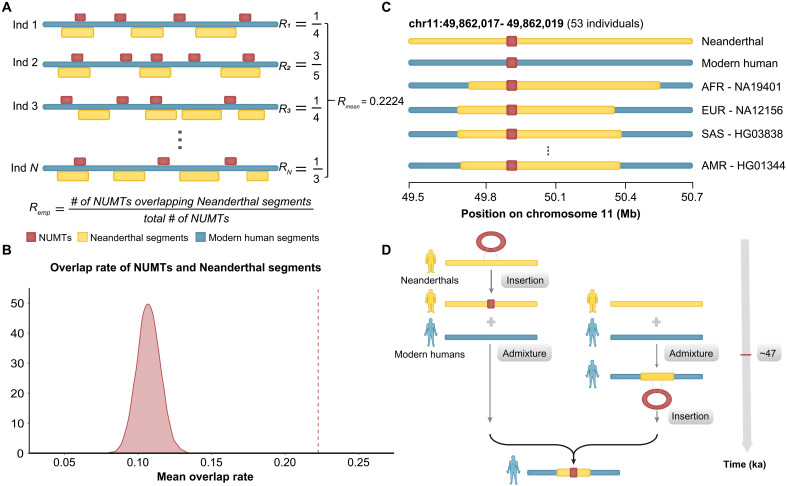 Figure 2
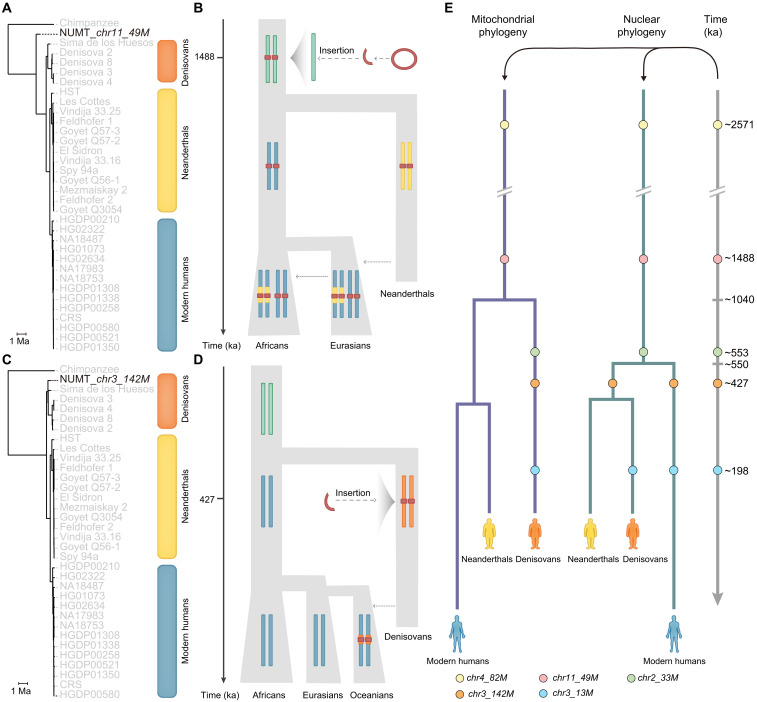 Figure 3
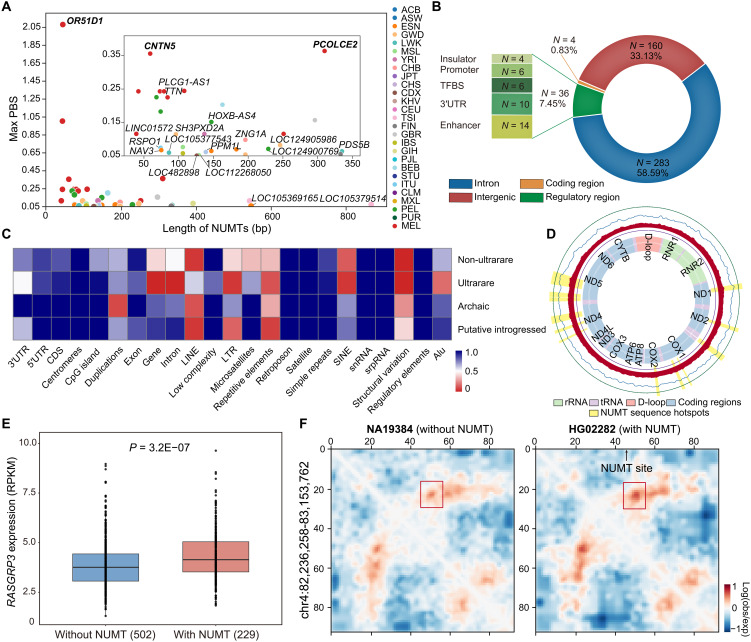 Figure 4
Peer Reviews
No public reviews on file for this paper yet. If you reviewed it on a platform where reviews are public (OpenReview, ICLR, NeurIPS, ICML), you can paste yours below so the community can read it here.
Videos
No videos yet. Explain this paper in a talk, walkthrough, or lecture? Add one.
Taxonomy
TopicsForensic and Genetic Research · Pleistocene-Era Hominins and Archaeology · Genomics and Phylogenetic Studies