Predictors of cognitive impairment in drug-resistant epilepsy: the role of interictal EEG abnormalities
Saleh Baeesa, Fawzi Babtain, Ahmad Albeshri, Amal Alkhotani, Rakan Bokhari, Motaz Fadul, Mohammed Karami, Mazen Basheikh, Adnan Badahdah, Ahmed Bamaga, Mohammed Alshurem, Raed Gasemaltayeb, Wareef Alzahrani, Ahmed Najjar, Yasser Alamri, Humaira Waseem, Amber Hassan, Maher Kurdi

TL;DR
This study explores whether EEG abnormalities can predict cognitive impairment in patients with drug-resistant epilepsy, finding that seizure frequency is a stronger predictor.
Contribution
The study evaluates the incremental predictive value of interictal EEG abnormalities beyond established clinical predictors of cognitive impairment in drug-resistant epilepsy.
Findings
Interictal EEG abnormalities were more prevalent in patients with cognitive impairment.
Seizure frequency was the strongest independent predictor of cognitive impairment.
EEG abnormalities did not provide additional predictive value after adjusting for seizure burden.
Abstract
Cognitive impairment (CI) affects approximately one-third of patients with drug-resistant epilepsy (DRE), underscoring the need for accessible predictors. Interictal electroencephalographic (EEG) abnormalities have been proposed as potential indicators of cognitive dysfunction; however, their independent diagnostic utility is unclear. This study aimed to investigate the association between interictal EEG patterns and CI in adults with DRE, with a specific focus on evaluating their incremental predictive value beyond established clinical predictors. In this cross-sectional study of 90 adults with DRE were recruited over a six-month period. Participants were stratified into two groups based on their Montreal Cognitive Assessment (MoCA): those with cognitive impairment (Cases; n = 45; MoCA < 26) and those with preserved cognition (Controls; n = 45; MoCA ≥ 26). All participants underwent…
Genes, proteins, chemicals, diseases, species, mutations and cell lines named across the full text — each resolved to its canonical identifier and authoritative record.
Click any figure to enlarge with its caption.
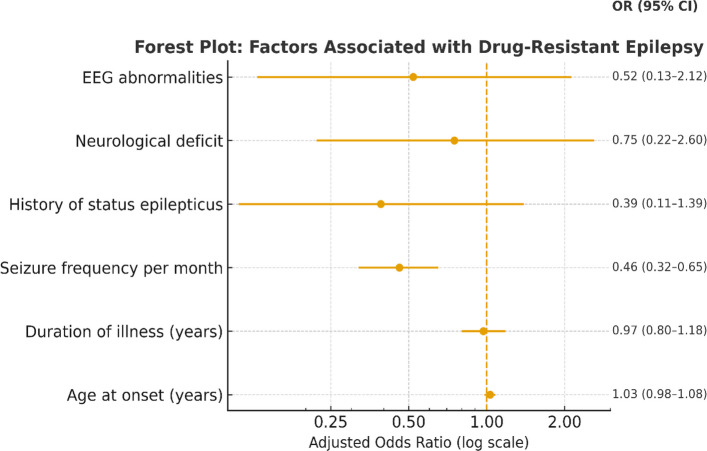 Figure 1
Peer Reviews
No public reviews on file for this paper yet. If you reviewed it on a platform where reviews are public (OpenReview, ICLR, NeurIPS, ICML), you can paste yours below so the community can read it here.
Videos
No videos yet. Explain this paper in a talk, walkthrough, or lecture? Add one.
Taxonomy
TopicsEpilepsy research and treatment · Pharmacological Effects and Toxicity Studies · Pharmacovigilance and Adverse Drug Reactions