Evolution of phenotypic plasticity owing to migration
Davorka Gulisija, Mitchell Newberry

TL;DR
The paper shows how migration between populations can maintain phenotypic plasticity even in stable environments where it's not directly beneficial.
Contribution
The study reveals that migration can sustain costly phenotypic plasticity in stable environments, even when it's not linked to the fittest genotype.
Findings
Low migration rates between populations can promote phenotypic plasticity in stable environments.
Plasticity can persist even when it's costly and not tied to the fittest genotype.
Migration enables plasticity to invade adapted populations through introduced maladapted phenotypes.
Abstract
Phenotypic plasticity enables organisms to produce better-suited phenotypes when the environment changes, improving fitness under adverse conditions. Yet responding to environmental cues may provide little use in a constant environment, where organisms already express optimal phenotypes. The forces that sustain plasticity and account for its widespread presence, thus, remain unclear, as plasticity must remain advantageous to persist. Although typically associated with changing environments, maintenance of plasticity requires generational turnover such that parents and offspring regularly encounter different conditions. Here, we demonstrate that even a low number of migrants between locally adapted populations, in constant environments, can promote the emergence and persistence of phenotypic plasticity even when plasticity is costly and never associated with the fittest genotype,…
Click any figure to enlarge with its caption.
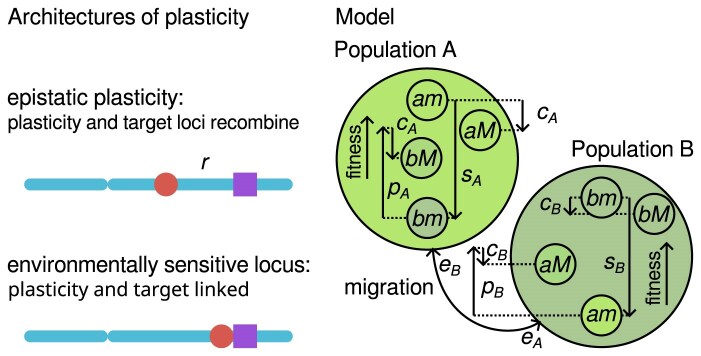 Figure 1
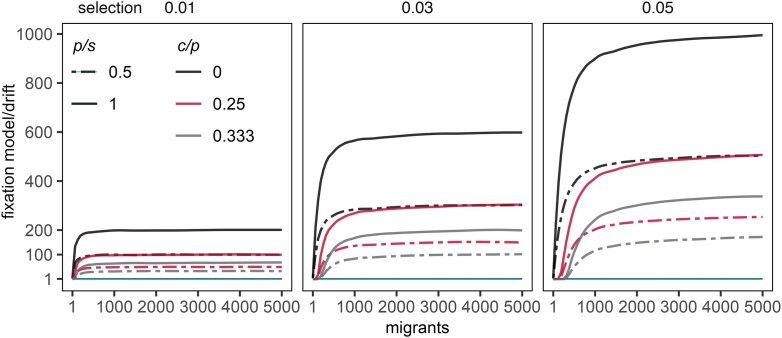 Figure 2
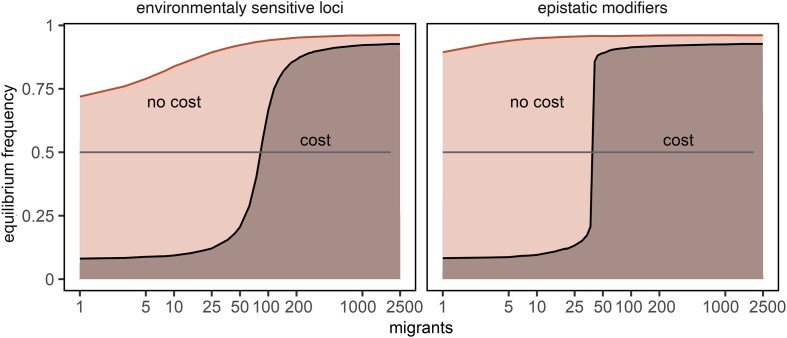 Figure 3
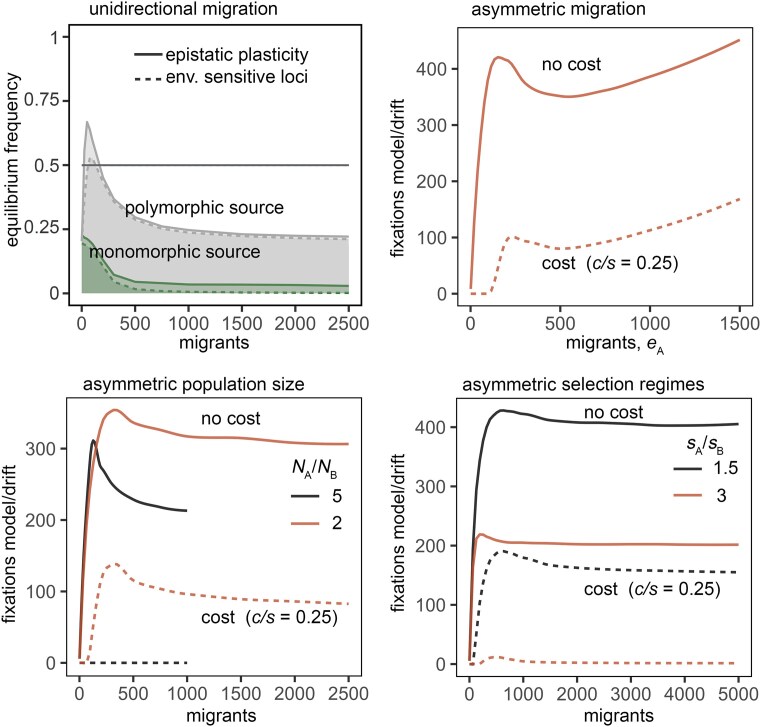 Figure 4
Peer Reviews
No public reviews on file for this paper yet. If you reviewed it on a platform where reviews are public (OpenReview, ICLR, NeurIPS, ICML), you can paste yours below so the community can read it here.
Videos
No videos yet. Explain this paper in a talk, walkthrough, or lecture? Add one.
Taxonomy
TopicsEvolution and Genetic Dynamics · Animal Behavior and Reproduction · Genetic diversity and population structure