Acidemia predicts mortality independently of lactate levels in patients after cardiac arrest
Dragos A. Duse, Andreea I. Ganea, Patrick Horn, Matthias Ortkemper, Jafer Haschemi, Philipp Deffke, Christian Jung, Malte Kelm, Ralf Erkens

TL;DR
Low blood pH after cardiac arrest predicts higher mortality, even when accounting for lactate and CO2 levels, making it a useful early marker for risk assessment.
Contribution
Acidemia is shown to independently predict mortality after cardiac arrest, beyond lactate and paCO2 levels.
Findings
Admission pH levels predicted in-hospital mortality with an area-under-curve of 0.75.
Severe acidemia (pH ≤ 7.2) was significantly associated with higher mortality independent of lactate, paCO2, and CPR characteristics.
The association between acidemia and mortality persisted in subgroup analyses and external validation.
Abstract
We examined whether post-cardiac arrest acidemia is associated with 30-day mortality and neurological outcomes among hospital survivors, independent of lactate and partial arterial carbon dioxide pressure (paCO2) levels, in patients after cardiopulmonary resuscitation (CPR). The predictive value of acidemia for in-hospital mortality was analyzed retrospectively in 742 non-traumatic cardiac arrest patients admitted to a German high-volume tertiary center using receiver operating characteristic (ROC) analysis. Patients were stratified using the ROC-derived (Youden-optimal) pH cut-off, and 30-day mortality was compared across strata. Cox regression assessed the association between severe acidemia (pH ≤ 7.2, binary) and mortality and examined its consistency across prespecified subgroups (age, sex, cardiac arrest type, lactate, and paCO2). Preliminary findings were externally validated in…
Genes, proteins, chemicals, diseases, species, mutations and cell lines named across the full text — each resolved to its canonical identifier and authoritative record.
Click any figure to enlarge with its caption.
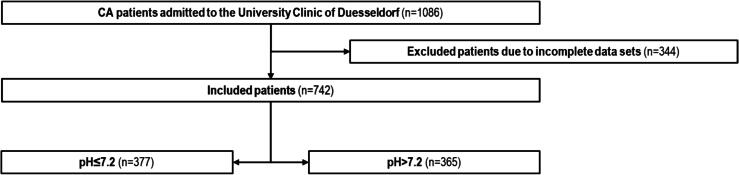 Figure 1
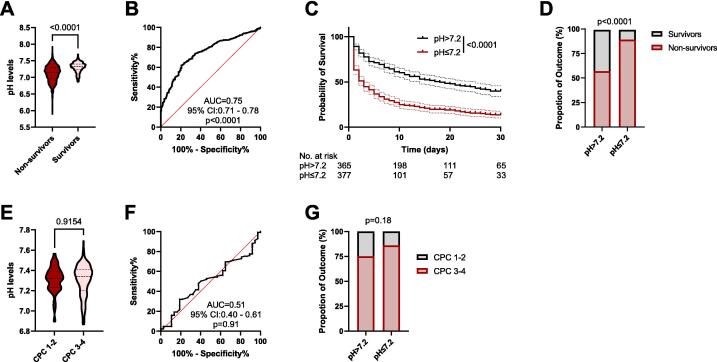 Figure 2
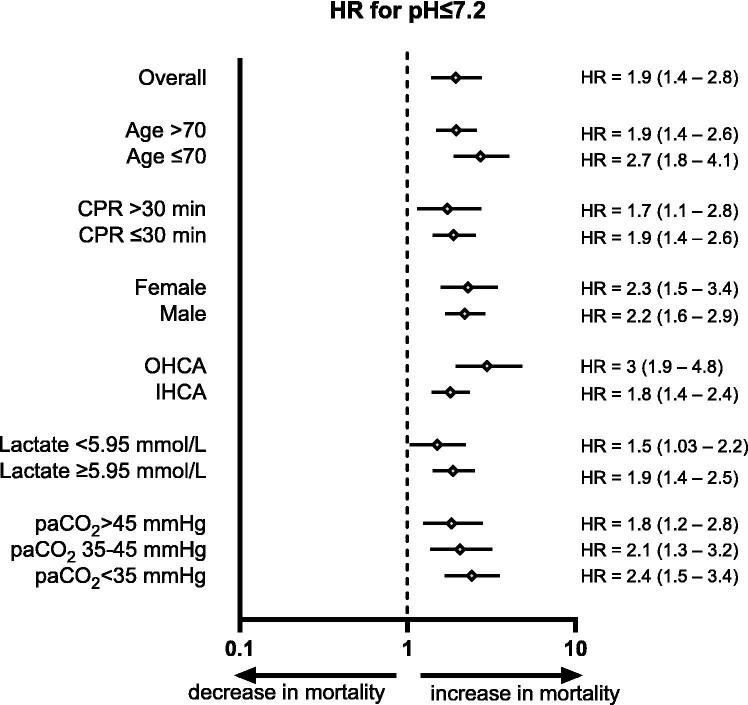 Figure 3
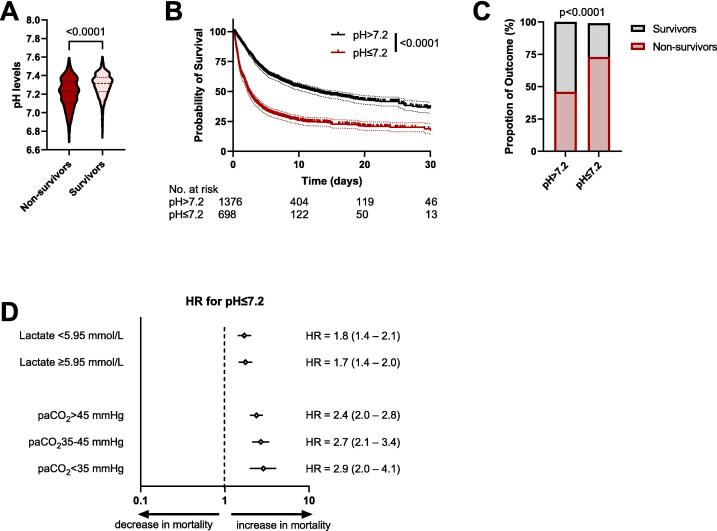 Figure 4
Peer Reviews
No public reviews on file for this paper yet. If you reviewed it on a platform where reviews are public (OpenReview, ICLR, NeurIPS, ICML), you can paste yours below so the community can read it here.
Videos
No videos yet. Explain this paper in a talk, walkthrough, or lecture? Add one.
Taxonomy
TopicsCardiac Arrest and Resuscitation · Sepsis Diagnosis and Treatment · Renal function and acid-base balance