Historical contingency limits adaptive diversification in a spatially structured environment
Gillian E Patton, John C Meraz, Michelle Yin, Sarah B Worthan, Sara Williams, Megan G Behringer

TL;DR
A first-step mutation in E. coli limits long-term adaptation in structured environments, showing how early genetic changes can restrict evolutionary paths.
Contribution
First experimental evidence that a non-essential gene mutation can create an evolutionary dead end in structured environments.
Findings
ΔfimA mutation initially benefits fitness in structured environments but later constrains adaptation.
In unstructured environments, wild-type and ΔfimA E. coli evolve similarly with parallel mutations.
Early beneficial mutations can trap populations on local fitness peaks, reducing diversification.
Abstract
Understanding how genotype-by-environment (G × E) interactions influence evolutionary trajectories and contribute to historical contingency is key to predicting adaptation. In structured environments, populations often diversify into ecotypes. This specialization depends on ecological opportunity and also hinges on the adaptive landscape, as early beneficial mutations may restrict access to new niches unless alternative trajectories or compensatory mutations arise. Previous studies demonstrated that Escherichia coli populations rapidly diversify into two coexisting ecotypes in nutrient-rich, spatially structured environments, mediated by first-step mutations that upregulate type 1 fimbriae, a pilus involved in biofilm formation that enables surface colonization. Here, we investigated how first-step mutations shape evolutionary trajectories by experimentally evolving wild-type and…
Genes, proteins, chemicals, diseases, species, mutations and cell lines named across the full text — each resolved to its canonical identifier and authoritative record.
Click any figure to enlarge with its caption.
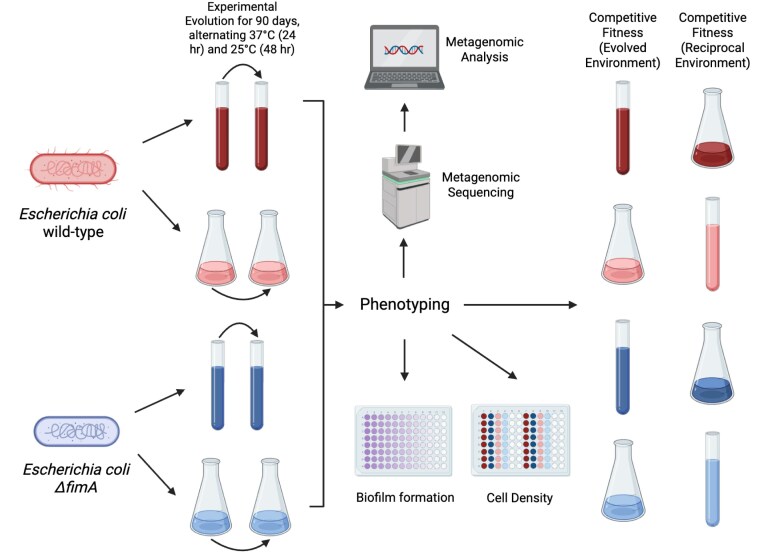 Figure 1
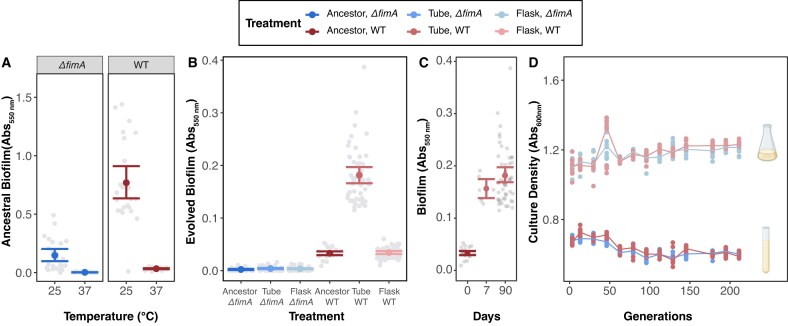 Figure 2
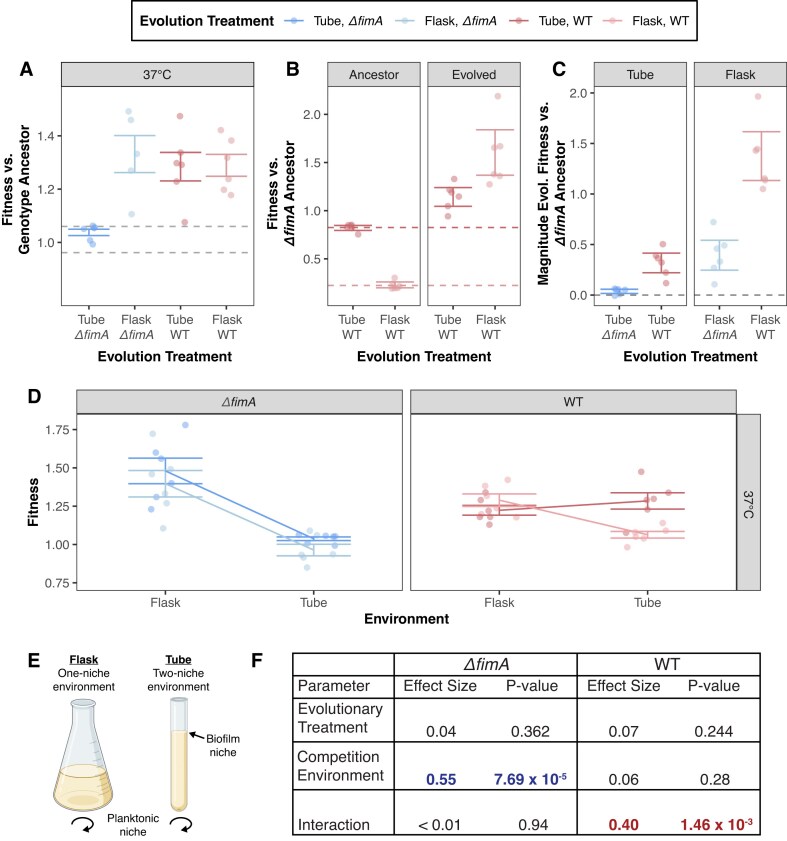 Figure 3
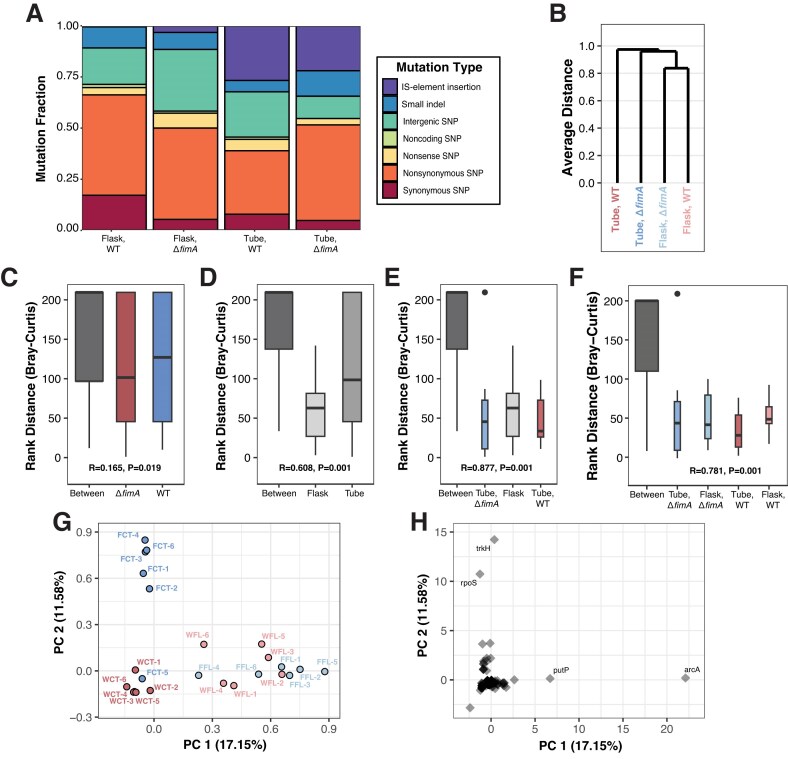 Figure 4
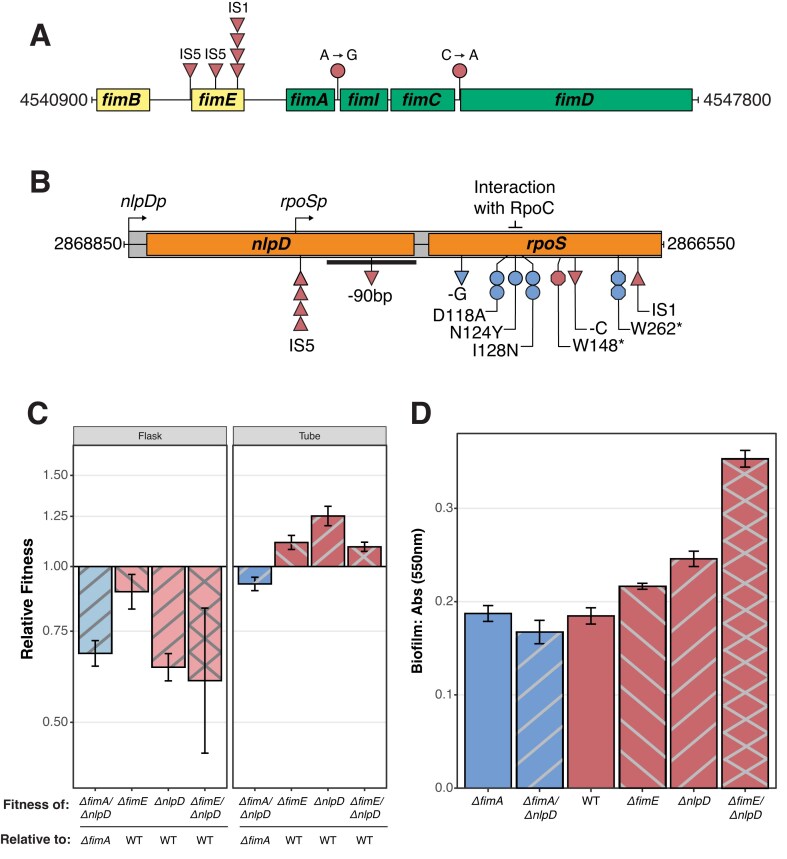 Figure 5
Peer Reviews
No public reviews on file for this paper yet. If you reviewed it on a platform where reviews are public (OpenReview, ICLR, NeurIPS, ICML), you can paste yours below so the community can read it here.
Videos
No videos yet. Explain this paper in a talk, walkthrough, or lecture? Add one.
Taxonomy
TopicsEvolution and Genetic Dynamics · Evolutionary Game Theory and Cooperation · RNA and protein synthesis mechanisms