Clostridioides difficile TcdB induces expression of its receptor (CSPG4) through a noncanonical Hippo signaling mechanism
Jason L. Larabee, Elizabeth J. Donald, Anushka A. Sukhadia, Tyler M. Shadid, Sarah J. Miller, Jimmy D. Ballard

TL;DR
This study reveals how a toxin from Clostridioides difficile increases its receptor CSPG4 by altering a signaling pathway involving Rho and Hippo kinases.
Contribution
The paper identifies a novel noncanonical Hippo signaling mechanism by which TcdB upregulates CSPG4 expression.
Findings
TcdB increases CSPG4 expression through Rho inactivation and Hippo kinase modulation.
CTCF, a DNA-binding protein, represses CSPG4, and TcdB reduces CTCF binding at the CSPG4 locus.
Inhibitors of MST1/2 and LATS1/2 block TcdB-induced CSPG4, but YAP/TAZ is not required.
Abstract
Chondroitin sulfate proteoglycan 4 (CSPG4) is a major receptor for Clostridioides difficile TcdB, but the dynamics and regulation of CSPG4 expression during C. difficile disease has not been described. Using a combination of experimental approaches, we discovered that TcdB induces CSPG4 expression through a mechanism involving small GTPase inactivation and modulation of kinases in the Hippo-signaling cascade. Treatment of HeLa cells or human pericytes with TcdB increased CSPG4 expression, and this could be mimicked by chemical inhibition of Rho. Experiments further demonstrated that TcdB-induced expression of CSPG4 is blocked by inhibitors of two core Hippo kinases (MST1/2 and LATS1/2), but the typical downstream target (YAP/TAZ) of these regulators was not required for the changes in CSPG4. Instead, data from RNA-seq and CUT&RUN experiments found CSPG4 expression was modulated by…
Genes, proteins, chemicals, diseases, species, mutations and cell lines named across the full text — each resolved to its canonical identifier and authoritative record.
Click any figure to enlarge with its caption.
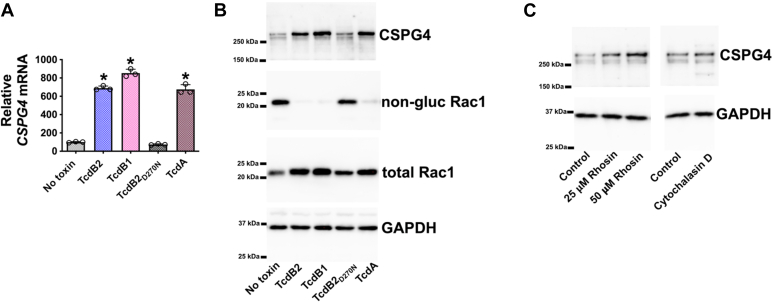 Figure 1
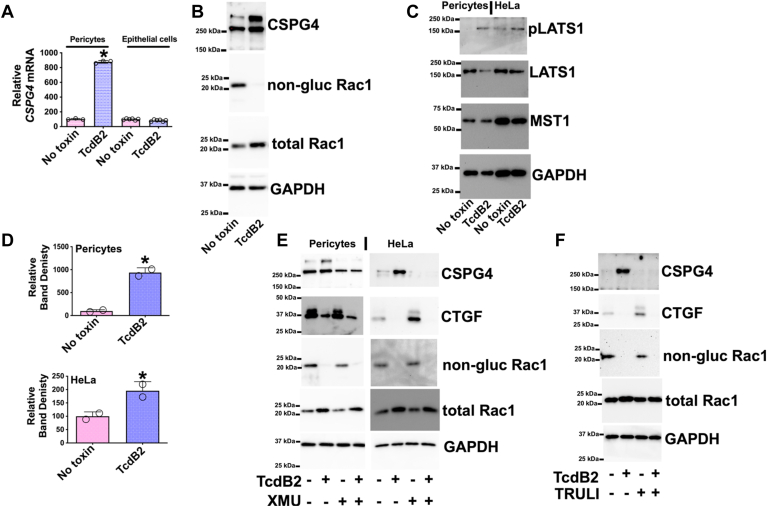 Figure 2
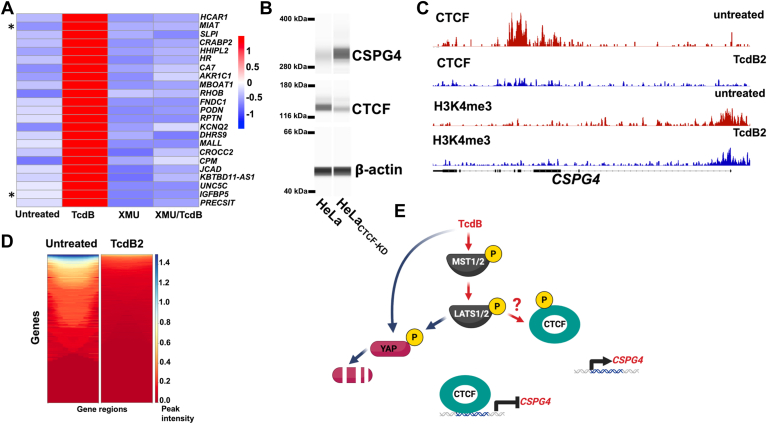 Figure 3
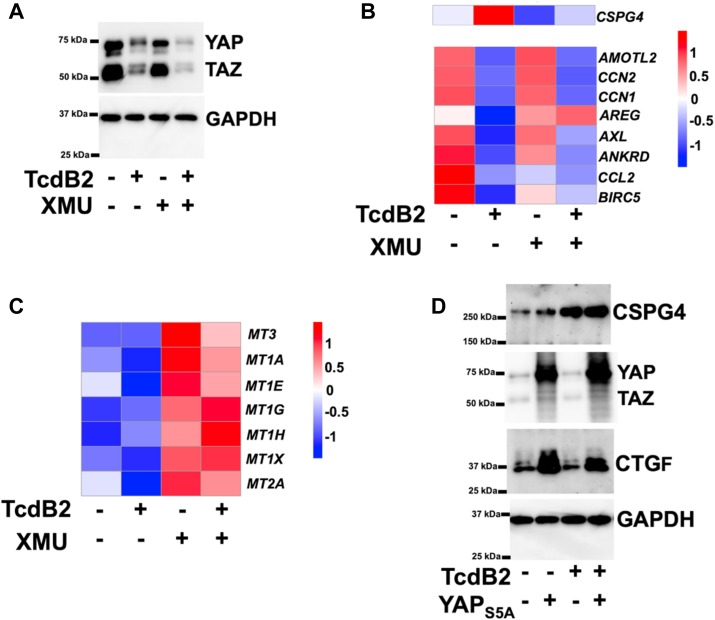 Figure 4
Peer Reviews
No public reviews on file for this paper yet. If you reviewed it on a platform where reviews are public (OpenReview, ICLR, NeurIPS, ICML), you can paste yours below so the community can read it here.
Videos
No videos yet. Explain this paper in a talk, walkthrough, or lecture? Add one.
Taxonomy
TopicsClostridium difficile and Clostridium perfringens research · Bacterial Genetics and Biotechnology · Endoplasmic Reticulum Stress and Disease