Identification and diagnostic evaluation of an aptamer targeting prostate-cancer-derived small extracellular vesicles
Ting Ding, Yue Li, Li Xue, Chaoliang Xiong, Lijuan Yu, Qian He, Jiayun Liu, Xiaoke Hao, Dan Zhao

TL;DR
This study developed a new aptamer that can detect prostate cancer by targeting specific small extracellular vesicles in urine, offering a non-invasive diagnostic tool.
Contribution
The paper introduces a novel aptamer (seq25) that specifically targets prostate cancer-derived extracellular vesicles with high affinity and diagnostic potential.
Findings
The aptamer seq25 showed strong binding affinity with a KD of 24.02 nM for prostate cancer-derived small extracellular vesicles.
Seq25 could distinguish prostate cancer-derived sEVs from normal prostate cell lines using nanoflow cytometry.
Urine samples from prostate cancer patients had significantly higher seq25-positive sEVs compared to those with benign prostatic hyperplasia.
Abstract
Prostate cancer (PCa) lacks convenient, non-invasive, and highly specific diagnostic markers. Aptamers have emerged as preferred probes for biosensors that target extracellular vesicles (EVs). This study aimed to explore the diagnostic value of PCa-specific EVs aptamer probes. We used EV-SELEX to identify aptamers that selectively target PCa small EVs (sEVs). Surface plasmon resonance (SPR) and nanoflow cytometry were used to verify aptamer affinity. The diagnostic value of PCa was evaluated using clinical samples from patients. We screened and validated an aptamer, seq25, which exhibited high specificity for PCa-derived sEVs. The SPR assay revealed a strong binding affinity, with a KD of 24.02 nM and a dose-dependent binding response. Nanoflow cytometry demonstrated that seq25 could distinguish sEVs from PCa and normal prostate cell lines. In clinical specimens, the proportion of…
Genes, proteins, chemicals, diseases, species, mutations and cell lines named across the full text — each resolved to its canonical identifier and authoritative record.
Click any figure to enlarge with its caption.
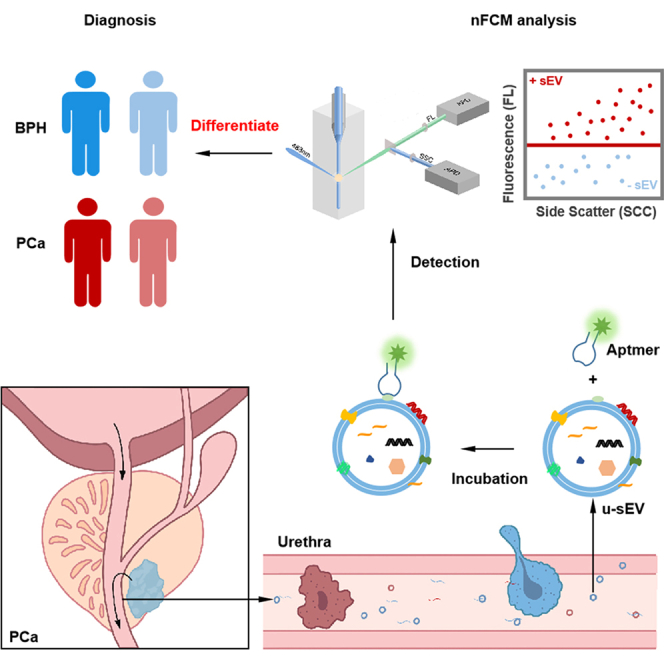 Figure 1
 Figure 2
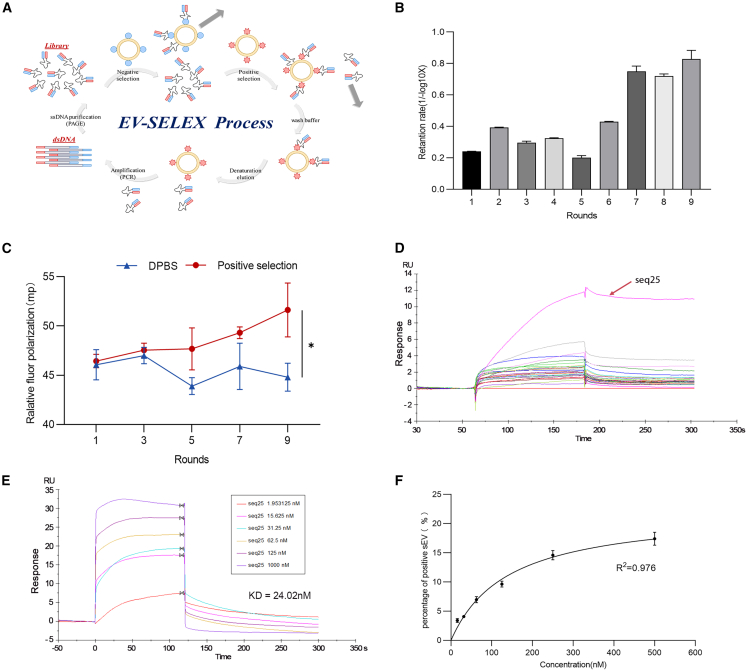 Figure 3
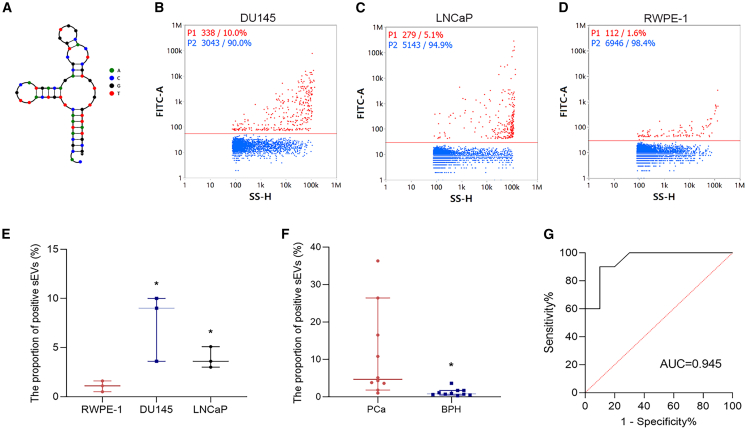 Figure 4
Peer Reviews
No public reviews on file for this paper yet. If you reviewed it on a platform where reviews are public (OpenReview, ICLR, NeurIPS, ICML), you can paste yours below so the community can read it here.
Videos
No videos yet. Explain this paper in a talk, walkthrough, or lecture? Add one.
Taxonomy
TopicsExtracellular vesicles in disease · Advanced biosensing and bioanalysis techniques · Protease and Inhibitor Mechanisms