Value of routine heart rate variability parameters for atrial fibrillation detection in ischaemic stroke and high-risk TIA patients
Kurt Moelgg, Anel Karisik, Lucie Buergi, Lukas Scherer, Luisa Delazer, Benjamin Dejakum, Silvia Felicetti, Theresa Koehler, Julian Granna, Christian Boehme, Raimund Pechlaner, Theresa Prock, Thomas Toell, Axel Bauer, Michael Schreinlechner, Daniel Pavluk, Michael Knoflach

TL;DR
Heart rate variability measures from Holter ECGs can better predict new atrial fibrillation in stroke and TIA patients than current clinical scores.
Contribution
HRV parameters PNN50, rMSSD, and SDSD significantly improve AF prediction in non-AF stroke/TIA patients.
Findings
PNN50, rMSSD, and SDSD showed better AF discrimination (AUCs 0.711–0.775) than clinical scores (AUC ≤ 0.612).
Optimal HRV cut-offs (e.g., PNN50 ≥ 5.5%) strongly associated with AF (ORs 5.34–7.70, p < 0.001).
Adding HRV parameters significantly improved AF prediction beyond existing scores.
Abstract
Undetected atrial fibrillation (AF) increases the risk of recurrent ischaemic stroke, but current prediction scores do not incorporate heart rate variability (HRV) measures readily available from 24-h Holter ECGs. In 697 patients with non-AF ischaemic stroke or non-AF high-risk transient ischaemic attack (TIA) from the STROKE-CARD Registry (NCT04582825), we assessed eight time-domain HRV parameters for predicting incident AF within 1 year. ROC analyses, logistic regression, and the Youden index were used to identify optimal cut-offs and compare HRV performance with Brown-ESUS AF and AS5F scores. New-onset AF was detected in 28 patients (4.0%). PNN50, rMSSD, and SDSD showed the best discrimination (AUC = 0.711, 0.766, and 0.775), outperforming both clinical scores (AUC ≤ 0.612). Optimal cut-offs were 5.5% (PNN50), 48.5 ms (rMSSD), and 43.5 ms (SDSD). Dichotomized analyses confirmed…
Genes, proteins, chemicals, diseases, species, mutations and cell lines named across the full text — each resolved to its canonical identifier and authoritative record.
Click any figure to enlarge with its caption.
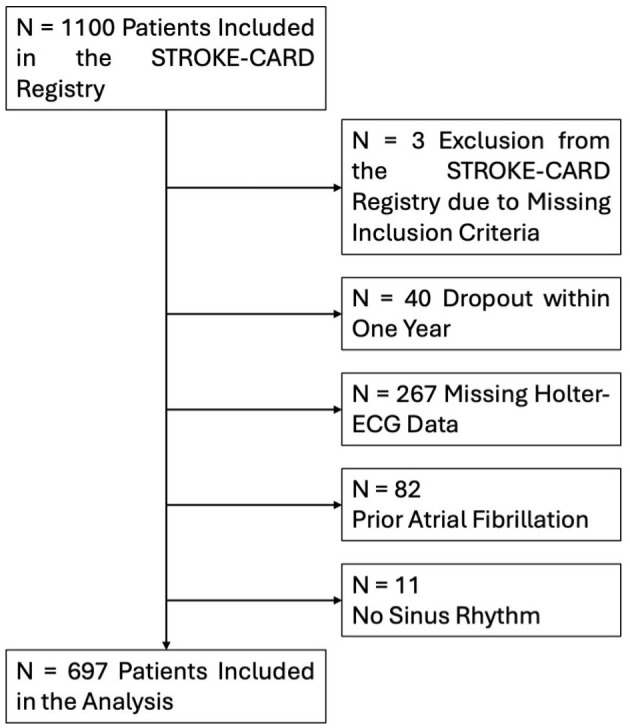 Figure 1
Peer Reviews
No public reviews on file for this paper yet. If you reviewed it on a platform where reviews are public (OpenReview, ICLR, NeurIPS, ICML), you can paste yours below so the community can read it here.
Videos
No videos yet. Explain this paper in a talk, walkthrough, or lecture? Add one.
Taxonomy
TopicsHeart Rate Variability and Autonomic Control · Atrial Fibrillation Management and Outcomes · ECG Monitoring and Analysis