Bacterial Nanocellulose Effect into Wettability and Thermal Stability of Carbon Fiber via Layer-by-Layer for LED Circuit Application
Maurelio Cabo, Nitin More, Kyle Nowlin, Ram Mohan, Dennis LaJeunesse

TL;DR
This study shows how adding bacterial nanocellulose to carbon fiber composites improves their water resistance and heat stability, making them suitable for LED circuits.
Contribution
The novel use of bacterial nanocellulose to enhance carbon fiber composites for low-voltage electronics is introduced.
Findings
BNC increased the contact angle from 79.6° to 106.46°, showing improved hydrophobicity.
Thermal stability improved with higher residual mass and final degradation temperature.
LED tests confirmed efficient current flow with minimal voltage drop in CF/BNC composites.
Abstract
This study aimed to investigate how bacterial nanocellulose (BNC) affects the wettability and thermal stability in carbon-fiber (CF) polymer composites. CF/BNC laminates were fabricated through layer-by-layer hot pressing and evaluated by using contact-angle measurements, thermogravimetric analysis, and low-voltage electrical testing. The CF/BNC interface enhanced nanoscale interlocking, increasing the contact angle from 79.6° to 106.46°. Thermal stability improved, as shown by final degradation temperature and higher residual mass, and electrical tests using a light-emitting diode (LED) confirmed efficient current flow with minimal voltage drop. The results demonstrate a pathway for multifunctional, hydrophobic, and thermally stable composites for low-voltage electronic applications.
Genes, proteins, chemicals, diseases, species, mutations and cell lines named across the full text — each resolved to its canonical identifier and authoritative record.
Click any figure to enlarge with its caption.
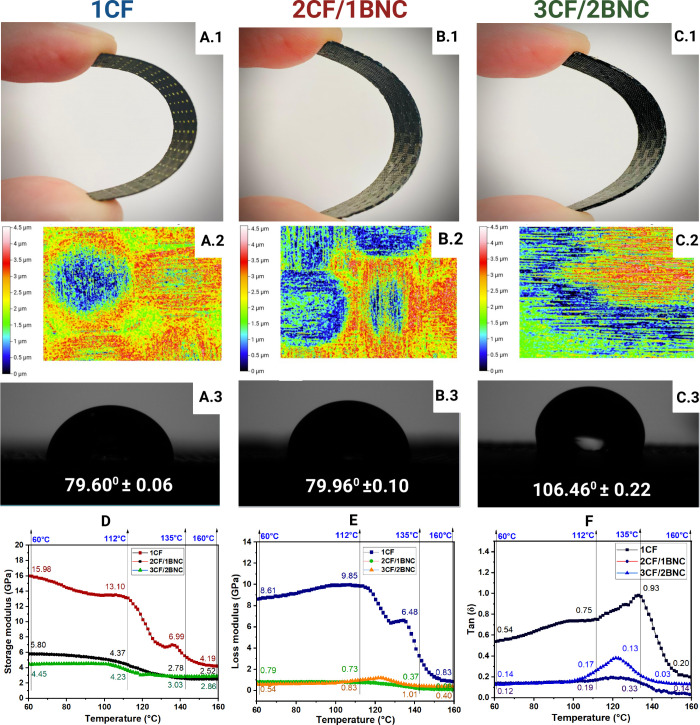 Figure 1
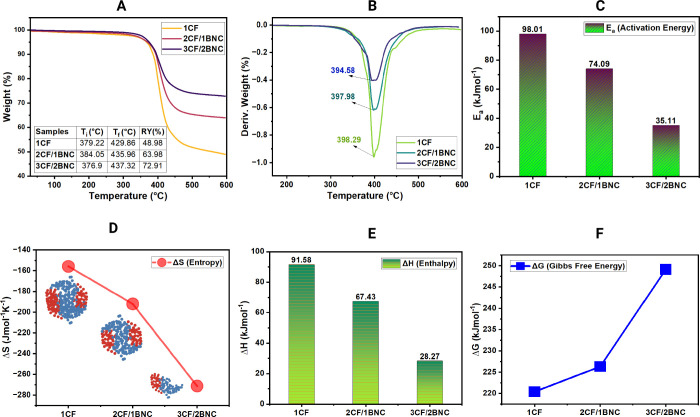 Figure 2
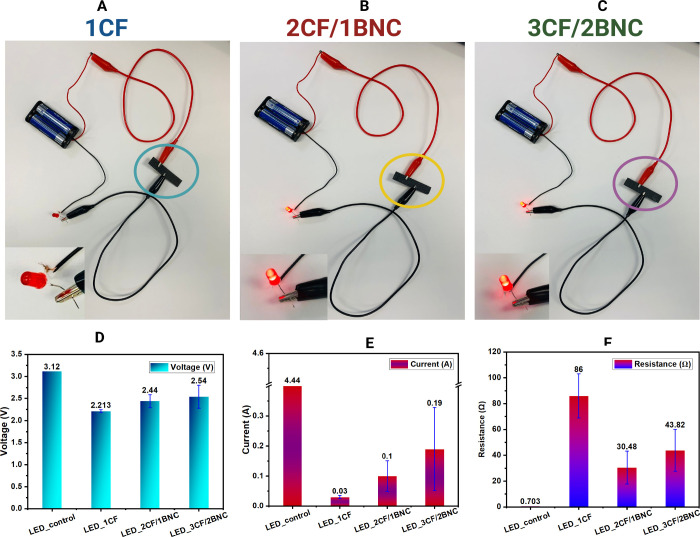 Figure 3
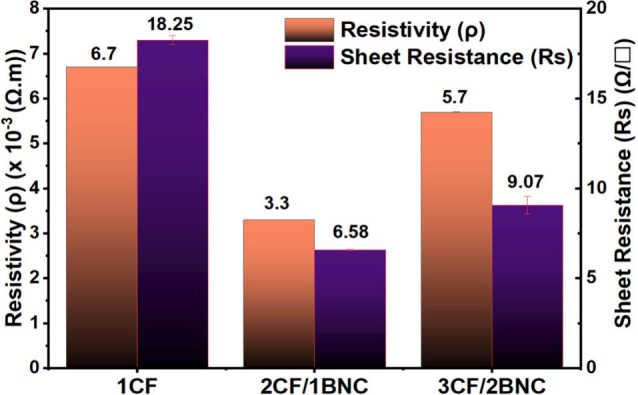 Figure 4
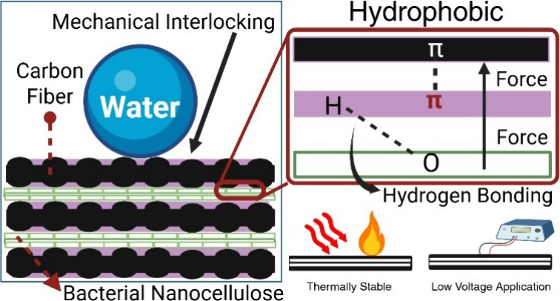 Figure 5
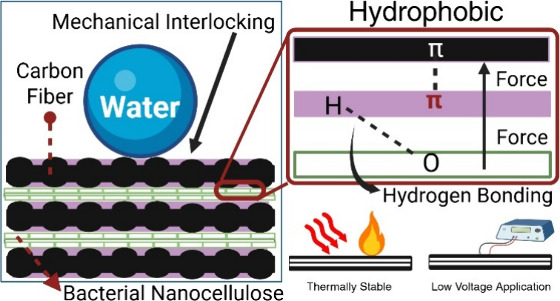 Figure 6
- —National Science Foundation10.13039/100000001
- —Joint School of Nanoscience and Nanoengineering10.13039/100017044
- —State of North Carolina10.13039/100023078
Peer Reviews
No public reviews on file for this paper yet. If you reviewed it on a platform where reviews are public (OpenReview, ICLR, NeurIPS, ICML), you can paste yours below so the community can read it here.
Videos
No videos yet. Explain this paper in a talk, walkthrough, or lecture? Add one.
Taxonomy
TopicsAdvanced Cellulose Research Studies · Fiber-reinforced polymer composites · Surface Modification and Superhydrophobicity
Carbon fiber reinforced polymers (CFRPs) are modern materials with high modulus and strength, ideal for applications requiring high strength and stiffness at a low weight. Typically used in aerospace, advanced engineering projects, cars, trains, sports equipment, ships, and wind energy over the past five decades^1.^ However, despite their impressive structural properties, carbon fibers cured with thermoset resin still open for more improvement, particularly in their surface chemistry ?,? and thermal stability in oxygen-rich atmospheres,? which can outperform its current capacities in harsh or multifunctional environments.
One of the persistent challenges with carbon fibers cured with epoxy resin is the relatively inert and hydrophilic surface, which leads to poor interfacial adhesion and weak resistance to moisture. In recent years, researchers have explored surface modification techniques, including plasma treatment,? oxidation,? and the use of functional nanofillers,? to address these limitations. Surface modification not only enhances fiber–matrix adhesion but also opens pathways for improving wettability, thermal conductivity, and chemical resistance.
Though carbon fiber is highly thermally stable in an oxygen-free environment, its composites when combined with conventional thermosetting and thermoplastic resins, such as epoxy and polypropylene, and when exposed in an oxygen-rich environment, may offer initial strength but often lack the thermal endurance required for long-term structural performance. Recent advancements have focused on hybrid reinforcement strategiescombining carbon fiber with cellulose that provides a synergistic effect in improving heat resistance and delaying decomposition onset.? Beyond technical performance, as plastic pollution and nonbiodegradable waste continue to pose severe ecological threats, there is growing pressure to develop composites that are not only high-performing but also environmentally responsible. Commercial carbon fiber composites rely on thermoplastic matrices that are difficult to recycle and contribute to long-term plastic pollution.? That is why cellulose came into the picture because replacing these polymers with bioderived, biodegradable, or recyclable alternatives has become a crucial research direction. Several recent studies incorporating cellulose focused more on bridging the gap between mechanical reinforcement and eco-compatibility in composite systems? but still leave room how biopolymer improves wettability and thermal stability without complex surface modifications in which our study has contributed. Herein, when we integrated into carbon fiber composites, BNC has the potential to enhance interfacial bonding, improve thermal stability, and control the electrical performance without further surface modification.
In this context, bacterial nanocellulose (BNC) emerges as a promising green alternative.? BNC is a highly pure, mechanically strong, and biodegradable nanomaterial synthesized by microbial fermentation.? Thus, developing CFRCs with BNC is both a technological necessity and an ecological imperative. This study aims to explore a new CF/BNC hybrid composite providing how bacterial nanocellulose (BNC) affects interfacial synergy with carbon fibers and establishes a framework for designing multifunctional, thermally stable, and hydrophobic polymer composites for next-generation low-voltage electronic applications.
Figure S1 shows that the composite samples were fabricated through a layer-by-layer approach, incorporating carbon fiber (CF) sheets and bacterial nanocellulose (BNC) while the Table S1 discloses the sample composition and curing parameters used. The three samples prepared include a single-layer carbon fiber sample (1CF), a hybrid structure with three layerstwo CF layers and one BNC layer (2CF/1BNC)and a more complex composite with five layersthree CF layers and two interleaved BNC layers (3CF/2BNC). Each sample was impregnated and cured with epoxy resin to form a consolidated composite structure. Despite the introduction of BNC layers, the flexibility of carbon fiber composites remained largely unaffected, Figure. Visual inspection of the bent samples, Figure(A.1, B.1, C.1), shows that all three samples show an apparent flexibility even when the BNC was introduced.
To better evaluate surface morphology, heat maps using KLA-Zeta analysis (Figure(A.2, B.2, C.2)) were generated. These reveal differences in surface roughness across the samples, suggesting that the curing process and the number of layers influence topographical outcomes. The increase in layers, particularly with BNC, appears to elevate the carbon fibers surface, from 1.261 up to 2.061 μm and depth from 0.94 to 1.574 μm as disclosed in Table S2. The heatmap also shows the disappearance of a more pronounced pattern which means the distance between each fiber was totally covered by succeeding layers and resins which indicates by intense blue areas.
In Figure S2(A), mass, volume, and density measurements show an increasing trend across the samples, consistent with the added layers of carbon fiber and bacterial nanocellulose (BNC). While the increase in volume and density changes is moderate, this led to our hypothesis to observe not only how the surface morphology changes but also how its surface hydrophobicity may improve. Surprisingly, in Figure(A.3, B.3, C.3), which displays contact angle measurements, the 1CF and 2CF/1BNC samples exhibit almost similar contact angles, 79.60° and 79.96°, respectively, indicating relatively hydrophilic or marginally wettable surfaces; however, 3CF/2BNC shows a markedly increased contact angle of 106.46°, clearly transitioning the material into the hydrophobic property. This significant increase implies a change in surface structure in spite of no surface modification or pretreatment before layer-by-layer fabrication.
Table S3 discloses the comparison of this result from other known carbon fiber reinforced polymers or composites. This behavior illustrates the interaction mechanisms within the layered composite suggesting hydrogen bonding between BNC and epoxy resin? and π–π stacking between CF and epoxy resin? layers contribute to mechanical interlocking and structural coherence. This layered architecture likely reduces the surface energy and modifies surface roughnesskey factors known to enhance water repellency.?
Samples evaluation of the mechanical behavior under dynamic and tensile conditions was also characterized. Herein, the Dynamic Mechanical Analysis (DMA) results in Figure(D, E, F) reveal how the addition of bacterial nanocellulose (BNC) affects viscoelastic performance across temperatures.
In FigureD, the storage modulus (G′) represents elastic stiffnessdeclines for all samples with increasing temperature, as expected. However, the 1CF initially demonstrates the highest modulus, 15.98 GPa at 60 °C, indicating strong interfacial interactions between CF and epoxy resin,? yet the 2CF/1BNC and 3CF/2BNC samples show reduced modulus values, likely due to increased structural damping? from additional BNC layers. FigureE, loss modulus (G″), and FigureF, tan δ, show lower damping behavior for BNC-containing samples, particularly for 3CF/2BNC, where the tan δ maximum peak is only 0.33 compared to 0.93 in 1CF at 135 °C which implies reduced chain mobility due to enhanced interfacial cohesion.? But its value lower than 1.0 confirmed its flexibility form.?
In support, the X-ray diffraction (XRD) patterns in Figure S2(B) show two key crystal phase peaks at 25° (002) and 44° (100). The slight decrease in crystallinity, Table S4, resulted in reduced stiffness and strength of the semicrystalline polymers but enhanced ductility due to fewer secondary intermolecular bonds and greater structural disorder.? Notably, an increase in crystallite size was observed at the 002 planes, from 0.91 in 1CF to 1.56 in 3CF/2BNC, and at the 100 planes, from 1.42 in 1CF to 2.28 in 2CF/1BNC. The functional groups and elemental composition of the samples were determined by Fourier-transform infrared spectroscopy (FTIR), Figure S2(C) and scanning electron microscopy-energy-dispersive X-ray (SEM-EDX), Figure S3, respectively. The FTIR spectra aligned with previous studies on thermosetting carbon fiber–reinforced plastic (CFRP) using epoxy resin.?
Functional groups such as N–H, CC, N–O, C–N, and C–O–C (oxirane) were attributed to the epoxy resin and curing agent, while O–H, C–H, and C–O were characteristic of carbon fibers and bacterial nanocellulose. The presence of these oxygen-rich groups, while evident in the spectra, supports the suggestion that the incorporation of bacterial nanocellulose ultimately enhanced the hydrophobicity of the composites by limiting the exposure of polar sites and water–surface interactions. While the SEM-EDX confirmed that C, O, and N were the prominent elements. This further revealed that the introduction of bacterial nanocellulose increased the proportion of O. This compositional shift is significant because, although oxygen content increased, much of it became integrated within the crystalline or cross-linked network, reducing the availability of polar groups at surface.? As a result, the material transitioned from being relatively hydrophilic to exhibiting enhanced hydrophobicity, consistent with contact angle results.
For further characterization, we are interested to know if there’s a significant effect on its thermal stability by looking at thermogravimetric analysis (TGA) curves. In FigureA, it reveals a significant improvement in residual yield (RY%) for BNC-containing samples. While the 1CF sample retains only 48.98% of its weight at 600 °C, the 2CF/1BNC and 3CF/2BNC composites achieve 63.98% and 72.91% RY, respectively. This improved stability corresponds with the morphology where BNC acts as a reinforcing barrier against thermal degradation which aligns with previous study of how thermally insulating materials based on renewable nanomaterials such as nanocellulose could reduce the energy consumption.?
The derivative weight curves, FigureB, revealed a slight downward shift in peak degradation temperatures for the BNC-enhanced samples (397.98 °C for 2CF/1BNC and 394.58 °C for 3CF/2BNC) compared to 398.29 °C for 1CF. This deviation from the usual trend is noteworthy, as these same samples demonstrated improved residual yield and a higher end set temperature,? indicating that while the onset of thermal decomposition occurred marginally earlier, the overall thermal stability and char-forming ability were enhanced. Figure(C–E) provides kinetic insights, showing a decrease in activation energy (E a), enthalpy (ΔH), and entropy (ΔS) with increasing BNC content. The reduction in E a (from 98.01 to 35.11 kJ/mol) and ΔH (from 91.58 to 28.27 kJ/mol) may initially suggest a less energy-intensive degradation process.
However, this is interpreted as a shift toward a more thermodynamically stable network, where energy barriers are lowered due to improved bonding interactions and uniform resin diffusion.? Interestingly, FigureF shows an increase in Gibbs free energy (ΔG), indicating greater thermal favorability? for the 3CF/2BNC composite. This thermodynamic behavior suggests that BNC not only stabilizes the composite structurally but also improves its resistance to thermal and environmental stresses.? Table S5 shows the full disclosure of each phase kinetics and thermodynamic parameter result, and Table S6 discloses a comparative study in terms of degradation temperature from the related studies.
In Figure to demonstrate a facile proof-of-concept application, highlighting the electrical conductivity potential of the carbon fiber–bacterial nanocellulose (CF/BNC) layered composites, we integrate these composites into a basic LED circuit powered by a battery source, the samples act as conductive bridges capable of enabling current flow to illuminate a low-voltage LED.?
In the visual setup, two out of three composites2CF/1BNC, FigureB, and 3CF/2BNC, FigureCsuccessfully complete the circuit and power the LED, confirming their ability to conduct electricity. LED in 1CF, FigureA, failed to have steady light up maybe due to insufficient and unstable current flow.? While the LED brightness varies slightly across samples, this demonstration validates the feasibility of using these composites in simple electronic or sensing applications. Quantitative measurements shown in Figure(D–F) further support this functionality. Voltage measurements, FigureD, indicate only moderate drops across the composite samples, 2.213 V for 1CF, 2.44 V for 2CF/1BNC, and 2.54 V for 3CF/2BNC, compared to the control voltage of 3.12 V.
These values suggest reasonable voltage retention, despite internal resistance. Current measurements, FigureE, reveal that the 3CF/2BNC sample allows the highest current flow, 0.19 A, among the composite samples, followed by 2CF/1BNC, 0.1 A and 1CF, 0.03 A which explains nonsteady LED lighting up. This trend correlates with the observed decrease in resistance, FigureF, where the 3CF/2BNC composite shows significantly lower resistance, 43.82 Ω than 1CF, 86 Ω, indicating better electron mobility in the layered architecture.? Additional information was also provided for the calculated resistivity (ρ) and sheet resistance (R s) as shown in Figure.
Although 1CF’s intrinsic resistivity is moderate, its thin structure results in a high effective resistance, preventing enough current from reaching the LED. In contrast, the thicker multilayer samples provide lower sheet resistance and better conductive pathways, allowing sufficient current flow to light the LED. The electrical performance showcased here suggests that the CF/BNC hybrids could serve lightweight, flexible, and low-voltage functional componentssuch as sensors, conductive coatings, or energy-harvesting layers in wearable or structural bioelectronics using functionalized BNC.?
This study presents the development of a carbon fiber–bacterial nanocellulose (CF/BNC) hybrid composite using a simple, scalable layer-by-layer hot-pressing method. Incorporating two layers of BNC between three carbon fiber sheets enhanced surface hydrophobicity and thermal stability without significantly reducing mechanical flexibility as confirmed by storage and loss modulus. A facile electrical test confirmed the composite’s conductivity, with the CF/BNC sample successfully powering a low-voltage LED. The CF/BNC hybrid composite combines thermal and surface functionality and electrical semiconductivity, making it a promising candidate for hybrid composite useful for flexible wearable materials, biosensors, and the next-generation low-voltage electronic applications.
Supplementary Material
The reference list from the paper itself. Each links out to its DOI / PubMed record.
- 1Wang H.Huo S.Chevali V.Hall W.Offringa A.Song P.Wang H.Carbon Fiber Reinforced Thermoplastics: From Materials to Manufacturing and Applications Adv. Mater.202537241870910.1002/adma.20241870940263922 PMC 12243730 · doi ↗ · pubmed ↗
- 2An J.Kim J. W.Kim D. H.Kim S. H.Shin G. J.Lee J. H.Simultaneously improving vertical thermal conductivity and oil resistance of carbon fiber reinforced composite through layer-by-layer plasma surface treatment Surf. Interfaces 20233710272310.1016/j.surfin.2023.102723 · doi ↗
- 3Kim J. H.Kwon D. J.Shin P. S.Baek Y. M.Park H. S.Lawrence De Vries K.Park J. M.New evaluation of interfacial properties and damage sensing in CFRC by VARTM using 3D ER mapping Compos B. Eng.201815517818610.1016/j.compositesb.2018.08.010 · doi ↗
- 4Raja T.Devarajan Y.Kailiappan N.Study on enhancing mechanical and thermal properties of carbon fiber reinforced epoxy composite through zinc oxide nanofiller Discov Appl. Sci.202461156610.1007/s 42452-024-06270-w · doi ↗
- 5Pitto M.Fiedler H.Kim N. K.Verbeek C. J.Allen T. D.Bickerton S.Carbon fibre surface modification by plasma for enhanced polymeric composite performance: A review Compos. - A: Appl. Sci. Manuf.202418010808710.1016/j.compositesa.2024.108087 · doi ↗
- 6Roseno S.Ammarullah M.Rohman S.Kurniawati F.Wahyudi T.Wargadipura A. H.Masmui M.Budiyanto D.Effendi M. D.Wahyudin W.Kalembang E.Hernawan H.Subari S.Habibie S.Simanjuntak T. P.Santoso H.Ahmad A.Juwono A. L.The effects of carbon fiber surface treatment by oxidation process for enhanced mechanical properties of carbon fiber/epoxy composites for biomedical application AIP Adv.202414101504410.1063/5.0183153 · doi ↗
- 7Ansari M. S.Zafar S.Pathak H.A comprehensive review of surface modification techniques for carbon fibers for enhanced performance of resulting composites Results Surf. Interfaces 20231210014110.1016/j.rsurfi.2023.100141 · doi ↗
- 8Oulanti L.Bendarma A.Rabhi L.Carbon fiber reinforced cellulose composites: a review Discov Civ Eng.20252110510.1007/s 44290-025-00260-6 · doi ↗