[Corrigendum] 3-Bromopyruvate sensitizes human breast cancer cells to TRAIL-induced apoptosis via the phosphorylated AMPK-mediated upregulation of DR5
Yuzhong Chen, Li Wei, Xiaojing Zhang, Xianfu Liu, Yansong Chen, Song Zhang, Lanzhu Zhou, Qixiang Li, Qiong Pan, Surong Zhao, Hao Liu

Abstract
Genes, proteins, chemicals, diseases, species, mutations and cell lines named across the full text — each resolved to its canonical identifier and authoritative record.
Click any figure to enlarge with its caption.
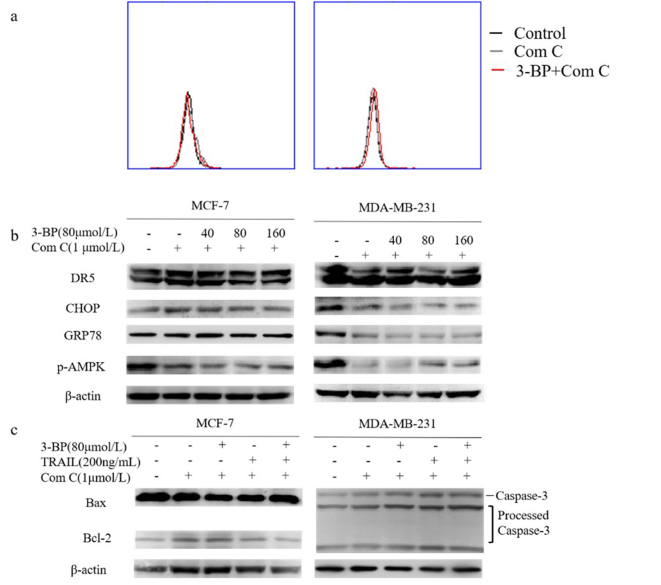 Figure 1
Peer Reviews
No public reviews on file for this paper yet. If you reviewed it on a platform where reviews are public (OpenReview, ICLR, NeurIPS, ICML), you can paste yours below so the community can read it here.
Videos
No videos yet. Explain this paper in a talk, walkthrough, or lecture? Add one.
Taxonomy
TopicsCell death mechanisms and regulation · Metabolism, Diabetes, and Cancer · Cancer, Stress, Anesthesia, and Immune Response
Oncol Rep 40: 2435-2444, 2018; DOI: 10.3892/or.2018.6644
Following the publication of the above article and a corrigendum (doi: 10.3892/or.2022.8264) that was published 3 years ago to resolve the issue of two sets of duplicated western blots in Fig. 3, an interested reader drew to the authors' attention that, in Fig. 5b on p. 2441, the western blot data bands shown to represent the GRP78 and Bcl-2 proteins in the MCF-7 group were strikingly similar; furthermore, the β-actin bands shown for the MDA-MB-231 group in Fig. 5c were strikingly similar to the β-actin bands shown in Fig. 2c on p. 2439.
After having re-examined their original data, the authors realized that the figure parts in question were inadvertently assembled erroneously. The revised version of Fig. 5, now featuring the correct data for the GRP78 western blot bands for the MCF-7 group in Fig. 5b and the β-actin bands in Fig. 5c, is shown in the next page. Note that the errors made in assembling this figure did not affect the overall conclusions reported in the paper. All the authors agree with the publication of this corrigendum, and are grateful to the Editor of Oncology Reports for granting them the opportunity to publish this; furthermore, they apologize to the readership for any inconvenience caused.