Two new mites of Armascirus Den Heyer, 1978 (Trombidiformes, Cunaxidae) from Chinese fauna

Abstract
Click any figure to enlarge with its caption.
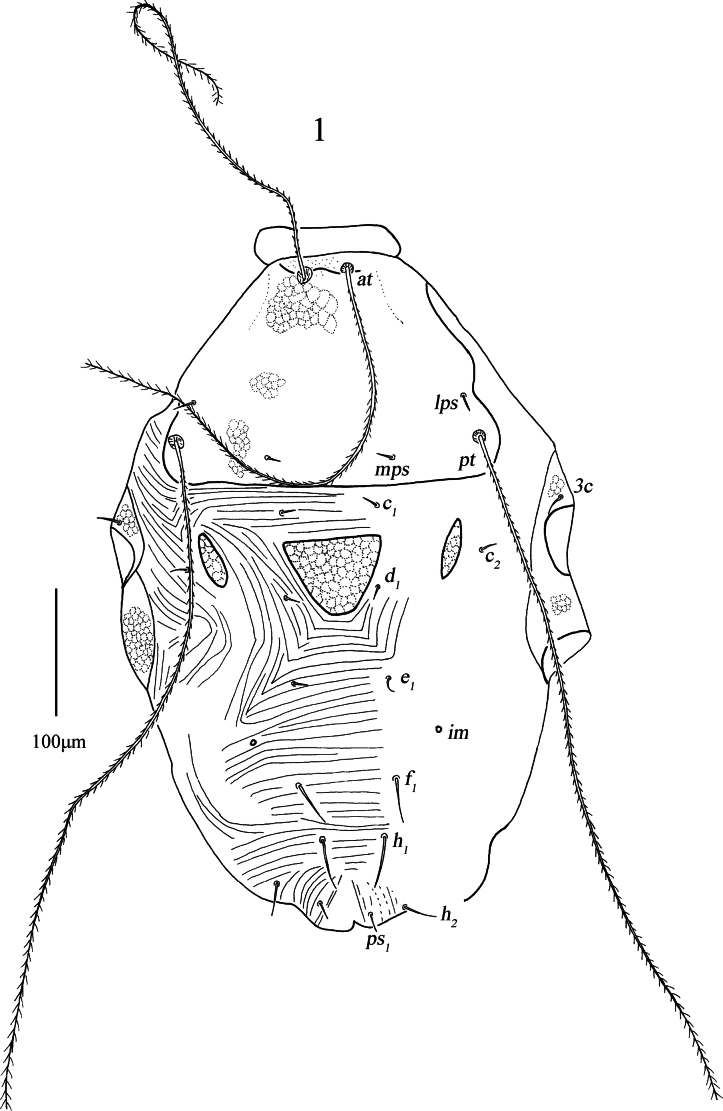 Figure 1
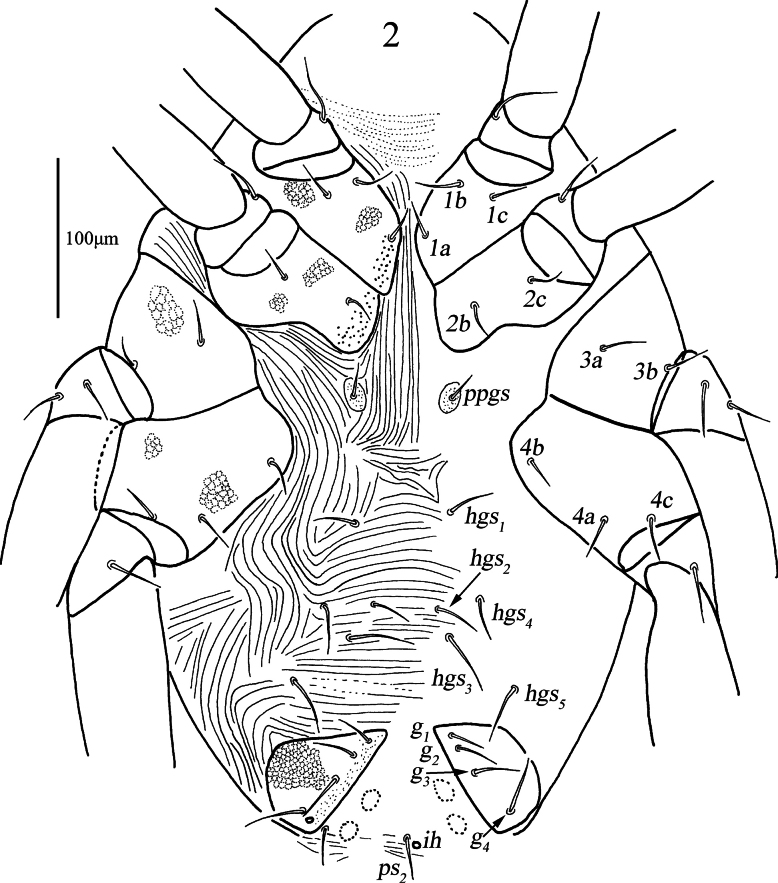 Figure 2
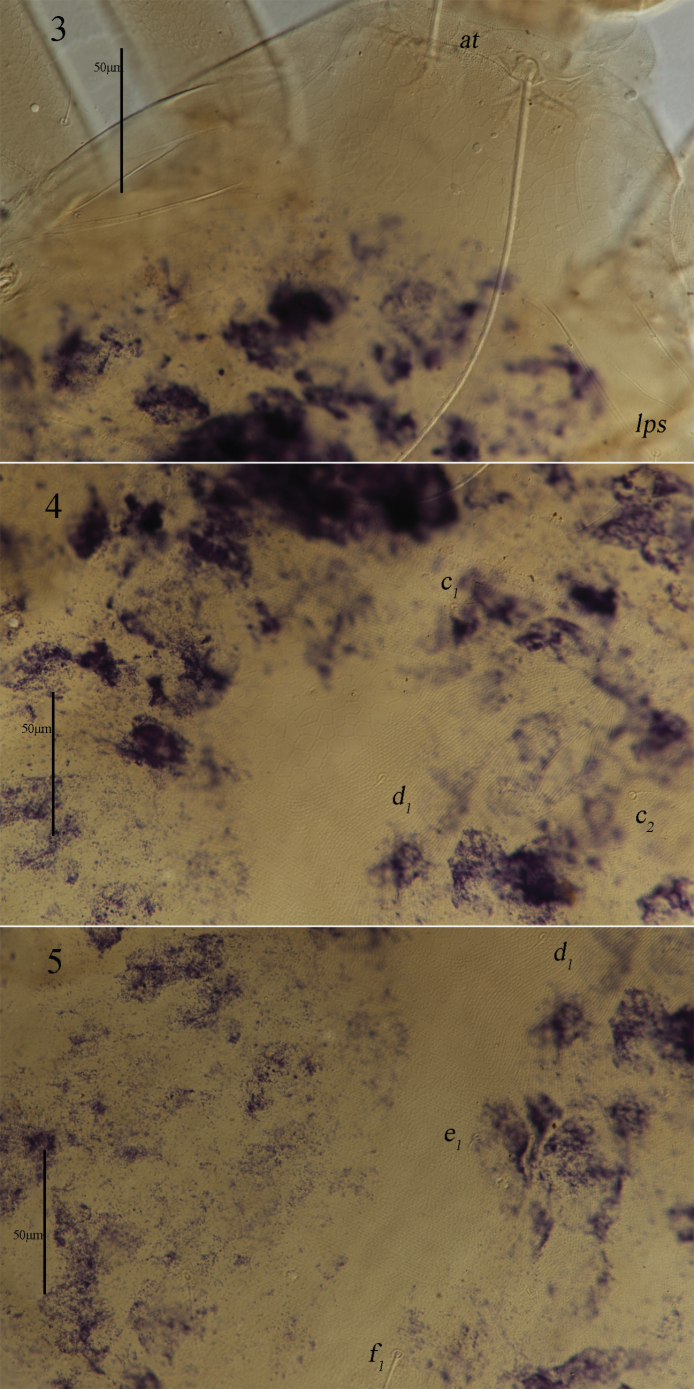 Figures 3–5
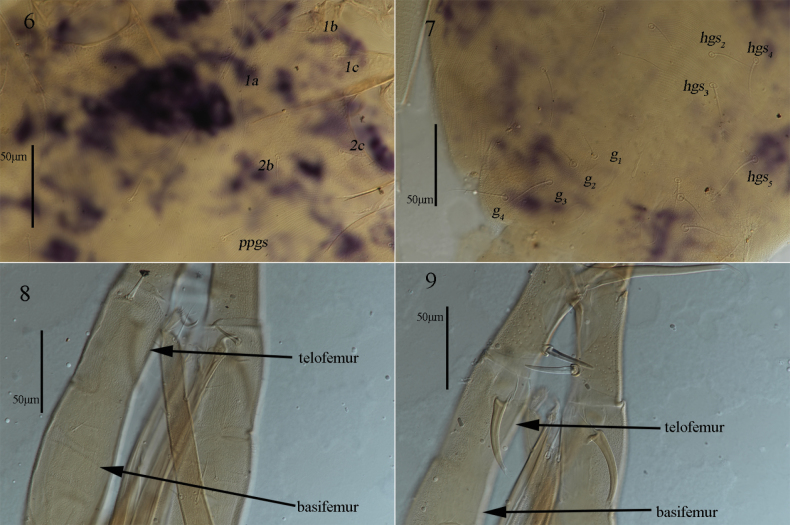 Figures 6–9
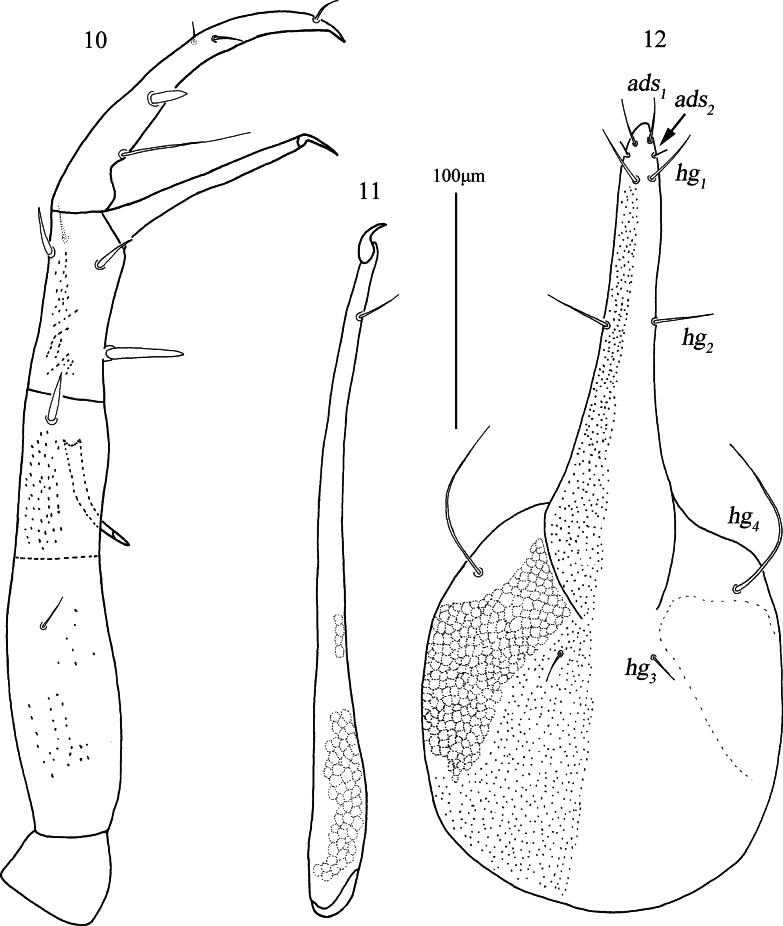 Figures 10–12
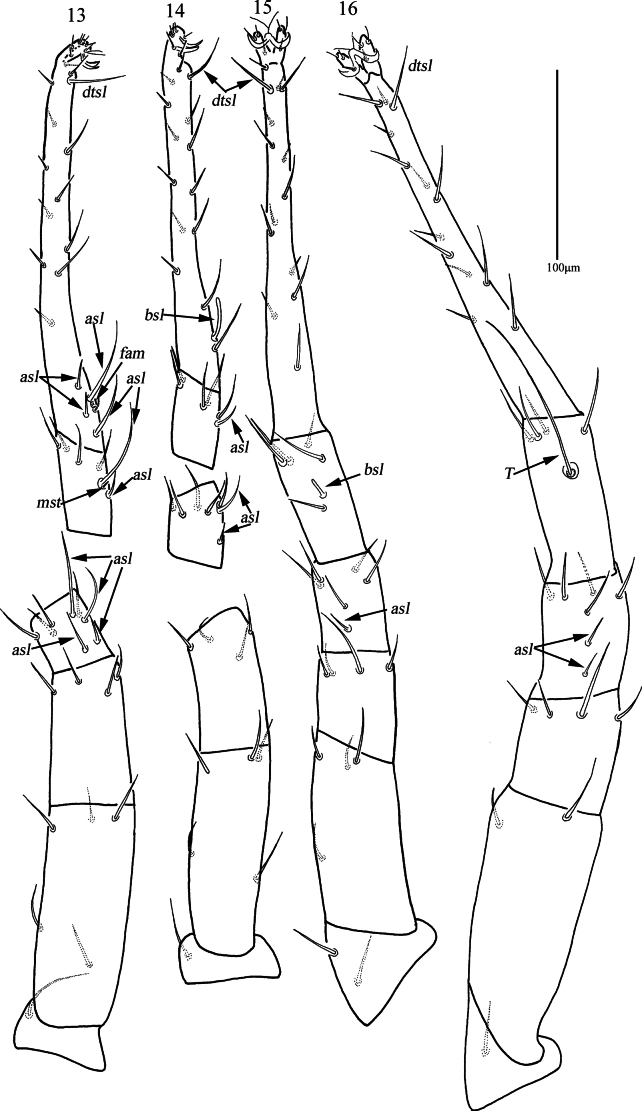 Figures 13–16
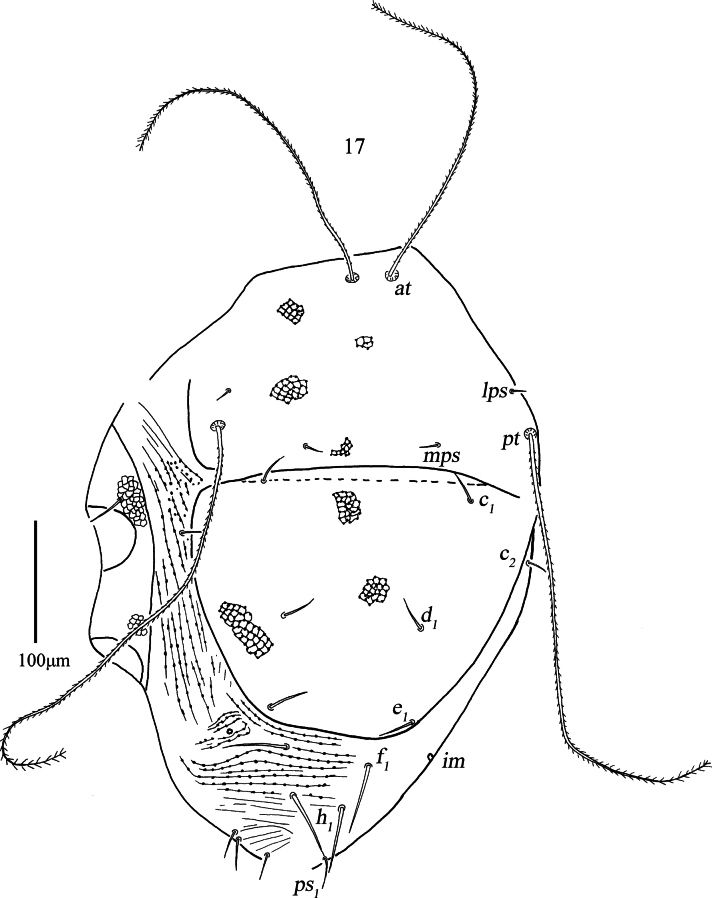 Figure 17
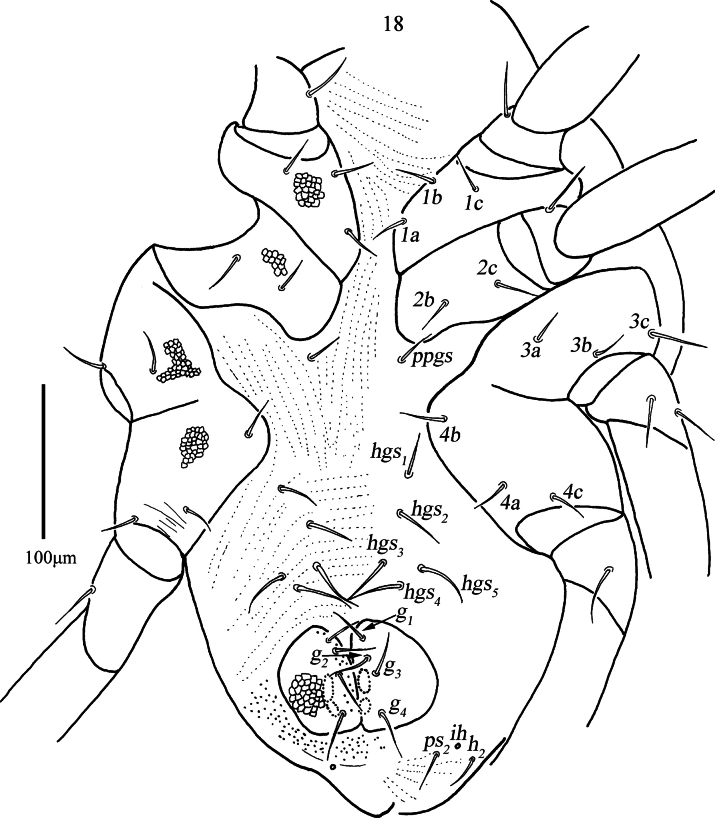 Figure 18
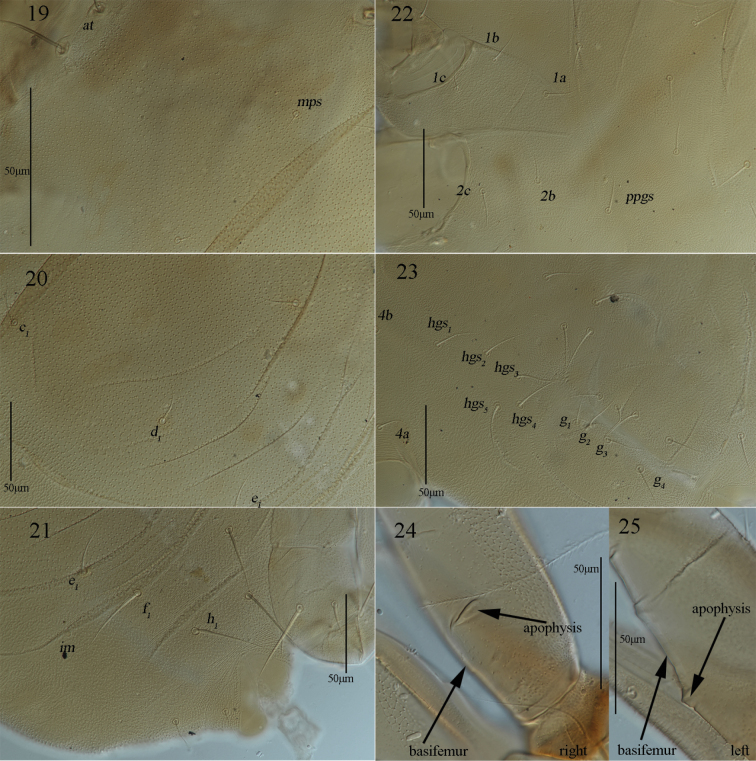 Figures 19–25
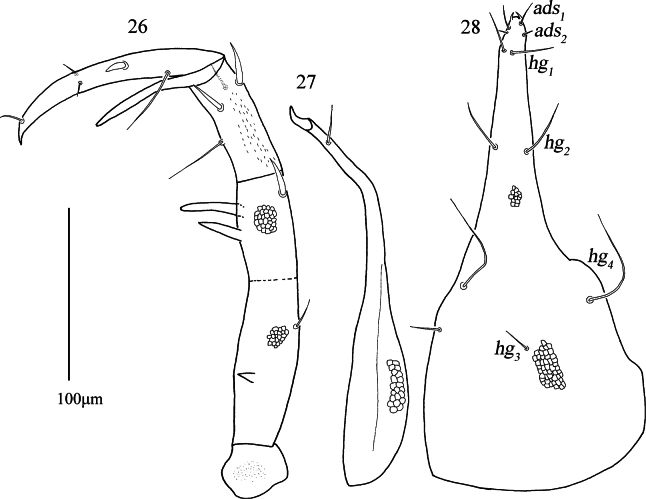 Figures 26–28
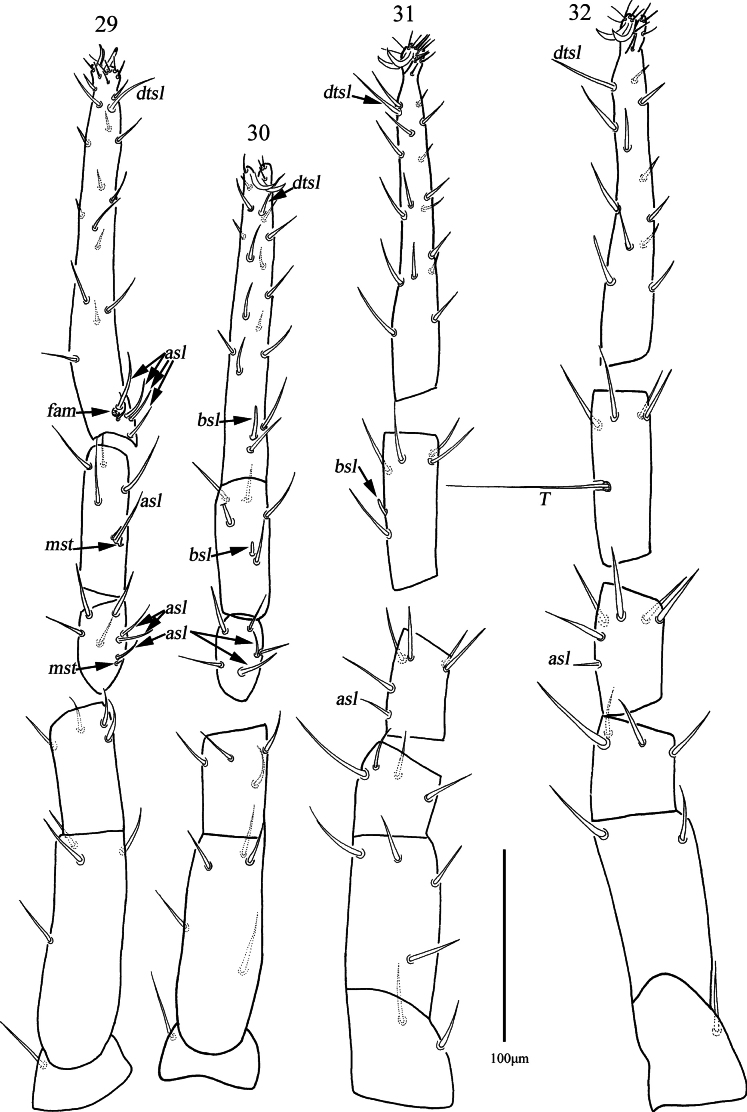 Figures 29–32
| 1 | Palp basifemur with one pointed apophysis |
|
| – | Palp basifemur without pointed apophysis |
|
| 2 | Proterosomal and median shields covered with star-shaped reticulations, median shield large and with three pairs of simple setae ( | |
| – | Proterosomal and median shields covered with general reticulations, median shield small and without setae, lateral plates present |
|
| 3 | Palp telofemur with two apophyses, five pairs of genital setae ( |
|
| – | Palp telofemur with one apophysis, four pairs of genital setae ( |
|
| 4 | Hysterosomal lateral plates absent |
|
| – | Hysterosomal lateral plates present |
|
| 5 | Lateral plates with longitudinal striae |
|
| – | Lateral plates with reticulations |
|
| 6 | Median shield with setae ( |
|
| – | Median shield without setae |
Peer Reviews
No public reviews on file for this paper yet. If you reviewed it on a platform where reviews are public (OpenReview, ICLR, NeurIPS, ICML), you can paste yours below so the community can read it here.
Videos
No videos yet. Explain this paper in a talk, walkthrough, or lecture? Add one.
Taxonomy
TopicsStudy of Mite Species · Bird parasitology and diseases · Leech Biology and Applications
Introduction
Predatory mites in the family Cunaxidae are found worldwide, except in Antarctica (Smiley 1992; Skvarla et al. 2014). These mites serve as important ecological regulators in terrestrial ecosystems by preying on nematodes, fungal spores, fungus gnats, springtails, and other small soil-inhabiting organisms (Skvarla et al. 2014; Hernandes et al. 2015).
Currently, the family Cunaxidae includes 32 genera and over 450 described species globally (Wurlitzer et al. 2022; Khaustov and Khaustov 2024; Mirza et al. 2025; Chen et al. 2025). The genus Armascirus Den Heyer, 1978 is particularly diverse, with 51 species recorded worldwide. However, in China, only five species have been recorded (A. taurus (Kramer, 1881), A. bison (Berlese, 1888), A. jini Liu, Yi & Guo, 2015, A. apophysis Chen & Jin, 2021, and A. yulongensis Chen & Jin, 2021). These species are distributed across Guizhou, Sichuan, Yunnan, Xizang (Tibet), Shanghai, Fujian, Jiangsu, Beijing, and Taiwan (Lin and Zhang 2010; Chen et al. 2021). This limited documentation suggests that many Armascirus species in China remain to be found or are undescribed, highlighting the need for further taxonomic research.
In this study, we report two new species of Armascirus from China, namely, A. kuandianensis Chen & Jin, sp. nov. and A. stellatus Chen & Jin, sp. nov. These discoveries bring number of Armascirus species in China to seven, significantly improving our understanding of cunaxid mite diversity in the Chinese fauna.
Materials and methods
Mite samples were isolated using modified Berlese-Tullgren funnels for 8–12 hours, preserved in 75% alcohol, and then mounted in Hoyer’s medium on slides (Walter and Krantz 2009). Geographic coordinates and altitudes were obtained by a smartphone with GPS. Line drawings were prepared with the aid of a drawing tube attached to a phase contrast and DIC Nikon Ni E microscope. Photographs were taken using a camera (Nikon DS-Ri 2) attached to the Nikon Ni E microscope and figures were edited with Adobe Photoshop CC 2019. The length of the gnathosoma was measured from the base to the top of the subcapitulum, the length of the idiosoma, from the suture between the gnathosoma and idiosoma to the posterior margin of the idiosoma, the width of the idiosoma at its broadest level and the length of the legs from the ventral insertion of coxae to the tip of the claw. All measurements were taken in micrometers (µm) using Nikon NIS Elements AR 4.50 software and provided for the holotype and the paratypes. The dorsal and ventral setal nomenclature follows Fisher et al. (2011), Skvarla et al. (2014), and Paktinat-Saeij et al. (2017); setal notation on legs follows Den Heyer (1981). The species were identified or compared using the keys of Kalúz (2009) and Skvarla et al. (2014). All types are deposited in the Institute of Entomology, Guizhou University, Guiyang, P.R. China (GUGC).
Abbreviations: prodorsum: anterior trichobothria (at), posterior trichobothria (pt), lateral proterosomal (lps), median proterosomal (mps); hysterosoma: internal humerals (c_1_), external humerals (c_2_), internal dorsals (d_1_), internal lumbals (e_1_), internal sacrals (f_1_), internal clunals (h_1_), external clunals (h_2_); venter: propodogastral seta (ppgs), hysterogastral seta (hgs); anal region: pseudanal (ps); genital region: genitals (g); gnathosoma: hypognathals (hg), adoral setae (ads); leg: attenuate (sharply) solenidion (asl), blunt-pointed rod-like solenidion (bsl), famulus (fam), trichobothria (T), simple tactile seta (sts), microseta (mst), dorsoterminal solenidion (dtsl).
Results
Family Cunaxidae Thor, 1902
Subfamily Cunaxinae Den Heyer, 1978
Armascirus
Taxon classificationAnimaliaTrombidiformesCunaxidae
Den Heyer, 1978
C68E7B1E-614D-5C1E-A025-BBD7F18E038F
Generic diagnosis.
Type species.
Armascirus huyssteeni Den Heyer, 1978
Armascirus
kuandianensis
Taxon classificationAnimaliaTrombidiformesCunaxidae
Chen & Jin sp. nov.
CE630FC9-E6A8-506D-9D55-6CB553864A6D
https://zoobank.org/173B7537-9907-4A4E-AD58-9D4A1F96453F
Figs 1, 2, 3, 4, 5, 6, 7, 8, 9, 10, 11, 12, 13, 14, 15, 16
Diagnosis.
Female. Proterosomal and hysterosomal (median) shield present; palp telofemur with one apophysis; subcapitulum with papillae, area lateral to hg_3_ and hg_4_ with reticulations; coxae I–IV with reticulations; propodogastral setae (ppgs) on small platelets.
Description.
Female (n = 3). Idiosoma 755 (755–760) long, 477 (477–537) wide.
Dorsum (Figs 1, 3–5). Proterosomal shield 186 (186–190) long, 219 (219–272) wide, and covered with reticulations, bearing two pairs of trichobothria (at and pt), two pairs of tactile setae (lps and mps), lps closer to pt, and pt longer than at. Hysterosomal (median) shield inverted triangle 63 (63–74) long, 84 (84–98) wide, and covered with reticulations, one pair of small lateral plates 51 (51–58) long, 13 (13–16) wide, and also covered with reticulations; except for median shield and lateral plates, hysterosomal dorsum soft and striated, area between proterosomal shield and median shield transverse striae, lateral area outside median shield with lengthwise striation, area between median shield and h_1_ with transverse striae; and with seven pairs of simple setae (c_1_, c_2_, d_1_, e_1_, f_1_, h_1_, and h_2_) and one pair of lyrifissures (im) situated anterolaterally to f_1_. Setal lengths and distances: at 405 (355–405), pt 559 (530–559), lps 18 (16–18), mps 18 (16–18), c_1_ 16 (12–16), c_2_ 14 (14–14), d_1_ 15 (14–15), e_1_ 13 (13–16), f_1_ 46 (43–46), h_1_ 50 (50–51), 32 (30–39); at–at 35 (33–35), pt–pt 239 (239–253), lps–lps 212 (212–221), mps–mps 127 (127–133), lps–mps 73 (73–80), at–lps 138 (138–138), pt–mps 72 (72–75), pt–lps 35 (34–35), at–mps 156 (150–156), at–pt 173 (170–173), c_1_–c_1_ 75 (75–96), c_2_–c_2_ 234 (234–253), d_1_–d_1_ 73 (73–108), e_1_–e_1_ 62 (62–109), f_1_–f_1_ 77 (77–103), h_1_–h_1_ 47 (47–55), c_1_–c_2_ 88 (88–144), c_1_–d_1_ 64 (64–87), c_2_–d_1_ 85 (85–150), d_1_–e_1_ 72 (72–93), e_1_–f_1_ 80 (80–111), f_1_–h_1_ 49 (49–58).
Armascirus kuandianensis Chen & Jin, sp. nov., female holotype: dorsal idiosoma.
Venter (Figs 2, 6–7). Ventral area between coxae I and gnathosoma with transverse striae. Coxae I–II with reticulations and papillae, whereas coxae III–IV only with reticulations; centrally, between coxae I–IV plates with longitudinal striae anterior to hgs_1_; areas between hgs_1_ and genital plates with transverse striae and outside with lengthwise striation. Setal formula of coxal plates I–IV: 3(1a–c)-2(2b–c)-3(3a–c)-3(4a–c) sts; one pair of propodogastral setae (ppgs) 23 (23–25) in length and present on small platelets that with dot-like papillae, five pairs of hysterogastral setae (hgs_1_–hgs_5_), 33 (31–33), 35 (33–35), 53 (43–53), 36 (36–50) and 51 (48–51) in length, respectively. Genital plates with papillae and reticulations, two pairs of visible genital papillae and four pairs of genital setae (g_1_–g_4_) that 32 (32–33), 36 (36–36), 40 (38–40) and 42 (39–42) in length, respectively. Anal region with two pairs of pseudanal setae (ps_1_–ps_2_), 21 (14–21) and 32 (28–32) in length, respectively, and one pair of lyrifissures (ih) close to ps_2_.
Armascirus kuandianensis Chen & Jin, sp. nov., female holotype: ventral idiosoma.
Armascirus kuandianensis Chen & Jin, sp. nov., female holotype: dorsal idiosoma.
Armascirus kuandianensis Chen & Jin, sp. nov., female holotype. 6, 7. Ventral idiosoma; 8, 9. Palp.
Gnathosoma (Figs 8, 9, 10). Palp (Figs 8, 9, 10). Five-segmented, 436 (425–436) long, all segments with papillae. Palp chaetotaxy: trochanter none; basifemur with one simple seta; telofemur with one spine-like seta and one apophysis; genu with one simple seta, three spine-like setae (one of which is stout near inner base) and one elongate pointed apophysis; tibiotarsus one spine-like seta, three simple setae (one longer near inner base) and one distal solenidion; claw well developed. Chelicera (Fig. 11). 282 (282–282) long, covered by reticulations; cheliceral seta 21 (21–24) in length; chela developed. Subcapitulum (Fig. 12). 322 (322–324) long, 158 (141–158) wide and with papillae, area lateral to hg_3_ and hg_4_ with reticulations; two pairs of short adoral setae, ads_1_–ads_2_, 20 (20–23) and 6 (6–9) in length; four pairs of hypostomal setae, hg_1_–hg_4_, 31 (31–31), 38 (38–40), 15 (15–18) and 89 (88–89) in length, respectively. Distances of hg setae: hg_1_–hg_1_ 8 (7–8), hg_2_–hg_2_ 19 (19–20), hg_3_–hg_3_ 38 (38–39), hg_4_–hg_4_ 109 (105–117), hg_1_–hg_2_ 62 (62–76), hg_2_–hg_3_ 153 (153–168), hg_3_–hg_4_ 51 (48–51).
Armascirus kuandianensis Chen & Jin, sp. nov., female holotype. 10. Palp; 11. Chelicerae; 12. Subcapitulum.
Legs (Figs 13–16). With reticulations, lengths of leg I–IV: 474 (474–507), 404 (404–466), 509 (509–524), 559 (541–559); lengths of tarsus I–IV: 192 (179–195), 172 (167–180), 207 (194–207), 206 (197–210). T on tibia IV 111 (110–112) in length. Legs I–IV chaetotaxy: coxae I–IV 3-2-3-3 sts; trochanters I–IV 1-1-2-1 sts; basifemora I–IV 5-5-4-2 sts; telofemora I–IV 4-4-4-4 sts. Genu I 4 asl, 4 sts; genu II 2 asl, 5 sts; genu III 1 asl, 5 sts; genu IV 2 asl, 5 sts. Tibia I 1 asl, {1 asl, 1 mst}, 4 sts; tibia II 1 asl, 5 sts; tibia III 1 bsl, 5 sts; tibia IV 1 smooth T, 4 sts. Tarsus I 4 asl, 1 fam, 1 dtsl, 20 sts; tarsus II 1 bsl, 1 dtsl, 19 sts; tarsus III 1 dtsl, 19 sts; tarsus IV 1 dtsl, 18 sts.
Armascirus kuandianensis Chen & Jin, sp. nov., female holotype: leg I–IV.
Other developmental stages.
Unknown.
Etymology.
The name of this new species is derived from the name of the county in which the type locality is located: Kuandian County.
Remarks.
The new species resembles A. cerris Kalúz, 2009 (adult female) with having hysterosomal median shield and one pair of small lateral platelets, and palp telofemur only with one apophysis. However, it can be distinguished from A. cerris by the following characteristics: (1) two pairs of genital papillae (vs three in A. cerris); (2) coxae I–II with reticulations and papillae, coxae III–IV only with reticulations (vs coxae I–II and III–IV contiguous and smooth in A. cerris); (3) one pair of propodogastral setae (ppgs) present on small platelets (vs integument in A. cerris).
Material examined.
Holotype: China • 1 ♀ (slide no. LN-CU-2010080101) Hekou Village, Changtian Town, Kuandian County, Dandong City, Liaoning Province; 40°29'6"N, 124°48'49" E; 102 m a.s.l.; 1 August. 2010; collected from fallen leaves by Li-Xia Xie, Da-Xing Yang, Rong Huang and Bin Li. Paratypes: China • 2 ♀ (LN-CU-2010080102–LN-CU-2010080103), the same data as for holotype.
Distribution.
Known only from the type locality.
Armascirus
stellatus
Taxon classificationAnimaliaTrombidiformesCunaxidae
Chen & Jin sp. nov.
4742E23F-C945-5F1D-8491-549E1FD95CC7
https://zoobank.org/F18C27A2-982C-49F9-92B1-F8D590CDBF6C
Figs 17, 18, 19, 20, 21, 22, 23, 24, 25, 26, 27, 28, 29, 30, 31, 32
Diagnosis.
Female. Proterosomal and median shields are covered with star-shaped reticulations, which are composed of papillae and reticulations, resembling stars connecting tracks (Figs 19, 21–23). The median shield large and with three pairs of simple setae (c_1_, d_1_, and e_1_), with no lateral plates present; palp basifemur with one short pointed apophysis, telofemur two elongate apophyses.
Description.
Female (n = 4). Idiosoma long 507 (507–600), wide 374 (374–441).
Dorsum (Figs 17, 19–21). Proterosomal shield 166 (157–166) long, 275 (213–275) wide, and covered with star-shaped reticulations, which consists of papillae (4–7, with 5 or 6 most common) and reticulation, resembling stars connecting tracks (Figs 19, 21, 22). It bears two pairs of trichobothria (at and pt), two pairs of tactile setae (lps and mps), lps closer to pt than at, pt longer than at. Hysterosomal (median) shield 223 (173–223) long, 266 (213–266) wide, and covered with star-shaped reticulations and with three pairs of simple setae (c_1_, d_1_, e_1_); median shield laterally flanked by longitudinal striae with papillae, area between median shield and h_1_ with transverse striae with papillae. Setae f_1_, h_1_, and one pair of lyrifissures (im) situated on integument. Setal lengths and distances: at 293 (291–300), pt 393 (393–452), lps 18 (14–18), mps 20 (12–20), c_1_ 32 (28–32), c_2_ 20 (20–22), d_1_ 34 (27–34), e_1_ 43 (37–43), f_1_ 62 (54–62), h_1_ 68 (56–68); at–at 32 (32–37), pt–pt 256 (245–256), lps–lps 231 (219–231), mps–mps 107 (100–107), lps–mps 76 (76–77), at–lps 133 (122–133), pt–mps 68 (71–68), pt–lps 31 (31–36), at–mps 139 (133–139), at–pt 158 (156–158), c_1_–c_1_ 171 (140–171), c_2_–c_2_ 276 (267–276), d_1_–d_1_ 110 (99–110), e_1_–e_1_ 109 (98–109), f_1_–f_1_ 70 (63–70), h_1_–h_1_ 42 (42–44), c_1_–c_2_ 80 (78–80), c_1_–d_1_ 110 (99–110), c_2_–d_1_ 106 (100–106), d_1_–e_1_ 76 (68–76), e_1_–f_1_ 35 (35–52), f_1_–h_1_ 41 (38–41).
Armascirus stellatus Chen & Jin, sp. nov., female holotype: dorsal idiosoma.
Armascirus stellatus Chen & Jin, sp. nov., female holotype: dorsal idiosoma.
Armascirus stellatus Chen & Jin, sp. nov., female holotype. 19–21. Dorsal idiosoma; 22, 23. Ventral idiosoma; 24, 25. Palp.
Venter (Figs 18, 22, 23). Coxae I–IV with reticulations, area between coxae I–II plate groups with longitudinal striae; area between ppgs and hgs_1_ with longitudinal striae; areas between hgs_1_ and genital plates with transverse striae. Setal formula of coxal plates I–IV: 3(1a–c)-2(2a, 2c)-3(3a–c)-3(4a–c) sts; one pair of propodogastral setae (ppgs), 28 (28–35) in length, and five pairs of hysterogastral setae (hgs_1_–hgs_5_), 32 (32–39), 37 (37–42), 41 (41–43), 43 (43–44) and 44 (44–46) in length. Genital plates with reticulations and papillae, two pairs of visible genital papillae and four pairs of genital setae (g_1_–g_4_) that 30 (27–30), 36 (34–36), 31 (31–32) and 34 (34–36) in length, respectively. Anal region with longitudinal striae, two pairs of pseudanal setae (ps_1_–ps_2_), 28 (22–28) and 30 (24–30) in length, and one pair of lyrifissures (ih).
Gnathosoma (Figs 24, 25, 26, 27, 28). Palp (Figs 24, 25, 26). Five-segmented, 399 (370–399) long, basifemur and telofemur with reticulations. Palp chaetotaxy: trochanter none; basifemur one dorsal simple seta and one short pointed apophysis; telofemur one dorsal spine-like seta, one pointed apophysis and one blunt apophysis; genu two spine-like setae, two simple setae and one elongate pointed apophysis; tibiotarsus three simple setae, one of which is longer near the inner base, one spine-like seta and one distal solenidion; claw well developed. Chelicera (Fig. 27). 265 (254–265) long, with reticulations and papillae; cheliceral seta 23 (22–25) in length; chela developed. Subcapitulum (Fig. 28) 303 (303–312) long, 143 (143–156) wide, with reticulations; two pairs of short adoral setae, ads_1_–ads_2_, 20 (20–20) and 8 (5–8) in length; four pairs of hypostome setae, hg_1_–hg_4_, 31 (30–31), 48 (40–48), 17 (17–20) and 83 (83–84) in length, respectively. Distances of hg setae: hg_1_–hg_1_ 6 (6–7), hg_2_–hg_2_ 22 (22–25), hg_3_–hg_3_ 57 (50–57), hg_4_–hg_4_ 83 (83–113), hg_1_–hg_2_ 60 (60–62), hg_2_–hg_3_ 112 (103–112), hg_3_–hg_4_ 50 (43–50).
Armascirus stellatus Chen & Jin, sp. nov., female holotype. 26. Palp; 27. Chelicerae; 28. Subcapitulum.
Legs (Figs 29–32). With reticulations, lengths of leg I–IV: 515 (503–515), 450 (450–480), 507 (490–507), 521 (521–525); lengths of tarsus I–IV: 187 (184–187), 156 (156–163), 178 (165–178), 173 (173–175). T on tibia IV 93 (88–93) in length. Legs I–IV chaetotaxy: Coxae I–IV 3-2-3-3 sts; trochanters I–IV 1-1-2-1 sts; basifemora I–IV 4-5-4-2 sts; telofemora I–IV 4-4-4-4 sts. Genu I 2 asl, {1 asl, 1 mst}, 4 sts; genu II 2 asl, 4 sts; genu III 1 asl, 5 sts; genu IV 1 asl, 5 sts. Tibia I {1 asl, 1 mst}, 4 sts; tibia II 1 asl, 5 sts; tibia III 1 bsl, 5 sts; tibia IV 1 smooth T, 4 sts. Tarsus I 4 asl, 1 fam, 1 dtsl, 23 sts; tarsus II 1 bsl, 1 dtsl, 19 sts; tarsus III 1 dtsl, 26 sts; tarsus IV 1 dtsl, 19 sts.
Armascirus stellatus Chen & Jin, sp. nov., female holotype: leg I–IV.
Other developmental stages.
Unknown.
Etymology.
The name of this new species, stellatus, is derived from the star-shaped reticulations covering its dorsal shields.
Remarks.
The new species is similar to A. apophysis Chen & Jin, 2021 in having one pointed apophysis on palp basifemur. However, it can be distinguished from A. apophysis by the following characteristics: (1) dorsal shields covered with star-shaped reticulations, which are composed of papillae and reticulations (vs general reticulations in A. apophysis); (2) median shield large and with three pairs of simple setae (c_1_, d_1_, e_1_) (vs small and without in A. apophysis); (3) hysterosoma lateral plates absent (vs present in A. apophysis); (4) subcapitulum with reticulations (vs without in A. apophysis).
The new species is similar to A. anastosi Smiley, 1992 in having two apophysis on palp telofemur. Nevertheless, it differs from A. anastosi in the following characteristics: (1) dorsal shields covered with star-shaped reticulations, which are composed of papillae and reticulations (vs general reticulations in A. anastosi); (2) median shield with three pairs of simple setae (c_1_, d_1_, e_1_) (vs two (c_1_, d_1_) in A. anastosi); (3) hysterosoma lateral plates absent (vs present in A. anastosi); (4) palp basifemur with one pointed apophysis (vs without in A. anastosi).
Material examined.
Holotype: China • 1 ♀ (slide no. QH-CU-2020071901), Sanjiangyuan National Nature Reserve, Qinghai Province; 35°13'17"N, 107°57'10"E; 3027 m a.s.l.; 19 July 2020; collected from moss by Dong-Dong Li and Hai-Tao Li. Paratypes: China • 1 ♀ (QH-CU-2019072001), Qingyanggou Section, Qilian Mountain Nature Reserve, Qinghai Province; 38°9'53"N, 100°26'10"E; 3162 m a.s.l.; 20 July 2019; collected from ground moss by Qian-Fen Zheng • 2 ♀ (XJ-CU-201907060601–XJ-CU-201907060602), Kanas National Nature Reserve, Buerjin County, Xinjiang Uygur Autonomous Region; 48°30'40"N, 87°10'16"E; 1330 m a.s.l.; 6 July. 2019; collected from moss by Jian-Xin Chen.
Distribution.
China (Qinghai Province and Xinjiang Uygur Autonomous Region).
Key to species of Armascirus in China (adult females)
**: **
Supplementary Material
XML Treatment for Armascirus
XML Treatment for Armascirus kuandianensis
XML Treatment for Armascirus stellatus
The reference list from the paper itself. Each links out to its DOI / PubMed record.
- 1Berlese A (1888) Acari Austro-Americani quos collegit Aloysius Balzan. Bollettino della Società Entomologica Italiana 20: 171–222.
- 2Chen JX, Yi TC, Guo JJ, Jin DC (2021) Two new species of Armascirus (Acariformes: Cunaxidae) from China. Acarologia 61(2): 453–467. 10.24349/acarologia/20214444 · doi ↗
- 3Chen JX, Yao MY, Wu YF, Guo JJ, Yi TC, Jin DC (2025) Two new species the genus Neocunaxiodes (Acariformes: Cunaxidae) from China. Acarologia 65(3): 900–916. 10.24349/tf 8q-wxeu · doi ↗
- 4Den Heyer J (1978) Four new species of Armascirus gen. nov. (Prostigmata: Acari) from the Ethiopian region. Journal of the Entomological Society of Southern Africa 41(2): 217–239.
- 5Den Heyer J (1981) Systematics of the family Cunaxidae Thor, 1902 (Actinedida: Acarida). Publications of the University of the North, Series A 24: 1–19.
- 6Fisher JR, Skvarla MJ, Bauchan GR, Ochoa R, Dowling APG (2011) Trachymolgus purpureus sp. n., an armored snout mite (Acari, Bdellidae) from the Ozark highlands: Morphology, development, and key to Trachymolgus Berlese. Zoo Keys 125: 1–34. 10.3897/zookeys.125.1875 PMC 318536621998535 · doi ↗ · pubmed ↗
- 7Hernandes FA, Castro TMMG, Venancio R (2015) Prostigmata (Acari: Trombidiformes) as biological control agents. In: Carrillo D, Moraes GJ, Peña JE (Eds) Prospects for Biological Control of Plant Feeding Mites and Other Harmful Organisms. Springer, Cham, 151–184. 10.1007/978-3-319-15042-0_6 · doi ↗
- 8Kalúz S (2009) Two new Palearctic mite species of the family Cunaxidae (Acari: Prostigmata). Zootaxa 2198(1): 27–40. 10.11646/zootaxa.2198.1.329689997 · doi ↗ · pubmed ↗