Personal, community, and societal factors associated with mukbang viewing among adolescents: findings from the Korea Youth Risk Behavior Survey
Cynthia Yursun Yoon, Seungha Shin, Haemi Jun, Hyeeun Park, Minseo Kim

TL;DR
This study explores why Korean adolescents watch mukbang videos frequently, finding that personal and community factors are linked to excessive viewing.
Contribution
The study identifies specific personal and community factors associated with mukbang viewing among adolescents and highlights gender differences in these associations.
Findings
Intrapersonal factors like perceived health, weight, stress, depression, and anxiety are linked to excessive mukbang viewing.
Boys living on campus are more likely to watch mukbang excessively compared to those living with family.
Community factors showed stronger associations in boys than in girls.
Abstract
Mukbang refers to livestreamed videos in which hosts consume large amounts of energy-dense, nutrient-poor foods while interacting with viewers. Mukbang is widely viewed by Korean adolescents and has been associated with adverse health outcomes. To inform efforts to prevent excessive engagement with mukbang content among Korean adolescents, this study examined personal, community, and societal factors associated with excessive mukbang viewing (≥7 times/wk) and explored gender differences in these associations. Data were drawn from the 2022 Korea Youth Risk Behavior Survey (n=36,990; mean age, 15.1±1.7 years; 48.6% girls; 53.2% attending middle school). Self-reported measures included personal (e.g., perceived health, weight, stress, depression, anxiety), community (e.g., living arrangement), and societal factors (e.g., socioeconomic status) and mukbang viewing frequency. Logistic and…
Genes, proteins, chemicals, diseases, species, mutations and cell lines named across the full text — each resolved to its canonical identifier and authoritative record.
Click any figure to enlarge with its caption.
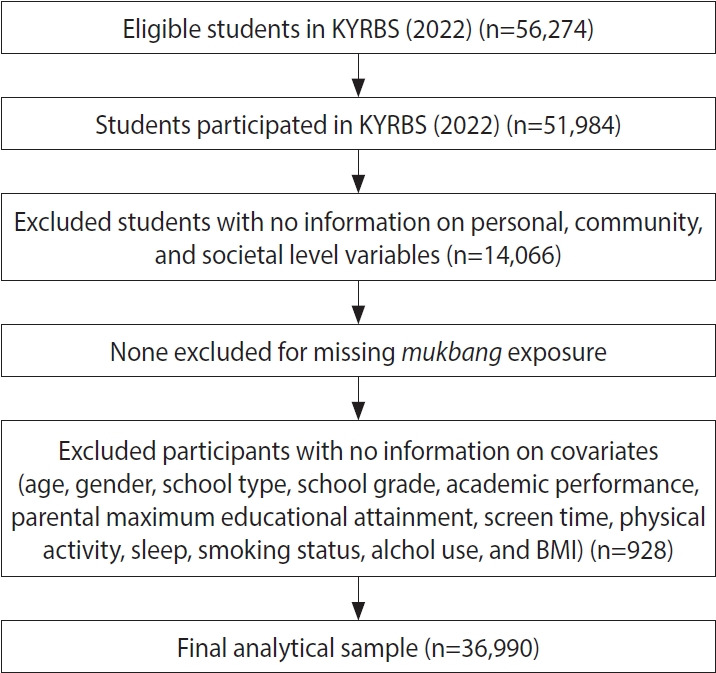 Figure 1
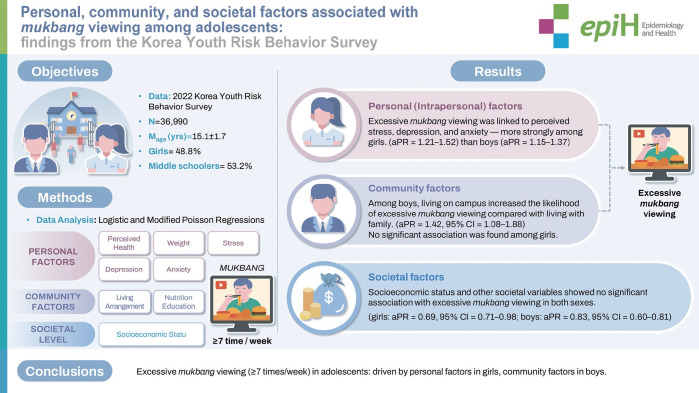 Figure 2
Peer Reviews
No public reviews on file for this paper yet. If you reviewed it on a platform where reviews are public (OpenReview, ICLR, NeurIPS, ICML), you can paste yours below so the community can read it here.
Videos
No videos yet. Explain this paper in a talk, walkthrough, or lecture? Add one.
Taxonomy
TopicsImpact of Technology on Adolescents · Education and Learning Interventions · Asian Culture and Media Studies
GRAPHICAL ABSTRACT
Key Message
Personal factors such as poor perceived health, stress, depression, and anxiety were strongly related to excessive mukbang viewing, particularly among girls, suggesting that emotional distress may drive girls to engage with mukbang as a form of coping or personal connection. Among boys, those living on campus were more likely to view mukbang excessively than those living with family, indicating that community environment and peer influence may contribute to higher engagement in mukbang. Socioeconomic status was not significantly associated with excessive mukbang viewing, implying that prevention efforts should address emotional well-being and healthy media use across all adolescents, regardless of the background.
INTRODUCTION
Mukbang refers to livestreamed videos in which hosts consume unusually large quantities of energy-dense, nutrient-poor foods while interacting with viewers in real time [1-6]. While mukbang has become a global phenomenon [3], it is particularly prevalent in Korea, particularly among adolescents [6]. Approximately 70.6% of Korean adolescents have been exposed to mukbang during the past year, and 13.2% reported viewing mukbang 5 or more times per week [6]. This high prevalence among Korean adolescents may reflect Korea’s collectivist culture, which places a strong value on communal eating and social connectedness [7,8]. Within this context, mukbang may serve as a digital extension of traditional offline mealtime gatherings and reinforce shared food-related experiences. Additionally, since adolescents are developing their identities and are especially sensitive to the influence of family, peers, and media, mukbang videos hosted by influencers—whom adolescents may view as role models—can provide further appeal. This pattern of mukbang consumption among Korean adolescents is concerning, as it may normalize excessive intake of energy-dense, nutrient-poor foods, often consumed within a short period (e.g., 2 hours). This type of content may also distort viewers’ perceptions of appropriate portion sizes and promote eating driven by external cues (e.g., watching others) or emotional states (e.g., boredom) rather than internal hunger signals [2,5]. These factors could potentially increase the risk of overeating or binge eating, which in turn can contribute to obesity [9-11].
The substantial prevalence of mukbang viewing among Korean adolescents [6] and its potential harmful consequences [9-11] underscore the need to examine factors that may place adolescents at heightened risk of excessive exposure to mukbang. This inquiry is theoretically grounded in the compensatory internet use model, which suggests that individuals may turn to online media to partially fulfill unmet emotional and psychological needs [12]. Additionally, the social ecological model [13] provides a conceptual framework to posit that personal, socio-cultural, and environmental factors influence adolescents’ exposure to mukbang. For example, personal factors such as anxiety and loneliness may increase emotional distress, leading adolescents to engage with mukbang media to cope or seek comfort [1,14,15]. Community-level factors such as living arrangements may also shape adolescents’ engagement in mukbang. Living alone or off campus can result in greater social and emotional isolation, which may increase reliance on online media for comfort or companionship [16,17] in managing these feelings. Societal factors, particularly socioeconomic status (SES), might further compound exposure to online or social media and result in excessive exposure to mukbang. Adolescents from lower-SES backgrounds may turn to online media, including mukbang, for vicarious experiences or emotional support due to limited food access and financial stress [18-21].
Emerging evidence further suggests that media consumption patterns may vary between girls and boys [22,23], reflecting gender differences in motivations for engaging with food-related media [24] and in susceptibility to psychosocial stressors [23]. Studies have documented that personal factors such as emotional loneliness are more commonly experienced by girls than boys [4,25-27], which could increase their likelihood of turning to media as a form of emotional coping. Adolescent girls living alone or off campus may perceive greater social and emotional isolation, potentially heightening their reliance on online media for comfort or companionship [16,17,28]. Societal factors, particularly SES, might also influence mukbang viewing in a gender-specific manner. When offline support is limited, girls from lower-SES backgrounds may seek comfort in portrayals of indulgent foods, social interaction, and a sense of inclusion [29]. For boys, economic or social marginalization may make traditional forms of masculine identity feel out of reach, leading them to symbolic performances—such as observing the consumption of large quantities of food—as a form of compensatory identity construction [30]. Understanding how personal, community, and social factors interact, as well as how they may differ by gender, could help identify adolescents most at risk and inform targeted interventions to prevent excessive exposure to mukbang.
Building on prior research and theoretical models, this study aims to explore personal, community, and societal factors in relation to excessive mukbang viewing (≥7 times/wk) among Korean adolescents and to examine how such factors differ by gender. We hypothesized that personal, community, and societal factors would be associated with excessive mukbang viewing among adolescents. Furthermore, given that girls tend to experience more emotional and social loneliness than boys, these factors were expected to display stronger associations in girls.
MATERIALS AND METHODS
Study sample and data
The Korea Youth Risk Behavior Survey (KYRBS) is a nationwide repeated cross-sectional survey that assesses the health and health-related behaviors of Korean adolescents (ages 12 to 18 years) [31]. Selected students voluntarily and anonymously complete a self-administered online questionnaire [31], with de-identified raw data analyzed for this study. Detailed information about the KYRBS is available elsewhere [31].
The 18th wave of the KYRBS was administered in 2022, targeting 56,274 adolescents; 51,984 responded (response rate, 92.4%). Non-participation (n=4,290) occurred mainly because of teachers’ heavy workloads or limited access to computer labs. An additional 14,994 participants were excluded due to missing data, yielding an analytic sample of 36,990 adolescents (19,579 middle school students and 17,311 high school students). A detailed flow diagram of participants is presented in Figure 1.
Measures
Independent variables included self-reported personal, community, and societal factors. The variables, the text of the questions, and the response options are provided in Table 1.
The dependent variable was excessive mukbang viewing, defined as ≥7 times/wk to capture daily or more frequent engagement and to identify adolescents with the most intensive viewing patterns. This cutoff corresponds to approximately the top 10% of viewers in this study and aligns conceptually with thresholds used to define excessive media use in the digital health literature (e.g., ≥3 hr/day in one study, which also reflected the top 10%) [32]. The questions and response options are detailed in Table 1.
Covariates included age, gender, school type, school grade, academic performance, parental highest educational attainment, screen time, physical activity, sleep, smoking status, alcohol use, and body mass index (BMI).
Statistical analysis
Data were analyzed using SAS version 9.4 (SAS Institute Inc., Cary, NC, USA). Survey weights were applied according to the KYRBS sampling design. Descriptive statistics were used to characterize respondents. Both overall and gender-stratified analyses were conducted. Although the formal interaction terms between gender and most independent variables did not indicate statistical significance (p for interaction >0.20), gender-stratified results are presented based on theoretical considerations and prior research suggesting gender-specific differences in mukbang and eating-related behaviors. Logistic regression was used to estimate the predicted probability (PP) of excessive mukbang viewing as a function of multilevel factors [33]. Modified Poisson regression was used to estimate prevalence ratios (PRs) and 95% confidence intervals for excessive exposure to mukbang by factor. For the non-stratified analyses, all models were adjusted for age, gender, school type, school grade, academic performance, parental highest educational attainment, screen time, physical activity, sleep, smoking status, alcohol use, and BMI. For gender-stratified analyses, models were adjusted for all covariates except gender. The final model was mutually adjusted for all independent variables.
Ethics statement
The KYRBS received Institutional Review Board approval from the Korea Disease Control and Prevention Agency (No. 117058) and adhered to the principles of the Declaration of Helsinki. Students were enrolled after they expressed interest, provided written informed consent, and were assured of their right to withdraw at any time.
RESULTS
General characteristics of study participants
The analytic sample comprised 36,990 students in 2022; 52.9% were middle school students. The mean age was 15.1±1.7 years, and 48.6% were girls (Table 2).
Predicted probabilities and prevalence ratios of excessive mukbang viewing by personal factors
Overall adolescents
After adjustment (Table 3, model 1), the PP of excessive mukbang viewing was highest among adolescents who perceived their health as extremely unhealthy (PP, 12.2%), followed by those with obesity (PP, 11.9%), severe anxiety (PP, 10.1%), depression (PP, 9.1%), high loneliness (PP, 9.1%), and high perceived stress (PP, 9.0%). Adolescents who perceived their health as extremely unhealthy had 1.46 times the prevalence of excessive mukbang viewing compared with those who perceived their health as extremely healthy (Table 4, model 1). Participants with obesity had 1.68 times the prevalence compared to those who perceived themselves as extremely underweight; those with severe anxiety had 1.44 times the prevalence of those with minimal anxiety (Table 4, model 1). Participants with depression had 1.31 times the prevalence compared to those without depression, those with high loneliness had 1.29 times the prevalence compared to those with low loneliness, and those with high perceived stress had 1.33 times the prevalence relative to those with low perceived stress (Table 4, model 1). These associations were attenuated after mutual adjustment, but the leading personal factors remained consistent (Tables 3 and 4, model 2).
Girls
Among girls, the PP of excessive mukbang viewing was highest among those who perceived themselves as having obesity (PP, 12.4%) (Table 3, model 1). After adjustment, this group had 1.52 times the prevalence of excessive mukbang viewing compared with those who perceived themselves as extremely underweight (Table 4, model 1). Associations were attenuated after mutual adjustment for independent variables (Tables 3 and 4, model 2).
High levels of anxiety were also related to excessive mukbang viewing; the PP was 11.7% among those who self-reported severe anxiety (Table 3, model 1), corresponding to 1.48 times the prevalence compared with those reporting minimal anxiety (Table 4, model 1). Other personal factors associated with excessive mukbang viewing included moderate or high loneliness (PP, 10.5%), depression (PP, 10.3%), high perceived stress (PP, 10.2%), and perceiving oneself as extremely unhealthy (PP, 10.0%) (Table 3, model 1). PRs relative to the respective reference groups after adjustment are presented in Table 4, model 1. Associations were attenuated toward the null after further adjustment for other independent variables.
Boys
Among personal factors, perceiving one’s health as extremely unhealthy emerged as the factor most strongly associated with excessive mukbang viewing (PP, 13.0%) (Table 3, model 1). Boys with this perception had 1.74 times the prevalence of those who perceived their health as extremely healthy (Table 4, model 1). Other personal factors related to excessive mukbang viewing included perceived obesity (PP, 11.3%), followed by severe anxiety (PP, 8.5%), depression (PP, 8.0%), high loneliness (PP, 7.7%), and high stress (PP, 7.9%) (Table 3, model 1). PRs for these factors, compared with the reference groups, are presented in Table 4, model 1. Little to no change was observed after further mutual adjustment for the independent variables (Tables 3 and 4, model 2).
Predicted probabilities and prevalence ratios of excessive mukbang viewing by community factors
Overall adolescents
The PP of excessive mukbang viewing was 7.3% among those who had received nutrition education in the past 12 months and 7.7% among those who had not. PPs of excessive mukbang viewing varied from 6.3% to 9.8% by living arrangement; however, the probability of excessive mukbang viewing did not differ significantly by living situation (Table 3, model 1). These findings remained largely unchanged after further mutual adjustment (Table 3, model 2).
Girls
Regarding community-level factors, adolescents living off campus had the highest prevalence of excessive mukbang viewing (PP, 13.5%); however, the prevalence of excessive viewing did not differ significantly by living arrangement. In addition, the PP of excessive mukbang viewing was similar between those who had not received nutrition education in the past 12 months (PP, 9.0%) and those who had (PP, 8.4%) (Table 3, model 1). Little to no change was observed after further adjustment for other independent variables (Tables 3 and 4, model 2).
Boys
The PP of excessive mukbang viewing was 9.3% among those who lived on campus, followed by those who lived off campus (7.2%), with family members (6.4%), and with relatives (5.4%) (Table 3, model 1). After adjustment, those who lived on campus had 1.42 times the prevalence of excessive mukbang viewing compared with those who lived with family members (Table 4, model 1). No significant difference in excessive mukbang viewing was observed between boys who had not received nutrition education in the past 12 months and those who had (Tables 3 and 4, model 1). No significant changes were observed after mutual adjustment (Tables 3 and 4, model 2).
Predicted probabilities and prevalence ratios of excessive mukbang viewing by societal factors
Overall adolescents
The PP of excessive mukbang viewing ranged from 7.2% among adolescents with medium SES to 9.9% among those with high SES (Table 3, model 1). However, the prevalence of excessive mukbang viewing did not differ significantly by SES (Table 4, model 1). These results remained consistent after further mutual adjustment (Tables 3 and 4, model 2).
Girls
The PP of excessive mukbang viewing was 10.1% among adolescents who self-reported their family’s SES as low, followed by medium (PP, 8.5%) and high (PP, 8.6%) (Table 3, model 1). However, the PRs of excessive mukbang viewing in the medium-SES or low-SES groups did not differ significantly compared with those in the high-SES group (Table 4, model 1). No significant differences were observed after further mutual adjustment (Tables 3 and 4, model 2).
Boys
The PP of excessive mukbang viewing among boys with low SES was 8.7%, corresponding to 1.15 times the prevalence among those with high SES (Table 3, model 1). Little to no difference was observed after further adjustment.
Sensitivity analyses
Sensitivity analyses were conducted to assess the robustness of the findings across alternative cutoffs for defining excessive mukbang viewing (≥1, ≥3, or ≥5 times/wk). The results of excessive mukbang viewing (≥1 times/week) are reported in Supplementary Materials 1 and 2; results of excessive mukbang viewing (≥3 times/wk) are reported in Supplementary Materials 3 and 4; results of excessive mukbang viewing (≥5 times/wk) are reported in Supplementary Materials 5 and 6 respectively.
DISCUSSION
The overarching aim of this study was to examine gender differences in personal, community, and societal factors related to excessive mukbang viewing (≥7 times/wk) among Korean adolescents. We first discuss overall findings regarding multilevel factors related to mukbang among Korean adolescents and then present gender-stratified findings, given theoretical and empirical evidence suggesting gender-specific differences in factors related to mukbang, despite non-significant interaction terms.
Overall, several personal factors were associated with excessive mukbang viewing (≥7 times/wk), including perceiving oneself as extremely unhealthy, perceiving oneself as having obesity, high perceived stress, high loneliness, depression, and severe anxiety. Notably, loneliness and anxiety were more strongly related to excessive mukbang viewing in girls than in boys. These findings—showing that personal factors such as high loneliness and anxiety are associated with excessive mukbang viewing, especially among girls—partially align with prior studies documenting links between anxiety-related stress and binge-eating behaviors [34] used to soothe negative emotions [35,36]. Additionally, given that mukbang is a contemporary social trend among Korean adolescents, avoiding this trend may amplify fear of missing out, reinforcing repeated exposure to mukbang in pursuit of belonging to a community [1,37]. This effect may be particularly pronounced among girls, whose smaller, more intimate friendship groups can heighten peer influence [38], thus amplifying behaviors, norms, and coping strategies and increasing sensitivity to social trends. Social modeling [39] may further reinforce mukbang viewing, as frequent exposure within peer networks normalizes the behavior. The interplay between personal vulnerability and the socially interactive nature of mukbang content may reflect adolescents’ desire for connection. The direct engagement of hosts with viewers during mukbang, along with real-time chat features, potentially fosters a sense of community [36,40-42]. Considering Korea’s collectivist culture [7]—characterized by conformity [8], uniformity, and a high value placed on communal eating—mukbang may be especially compelling as a socially endorsed activity, offering adolescents, particularly girls a sense of social participation and belonging that may help fulfill their emotional needs.
Although no specific community-level factors were related to excessive mukbang viewing among adolescents overall, gender-stratified analyses revealed that boys living on campus were more likely to engage in excessive viewing, whereas no such association was observed in girls. This finding, together with the observation that boys who described their health as extremely unhealthy, perceived themselves to have obesity, or reported high perceived stress also exhibited greater mukbang viewing, suggests that campus-specific stressors may play a significant role for boys. Such stressors may include academic pressure, the need to fit in, and heightened peer influence [43], which can lead to increased media consumption as a means of alleviating stress. Limited access to supportive offline coping outlets and a tendency toward sedentary routines—particularly among those living in dormitories—may further contribute to excessive mukbang viewing. These factors might reduce motivation for physical activity and encourage obesogenic behaviors. For some boys, mukbang may serve as a form of emotional regulation [15] or social substitution, reinforced by peer norms that normalize or encourage such viewing as a shared activity.
The comparable prevalence of mukbang across socioeconomic strata, with no significant differences by SES or gender, highlights the need for inclusive approaches that target all adolescents, regardless of background, to raise awareness and prevent excessive mukbang viewing, given its associations with adverse health outcomes [9-11].
This study has several strengths. First, it used a nationally representative survey of Korean middle school and high school students in 2022, supporting the generalizability of the results to Korean adolescents. Second, it assessed a wide range of personal, community, and societal factors, enabling a broad examination of their relations to mukbang among adolescents.
However, this study also has several limitations. First and foremost, although a nationally representative dataset was used, applying the findings to populations outside adolescents or beyond Korea may be challenging. Additionally, the cross-sectional design precludes the establishment of causal relationships. For instance, although the factors assessed in this study were assumed to be predictors of excessive mukbang viewing, reverse causation or a feedback loop may exist given the cross-sectional nature of the design. In other words, excessive mukbang viewing might contribute to greater depressive symptoms, heightened anxiety, or poorer self-rated health and weight perception. Individuals experiencing depressive symptoms may also be more likely to engage in excessive mukbang viewing as a coping mechanism, which in turn may reinforce or exacerbate their psychological distress over time, creating a potential feedback loop between emotional states and mukbang media consumption. Thus, longitudinal studies are also needed to determine whether these personal, community, and societal factors have short-term effects that persist only through adolescence or whether they influence exposure to mukbang into emerging adulthood. Furthermore, “excessive exposure” in this study referred to the frequency of viewing within a week rather than the amount of time (i.e., duration) spent watching such content. Future research should explore how personal, community, and societal factors relate to both the frequency and the amount of time spent on such media. Additionally, because the exposure timeframe was limited to the past 12 months, adolescents who were excessively exposed prior to this period may not have been captured, and the measure does not distinguish between acute and chronic exposure.
Moreover, this study relies exclusively on self-reported exposure, outcome, and covariate data, introducing the potential for misclassification bias. Underreporting of mukbang viewing and psychological symptoms (e.g., depression, anxiety) may occur due to recall difficulties or social desirability, whereas some variables, such as perceived health, might be overreported. SES may also be inaccurately reported if adolescents conflate their current and aspirational circumstances. These errors are likely non-differential, which may bias results toward the null and potentially underestimate the true associations. Nevertheless, differential misclassification cannot be entirely ruled out; for instance, adolescents with greater psychological distress might report mukbang viewing or health characteristics differently, which could either inflate or attenuate observed associations. These limitations should be considered when interpreting the findings of this study. Furthermore, the results may have been influenced by unmeasured residual confounding variables. Lastly, we conducted gender-stratified analyses to explore potential differences in associations with excessive mukbang viewing. Although conceptually justified based on prior evidence of gender differences in media use, food attitudes, and emotional coping, the interaction terms for gender-specific associations were not statistically significant for most variables, and confidence intervals for PRs frequently overlapped between girls and boys. Therefore, our findings should be considered exploratory and hypothesis-generating rather than conclusive, and the observed patterns should be interpreted with caution.
The findings of this study have important implications for researchers and clinicians. For researchers, the associations between personal factors related to emotion—such as loneliness, depression, and anxiety—and excessive mukbang viewing highlight the need to examine emotion regulation processes and their role in mukbang. Investigating gender differences in these mechanisms is especially warranted. Longitudinal studies are also needed to track how personal, community, and societal influences on mukbang viewing evolve over time.
For clinicians, the link between emotion-related personal factors and excessive mukbang viewing points to a subgroup of adolescents who may be particularly vulnerable. Interventions should focus on improving self-esteem, promoting positive body image, and developing healthy coping strategies to reduce reliance on mukbang as a form of emotional avoidance or regulation.
The reference list from the paper itself. Each links out to its DOI / PubMed record.
- 1Kim Y Sell your loneliness: mukbang culture and multisensorial capitalism in South Korea In: Lim L, Lee HK, editors. Routledge handbook of cultural and creative industries in Asia. London: Routledge; 2019, p. 227-238
- 2Kang E Lee J Kim KH Yun YH The popularity of eating broadcast: content analysis of “mukbang” You Tube videos, media coverage, and the health impact of “mukbang” on public Health Informatics J 2020262237224810.1177/146045822090136031992111 · doi ↗ · pubmed ↗
- 3Kircaburun K Yurdagül C Kuss D Emirtekin E Griffiths MD Problematic mukbang watching and its relationship to disordered eating and internet addiction: a pilot study among emerging adult mukbang watchers Int J Ment Health Addict 2021192160216910.1007/s 11469-020-00309-w · doi ↗
- 4Kircaburun K Balta S Emirtekin E TosuntasŞB Demetrovics Z Griffiths MD Compensatory usage of the internet: the case of mukbang watching on You Tube Psychiatry Investig 20211826927610.30773/pi.2019.0340 PMC 810301533849247 · doi ↗ · pubmed ↗
- 5von Ash T Huynh R Deng C White MA Associations between mukbang viewing and disordered eating behaviors Int J Eat Disord 2023561188119810.1002/eat.2391536807921 · doi ↗ · pubmed ↗
- 6Sung J Hong JY Kim J Jung J Choi S Kang JY Mukbang and Cookbang watching and dietary behavior in Korean adolescents Nutr Res Pract 20241852353310.4162/nrp.2024.18.4.52339109196 PMC 11300121 · doi ↗ · pubmed ↗
- 7Kim U Triandis H Kagitcibasi C Choi SC Yoon G Individualism and collectivism: theory, method, and applications Thousand Oaks Sage Publications 1994157174
- 8Jiang Y Bong M Kim SI Conformity of Korean adolescents in their perceptions of social relationships and academic motivation Learn Individ Differ 201540415410.1016/j.lindif.2015.04.012 · doi ↗