Generalized eruptive syringomas
Shufang Chai, Aihua Wei Sr, Rong Tao Sr

TL;DR
This paper presents a rare case of syringomas appearing in multiple body areas, highlighting the difficulties in diagnosis and treatment.
Contribution
The novelty lies in documenting a generalized and extensive case of syringomas, which is uncommon in clinical practice.
Findings
Syringomas were found in multiple anatomical regions, which is atypical.
The case emphasizes the diagnostic challenges associated with generalized syringomas.
Abstract
This report describes an unusual clinical case of extensive syringoma involvement spanning multiple anatomical regions, offering insights into diagnostic challenges and management strategies for this rare manifestation.
Genes, proteins, chemicals, diseases, species, mutations and cell lines named across the full text — each resolved to its canonical identifier and authoritative record.
Click any figure to enlarge with its caption.
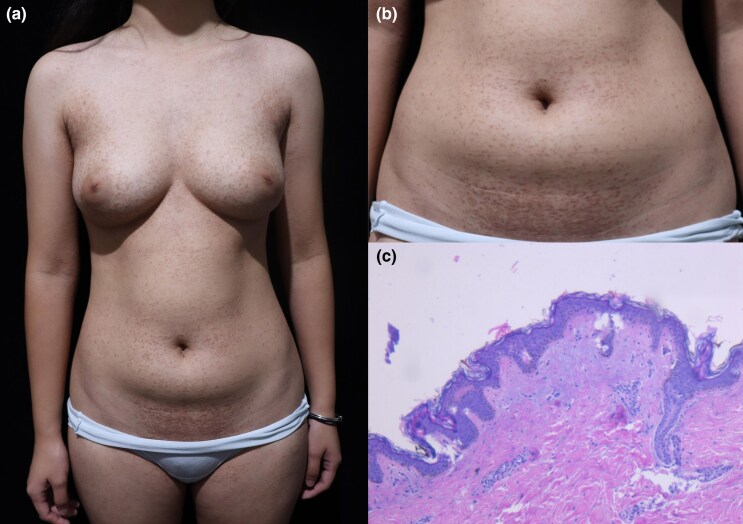 Figure 1
Peer Reviews
No public reviews on file for this paper yet. If you reviewed it on a platform where reviews are public (OpenReview, ICLR, NeurIPS, ICML), you can paste yours below so the community can read it here.
Videos
No videos yet. Explain this paper in a talk, walkthrough, or lecture? Add one.
Taxonomy
TopicsCancer and Skin Lesions · Nasolacrimal Duct Obstruction Treatments · Ear and Head Tumors
Dear Editor, A 20-year-old woman presented with a 6-year history of widespread, chronic, asymptomatic and skin-coloured to light-brownish papules. Physical examination revealed symmetrically distributed shiny papules (2–4 mm) (Figure 1a), densely concentrated on the anterior chest and abdomen, with sparse distribution on the extremities (Figure 1b). Histopathological examination revealed dilated eccrine ducts with basophilic epithelial nests in the dermis, featuring a double-layered epithelium and distinctive comma-like or tadpole-like ductal configurations (Figure 1c). We diagnosed the patient as having generalized eruptive syringomas. At the 5-month follow-up, lesions remained stable without progression or regression. No treatment was administered.