Perceptions of Medical Postgraduates in India Toward Pursuing Super Specialty Education: A Cross-Sectional Study
Zia Arshad, Ravi Prakash, Anita Rani, Rakesh K Dewan, Rakesh Dixit, Amita Pandey

TL;DR
This study explores why Indian medical postgraduates choose or avoid advanced specialty training, highlighting financial and structural barriers.
Contribution
The study provides insights into the motivations and barriers influencing Indian medical postgraduates' decisions to pursue super specialty education.
Findings
74.60% of postgraduates expressed willingness to pursue super specialty education.
Financial constraints and service bonds were major barriers to pursuing further training.
Critical Care was the most preferred specialty, particularly among anesthesiology residents.
Abstract
Background Super specialty (SS) courses such as Doctorate of Medicine (DM) and Master of Chirurgiae (MCh) represent the highest level of medical training in India. Understanding postgraduate (PG) perceptions toward SS is vital for workforce planning and educational reforms. Objective To assess the relationship between demographic factors and PG students’ choice of SS, as well as influencing factors, perceived benefits, and barriers. Methods A cross-sectional, questionnaire-based survey was conducted among PG residents in medicine, surgery, and anesthesiology at a state medical university. Data on demographics, financial and social factors, and career motivations were analyzed using descriptive and inferential statistics. Results Among 63 respondents, 47 (74.60%) were willing to pursue SS. Recognition 20 (31.74%) and academic interest 10 (15.87%) were key motivators. Major…
Click any figure to enlarge with its caption.
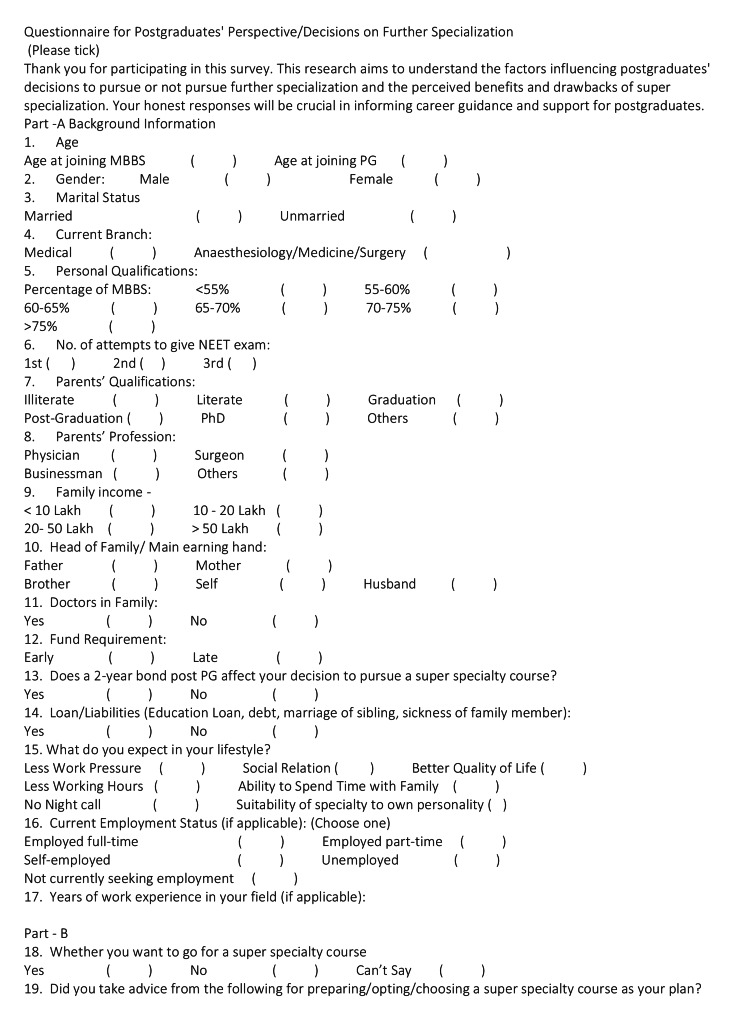 Figure 1
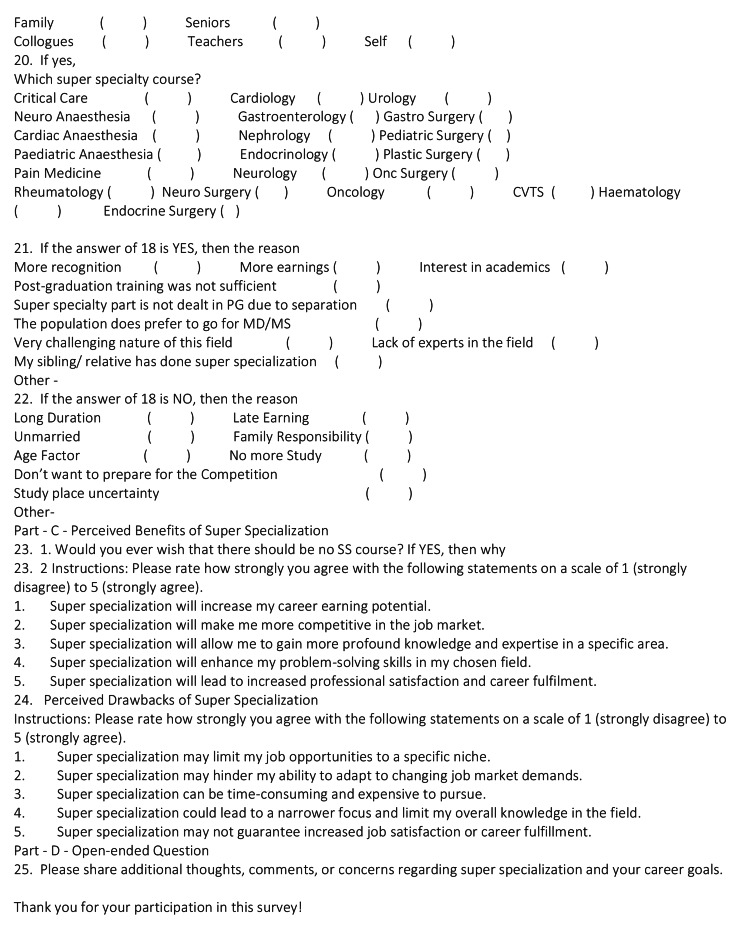 Figure 2
| Variable | Categories | Frequency (n) | Percentage (%) |
| Age at joining MBBS | <18 years | 5 | 7.94 |
| 18–20 years | 12 | 19.05 | |
| >20 years | 9 | 14.29 | |
| Age at joining PG | <25 years | 4 | 6.35 |
| 25–30 years | 23 | 36.51 | |
| >30 years | 10 | 15.87 | |
| Course | MBBS | 26 | 41.27 |
| PG | 37 | 58.73 | |
| Gender | Male | 32 | 50.79 |
| Female | 31 | 49.21 | |
| Marital Status | Married | 17 | 26.98 |
| Unmarried | 46 | 73.02 | |
| Current PG Branch | Medicine | 16 | 25.39 |
| Surgery | 10 | 15.87 | |
| Anaesthesia | 37 | 58.73 | |
| MBBS Percentage | <55% | 7 | 11.11 |
| 55–60% | 26 | 41.27 | |
| 60–65% | 18 | 28.57 | |
| 65–70% | 7 | 11.11 | |
| >70% | 5 | 7.94 | |
| NEET Attempt | 1st | 28 | 44.44 |
| 2nd | 27 | 42.86 | |
| 3rd | 6 | 9.52 | |
| 4th+ | 2 | 3.17 | |
| Parent Qualification | Illiterate | 3 | 4.76 |
| Literate | 17 | 26.98 | |
| Graduate | 24 | 38.10 | |
| PG | 17 | 26.98 | |
| PhD | 2 | 3.17 | |
| Parent Profession | Doctor | 5 | 7.94 |
| Teacher | 4 | 6.35 | |
| Job | 16 | 25.40 | |
| Business | 16 | 25.40 | |
| Retired | 9 | 14.29 | |
| Agriculture | 5 | 7.94 | |
| Other | 8 | 12.70 | |
| Family Income (INR) | <10L | 37 | 58.73 |
| 10–20L | 22 | 34.92 | |
| 20–50L | 3 | 4.76 | |
| >50L | 1 | 1.59 | |
| Head of Family | Father | 43 | 68.25 |
| Mother | 5 | 7.94 | |
| Self | 9 | 14.29 | |
| Brother | 4 | 6.35 | |
| Spouse | 2 | 3.17 | |
| Doctor in Family | Yes | 12 | 19.05 |
| No | 51 | 80.95 |
| Variable | Categories | Frequency (n) | Percentage (%) |
| Financial Requirement Post-PG | Early | 54 | 85.71 |
| Late | 9 | 14.29 | |
| 2-year Bond Affects Decision | Yes | 46 | 73.02 |
| May be | 15 | 23.81 | |
| No | 2 | 3.17 | |
| Loan/Liabilities Present | Yes | 32 | 50.79 |
| No | 31 | 49.21 |
| Career Expectation | Frequency (n) | Percentage (%) |
| Less Work Pressure | 30 | 47.62 |
| Less Working Hours | 17 | 26.98 |
| Better Quality of Life | 6 | 9.52 |
| Suitability to Personality | 1 | 1.59 |
| Social Relationship | 25 | 39.68 |
| Time with Family | 39 | 61.90 |
| No Night Calls | 11 | 17.46 |
| Response | Frequency (n) | Percentage (%) |
| Yes | 47 | 74.60 |
| No | 6 | 9.52 |
| Can’t Say | 9 | 14.29 |
| Source | Frequency (n) | Percentage (%) |
| Seniors | 29 | 46.03 |
| Self | 18 | 28.57 |
| Teachers | 8 | 12.70 |
| Colleagues | 5 | 7.94 |
| Family | 3 | 4.76 |
| Total | 63 | 100.00 |
| Super Speciality | Frequency (n) | Percentage (%) |
| Critical Care | 26 | 41.27 |
| Cardiac Anaesthesia | 7 | 11.11 |
| Pain Medicine | 6 | 9.52 |
| Plastic Surgery | 3 | 4.76 |
| Neuro Surgery | 3 | 4.76 |
| Neuro Anaesthesia | 2 | 3.17 |
| Oncology | 2 | 3.17 |
| Paediatric Anaesthesia | 2 | 3.17 |
| Gastronterology | 2 | 3.17 |
| CVTS | 2 | 3.17 |
| Rheumatology | 2 | 3.17 |
| Nephrology | 1 | 1.59 |
| Endocrinology | 1 | 1.59 |
| Cardiology | 1 | 1.59 |
| Neurology | 1 | 1.59 |
| Onco Surgery | 1 | 1.59 |
| Urology | 1 | 1.59 |
| Reason | Frequency (n) | Percentage (%) |
| More Recognition | 20 | 31.75 |
| More Earning | 7 | 11.11 |
| Interest in Academics | 10 | 15.87 |
| Patients prefer to go to a super specialist | 5 | 7.94 |
| Post-graduation training was not sufficient | 4 | 6.35 |
| Reframe the very challenging nature of this field | 5 | 7.94 |
| The super specialty part is not dealt with in PG due to separation | 2 | 3.17 |
| Lack of experts in the field | 1 | 1.59 |
| Response | n = 63 | % |
| Yes | 13 | 20.63 |
| No | 50 | 79.36 |
| Reason | Frequency (n = 17) | Percentage (%) |
| Long Duration | 6 | 9.52 |
| Financial Burden | 4 | 6.34 |
| Family Responsibilities | 3 | 4.76 |
| Late Earning | 2 | 3.17 |
| Not Interested in Further Study | 1 | 1.58 |
| Study Place Uncertainty | 1 | 1.58 |
| Unmarried | 0 | 0 |
| Increases career earning potential | Improves job market competitiveness | Gain deeper knowledge/ expertise | Enhance problem-solving skills | Increases professional satisfaction | |
| Strongly Disagree | 4 (6.34) | 4 (6.34) | 3 (4.76) | 4 (6.34) | 5 (7.93) |
| Disagree | 6 (9.52) | 5 (7.93) | 4 (6.34) | 5 (7.93) | 10 (15.87) |
| Neutral / Neither Agree nor Disagree | 16 (25.39) | 18 (28.57) | 15 (23.80) | 14 (22.22) | 13 (20.63) |
| Agree | 20 (31.74) | 15 (23.80) | 16 (25.39) | 16 (25.39) | 18 (28.57) |
| Strongly Agree | 17 (26.98) | 21 (33.33) | 25 (39.68) | 24 (38.09) | 17 (26.98) |
| Limit job opportunities | Hinder adaptability | Time-consuming/ expensive | Narrower focus/less knowledge | No guaranteed satisfaction | |
| Strongly Disagree | 5 (7.93) | 8 (12.69) | 7 (11.11) | 10 (15.87) | 6 (9.52) |
| Disagree | 13 (20.63) | 21 (33.33) | 6 (9.52) | 13 (20.63) | 17 (26.98) |
| Neutral / Neither Agree nor Disagree | 19 (30.01) | 20 (31.74) | 17 (26.98) | 22 (34.92) | 20 (31.74) |
| Agree | 18 (28.57) | 8 (12.69) | 21 (33.33) | 12 (19.04) | 11 (17.46) |
| Strongly Agree | 8 (12.69) | 6 (9.52) | 12 (19.04) | 6 (9.52) | 9 (14.28) |
| Variable | Categories | % Chose SS | p-value |
| Gender | Male / Female | 75.0 / 74.2 | 1.000 |
| Income | Low / Mid / High | 78.4 / 63.6 / 100.0 | 0.386 |
| Doctors in Family | Yes / No | 66.7 / 76.5 | 0.739 |
| Branch | Medicine / Anaesthesia / Surgery | 68.3 / 84.2 / 100.0 | 0.590 |
| Theme | Illustrative Quote |
| Financial Barriers | “The system is made so that only the rich can pursue SS.” |
| Academic Interest | “More academics should be included in PG to motivate SS.” |
| Systemic Limitation | “Bond policy and work overload deter SS pursuit.” |
Peer Reviews
No public reviews on file for this paper yet. If you reviewed it on a platform where reviews are public (OpenReview, ICLR, NeurIPS, ICML), you can paste yours below so the community can read it here.
Videos
No videos yet. Explain this paper in a talk, walkthrough, or lecture? Add one.
Taxonomy
TopicsDiversity and Career in Medicine · Hospital Admissions and Outcomes · Health and Medical Research Impacts
Introduction
In India, postgraduate (PG) medical education serves as the cornerstone of specialist training, providing physicians with advanced clinical expertise and professional competence. Beyond this stage, super specialty (SS) programs-such as the Doctor of Medicine (DM) and Master of Chirurgiae (MCh)-represent the pinnacle of medical education and professional development. These programs cultivate highly skilled experts capable of conducting research, driving innovation, and leading within tertiary care settings, thereby addressing the country’s growing need for specialized healthcare services.
There was a noticeable change in students' perceptions at the end of graduation compared to when they entered [1]. The decision to pursue SS training is multifactorial, shaped by personal aspirations, recognition, financial stability, and lifestyle preferences. While many PGs view SS qualifications as a path to professional advancement and prestige, systemic challenges such as limited training opportunities, bond obligations, financial constraints, and prolonged study durations often influence their choices. These factors may deter even highly motivated candidates who aspire to advance their careers in subspecialties.
Previous studies have reported a strong interest in SS training among Indian PGs, with over 80% of respondents expressing intent to pursue further specialization. Preference for branches among graduates is influenced by age-group, sex, and the type of medical school they graduate from [2].
Motivators such as self-esteem, academic growth, and lifestyle enhancement were prominent. Conversely, inadequate mentorship, high financial burden, and lack of institutional support emerged as significant deterrents. Despite policy measures such as reduced qualifying thresholds for entrance examinations, several SS seats remain unfilled annually, reflecting ongoing structural limitations in access and distribution of training.
Understanding PG perceptions toward SS training is crucial for evidence-based workforce planning and medical education reforms in India. The findings may inform targeted interventions to make SS education more equitable, sustainable, and aligned with future healthcare needs.
Study objective
This study, therefore, aims to assess the relationship between demographic variables and the decision to pursue SS courses, to identify influencing factors and perceived benefits, and to analyze barriers that hinder pursuing SS.
Materials and methods
Study design
A cross-sectional survey was the suitable design as it captures information at a specific point in time and provides a snapshot of the perceptions of medical postgraduates at the time of the study. The target population was medical postgraduates enrolled in King George's Medical University (KGMU). The sampling method chosen was stratified random sampling. This method ensures representation from different specialties and years of postgraduate study.
Data collection was done by a self-administered survey. We developed a questionnaire (pilot testing was conducted with a small group of residents) that captures information on demographics (age, gender, specialty), factors influencing the decision to pursue a super specialty (interest, job prospects, income potential, work-life balance, workload), perceived benefits and challenges of pursuing a super specialty, awareness and access to information about super-specialty courses, preferred mode of preparation for super specialty entrance exams (Appendices 1, 2).
An anonymous feedback form was prepared following discussions with faculty members from medicine, surgery, anaesthesia, and other relevant departments. The feedback form was designed to be a comprehensive document that aims to gather as much information as realistically possible about all factors, both direct and indirect, that can potentially impact the choice of specialty for a medical undergraduate. The students were asked to complete an anonymous feedback form regarding their family and educational background, as well as their prospective fields of specialization and career placement. After that, we administer the questionnaire to a small group of postgraduates to ensure clarity and comprehensiveness. We used online survey tools (e.g., Google Forms) as a data collection platform. The participants in this study are postgraduate medical residents doing Doctor of Medicine (MD)/ Master of Surgery (MS) in KGMU in different specialities. They were sent a questionnaire via Google Forms through email and WhatsApp. They were asked to respond in one week. An extension of a week was given with a reminder to those who didn't respond on time. If they didn't reply in two weeks, then they were excluded from the study.
Data analysis
Data analysis was done using SPSS version 28 (IBM Corp., Armonk, New York). Quantitative analysis used descriptive statistics (frequencies, percentages) to summarize the demographics and responses to various survey questions. Qualitative analysis used open-ended questions are included and analyzed the textual responses thematically to identify emerging patterns and insights. Chi-square test and mean were used. A Likert-type scale was also used for analyzing and interpreting data [3].
Ethical considerations
Obtained informed consent from all participants (Institutional ethics committee King George Medical University issued approval "136 ECM IIA/P20” ). Ensured anonymity and confidentiality of the data collected. Obtained ethical approval from the relevant institutional review board before commencing the study.
By following these methodological steps, we conducted a comprehensive study that provides valuable insights into the perceptions of medical postgraduates regarding the pursuit of super-specialty courses. This cross-sectional, observational study was conducted at a medical university in the state capital. The subjects will be postgraduate residents of anaesthesiology, medicine, and surgery in their third year of the course, to analyze their choice of specialty and the factors associated with it.
Results
The demographic distribution of the participants (N = 63) included age at joining Bachelor of Medicine and Bachelor of Surgery (MBBS) and PG, gender, marital status, current branch, MBBS percentage, number of National Eligibility cum Entrance Test (NEET) attempts, parental qualification and profession, family income, head of the family, and whether there were doctors in the family. The majority joined MBBS between the ages of 18-20, 12 (19.05%), joined PG at 25-30 years, 23 (36.51%), were pursuing PG, 37 (58.73%), and were almost equally distributed between males, 32 (50.79%), and females, 31 (49.21%). Most were unmarried, 46 (73.02%). MBBS scores between 55-60, 26 (41.27%), and attempted NEET once, 28 (44.44%). The largest parental education group was graduates, 24 (38.10%), most parents worked in jobs or business, 16 (25.40%), 18family income was predominantly <10 lakh, 37 (58.73%), the father was most often head of family, 43 (68.25%), and most had no doctors in the family, 51 (80.95%) (Table 1).
The financial and social influences on the choice of super specialty. A large proportion required early financial returns post-PG 54 (85.71%), with most feeling that the two-year bond would influence their decision 46 (73.02%), and approximately half reported having loans or liabilities 32 (50.79%) (Table 2).
The most frequently cited expectations were spending time with family 39 (61.90%), reduced work pressure 30 (47.62%), and maintaining social relationships 25, 39.68%). Less working hours 17 (26.98%), no night calls 11 (17.46%), and a better quality of life 6 (9.52%) were reported less frequently (Table 3).
The willingness to pursue a super specialty shows that most participants 47 (74.60%) expressed willingness, 6 (9.52%) said no, and 9 (14.29%) were unsure (Table 4).
Seniors were the most common source, 29 (46.03%), followed by self-motivation, 18 (28.57%), teachers, 8 (12.70%), colleagues, 5 (7.94%), and family, 3 (4.76%) (Table 5).
Critical care was the most preferred 26 (41.27%), followed by cardiac anesthesia 7 (11.11%), pain medicine 6 (9.52%), plastic surgery 3 (4.76%), neurosurgery 3 (4.76%), and several others, including gastroenterology, cardiovascular and thoracic surgery (CVTS), rheumatology, nephrology, cardiology, and urology (each ≤3.17%) (Table 6).
The following table presents the reasons for opting for super-specialty care. More recognition 20 (31.75%) was the leading reason, followed by interest in academics 10 (15.87%), more earnings 7 (11.11%), patients’ preference for super specialists 5 (7.94%), and the challenging nature of the field 5 (7.94%). Fewer cited insufficient PG training 4 (6.35%), separation of the SS part in PG 2 (3.17%), or lack of experts 1 (1.59%) (Table 7).
In response to the question "whether participants had a sibling/relative with super specialization," only 13 (20.63%) answered “Yes,” while 50 (79.36%) said “No.” (Table 8).
The reasons for not opting for super specialty among the “No” group, long duration was most cited 6 (9.52%), followed by financial burden 4 (6.34%), family responsibilities 3 (4.76%), late earning 2 (3.17%), and lack of interest in further study 1 (1.58%) (Table 9).
The following were the perceived benefits of super specialization on a "Likert scale" [3]. The most agreed-upon benefits were gaining deeper knowledge/expertise, 25 (39.68%) strongly agree, 16 (25.39%) agree, and enhancing problem-solving skills, 25 (38.09%) strongly agree, 16 (25.39%) agree. Many agreed that it increases career earning potential 17 (26.98%) strongly agree, 20 (31.74%) agree, and professional satisfaction 17 (26.98%) strongly agree, 18 (28.57%) agree, although some responses were neutral or disagreed (Table 10).
The following were found to be the perceived drawbacks of super-specialization. A significant proportion agreed it is time-consuming/expensive, 12 (19.04%) strongly agree, 21 (33.33%) agree, and may limit job opportunities, 8 (12.69%) strongly agree, 18 (28.57%) agree. Other concerns included hindering adaptability, a narrower focus, and no guaranteed satisfaction, with many participants expressing neutrality or disagreement (Table 11).
The association between demographic factors and the choice of super specialty is shown below. No statistically significant associations were found between the choice of SS and gender (p = 1.00), income (p = 0.386), presence of doctors in the family (p = 0.739), or branch of study (p = 0.590) (Table 12).
The thematic analysis of open-ended feedback from participants regarding super specialization shows three main themes. Financial barriers - Some respondents felt that the current system favours those with higher financial means, as reflected in the quote: “The System is made so that only the rich can pursue SS”, academic interest - A recurring suggestion was to increase academic exposure during PG to foster interest in super specialization: “More academics should be included in PG to motivate SS”, and systemic limitation - Policy-related and workload challenges were highlighted as deterrents: “Bond policy and work overload deter SS pursuit” (Table 13).
Discussion
Studies on career decision-making among residents highlight the role of personal values. This study examined the perceptions of postgraduate (PG) students in medicine, surgery, and anaesthesiology regarding the pursuit of super-specialty (SS) training. The results reveal a complex interaction of demographic, financial, lifestyle, and institutional factors influencing career choices, broadly consistent with prior research in India and abroad. The fundamental skills required for clinical practice appear to be well understood by advanced students. To help students make a realistic choice of a specialty for postgraduate training, medical schools should assist their students in matching their impressions of the competencies required for particular specialties with the specialty-specific needs [4].
Demographics and background factors revealed a balanced gender distribution and a predominantly first-generation composition of medical professionals. Academic performance was modest for many, with nearly half clearing the NEET on their first attempt; yet, SS aspirations remained high. This suggests that academic excellence alone does not dictate specialization decisions, echoing Dattner et al., who noted the importance of personal values and specialty characteristics over performance metrics [1].
Financial pressures were among the strongest barriers to progress. Most participants emphasized the need for early financial returns, while half reported loans or liabilities. Bond obligations were particularly unpopular, with two-thirds viewing them as deterrents. These concerns align with those of Bhattacharya et al., who reported persistent SS seat vacancies due to financial viability, litigation risks, and a lack of institutional incentives [5].
Lifestyle preferences also strongly shaped choices. Participants prioritized family time, reduced workload, and emotional well-being over economic drivers. This explains the appeal of critical care, cardiac anaesthesia, and pain medicine among anaesthesiology postgraduate students, who are perceived to offer structured working hours. Similar patterns were noted by Das et al., who found that lifestyle preferences and self-esteem were primary motivators for pediatric PGs [2].
Despite systemic barriers, overall willingness to pursue SS was high (74.6%), though married participants-particularly women-were less inclined, reflecting family responsibilities. Importantly, no significant association was observed between SS aspirations and factors such as income, PG branch, or medical family background, highlighting the influence of intrinsic motivation and systemic factors.
Motivators included recognition and academic interest, with financial gain ranking lower in importance. Barriers such as prolonged training, financial strain, and family obligations mirrored findings from Mohan et al., who emphasized systemic gaps in postgraduate support [6]. Participants acknowledged benefits such as enhanced expertise, problem-solving ability, and satisfaction, but concerns over time, expense, and limited opportunities created ambivalence. This resonates with Shetty et al., who underscored the role of mentorship and institutional guidance in career decision-making [7]. The attitudes of employed nurse practitioners (NPs) and physician assistants/associates (PAs) are generally positive toward the concept of postgraduate specialty-specific training [8].
There was a change in students' perceptions at the end of graduation as compared to the time of entry. Their focus shifted from being in a respectful profession and serving the community to getting jobs and earning money [9]. Specialty preferences were aligned with PG background: anaesthesiology PGs chose critical care and related subspecialties, surgery PGs leaned toward plastic surgery and neurosurgery, while medicine PGs expressed diverse interests. The majority of the students preferred only the clinical subjects. Preference for branches among graduates is influenced by age-group, sex, and the type of medical school they graduate from [10]. These patterns parallel national trends favoring lifestyle-friendly or “end-branch” specialties over infrastructure-heavy fields. Laishram et al. concluded that the two main factors influencing a medical specialty's decision were interest in the field and compassion for patients [11]. Clinical branches remain preferred over non-clinical specialties, and research remains a low priority among students. Introducing innovative methods in teaching pre and paraclinical subjects and making medical teaching a more attractive career prospect can help improve this picture [12]. Despite their discontent with the infrastructure, the majority of alumni found their residency training to be advantageous for their professions [13]. Various factors like gender, marital status, friends, and seniors' advice affect the choices for preferred specialty. Various factors like gender, marital status, and friends' and seniors' advice affect the choices for preferred specialty [14]. The various groups have different factors that impact the selection of surgical subspecialties. When creating programs and organizing professional career guidance and counseling, this information can be helpful [15]. The decision to pursue a super specialty course is a complex one for medical postgraduates, and their perceptions play a significant role in the process. Several factors can influence their perception, including career aspirations, job opportunities, work-life balance, and financial considerations.
Limitations
This study has certain limitations. A small sample size is one of the limitations. Further study with a larger sample size will give more detailed information. Being a single-institution study, the findings may have limited generalizability to other settings. The cross-sectional design restricts the ability to capture evolving perceptions over time. Additionally, since the data were self-reported, the possibility of response bias cannot be ruled out. Also, the questionnaire was peer validated, which further has its own limitations.
Conclusions
In conclusion, despite Indian PGs' strong desire for SS training, their pursuit is hampered by a lack of supervision, lifestyle concerns, and budgetary constraints. Reducing financial obstacles, filling mentorship shortages, and providing flexible pathways could increase adoption and better match the SS workforce with India's changing healthcare needs.
The recommendations that follow are based on the observations mentioned above. Establish structured career counseling and mentorship during PG training, provide financial assistance schemes and flexible bond policies, and enhance PG-level academic exposure and research opportunities. National-level policies should address systemic inequities to optimize the uptake of SS.
The reference list from the paper itself. Each links out to its DOI / PubMed record.
- 1Career decision-making among pediatric residents Med Educ Online Dattner L Ozuah PO 43841020052825314610.3402/meo.v 10i.4384 · doi ↗ · pubmed ↗
- 2Factors influencing postgraduates' pursuit of pediatrics super-specialty training Indian J Pediatr Das BK Barman H Barman D 3209220253974559610.1007/s 12098-024-05366-w · doi ↗ · pubmed ↗
- 3Analyzing and interpreting data from likert-type scales J Grad Med Educ Sullivan GM Artino AR Jr 541542520132445499510.4300/JGME-5-4-18PMC 3886444 · doi ↗ · pubmed ↗
- 4Advanced undergraduate medical students' perceptions of basic medical competences and specific competences for different medical specialties - a qualitative study BMC Med Educ Zelesniack E Oubaid V Harendza S 590222022 https://doi.org/10.1186/s 12909-022-03606-13591543910.1186/s 12909-022-03606-1PMC 9341094 · doi ↗ · pubmed ↗
- 5Why DM and M Ch seats are lying vacant?Natl Med J India Bhattacharya S Bhattacharya K 2752773720243995387710.25259/NMJI_135_2024 · doi ↗ · pubmed ↗
- 6Postgraduate training in medical colleges of India: resident physicians’ perspective Indian Journal of Physiology and Pharmacology Mohan L Pant J Agrawal M Shah Z 245255652022
- 7Knowledge and choice of medical undergraduates in pursuing post graduates and super speciality: an original research Journal of Pharmaceutical Shetty A Shetty A Khot SN 25562553(2022)
- 8Perceptions of nurse practitioners and physician assistants/associates toward the concept of developing an advanced practice postgraduate residency/fellowship program at a large academic medical center Cureus Kidd VD Douglas G 016202410.7759/cureus.67820 PMC 1134681339188334 · doi ↗ · pubmed ↗