A bubble-free strategy for saline-immersion endoscopic submucosal dissection: optimized electrosurgical settings and continuous low-pressure saline perfusion
Masafumi Kitamura, Yuji Ino, Kosei Hashimoto, Hisashi Fukuda, Mayo Tanabe, Haruhiro Inoue, Hironori Yamamoto

Abstract
Genes, proteins, chemicals, diseases, species, mutations and cell lines named across the full text — each resolved to its canonical identifier and authoritative record.
Click any figure to enlarge with its caption.
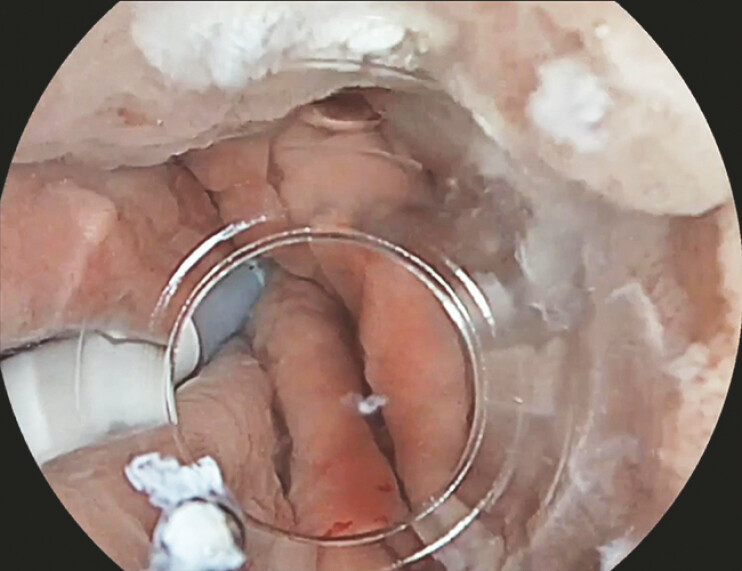 Fig. 1
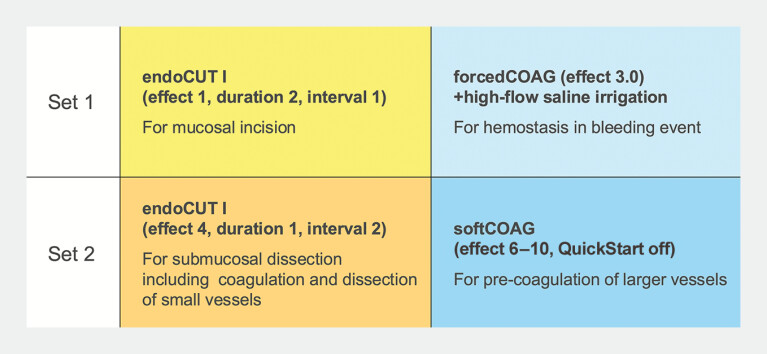 Fig. 2
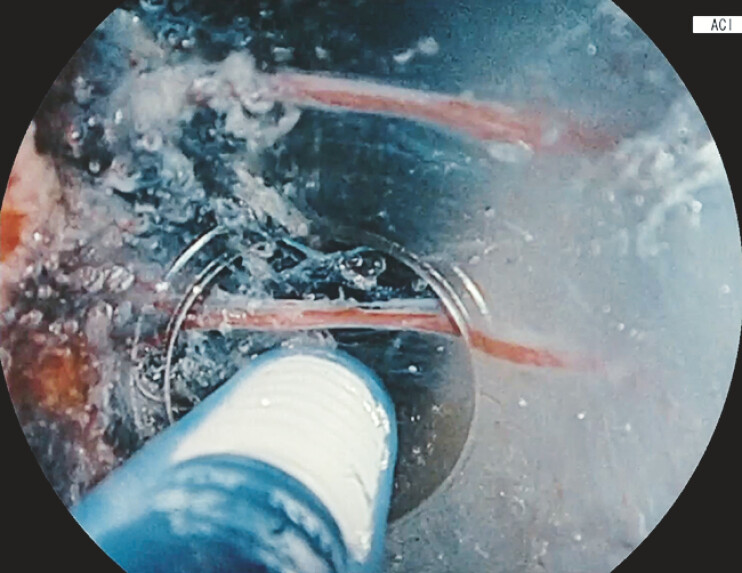 Fig. 3
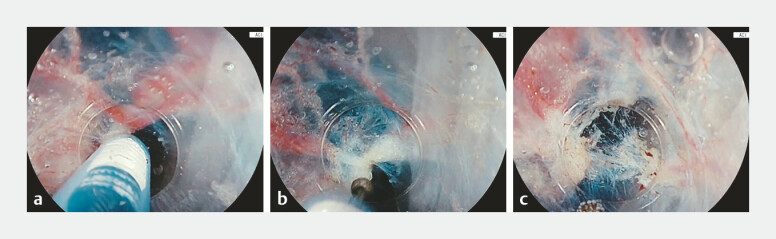 Fig. 4
Peer Reviews
No public reviews on file for this paper yet. If you reviewed it on a platform where reviews are public (OpenReview, ICLR, NeurIPS, ICML), you can paste yours below so the community can read it here.
Videos
No videos yet. Explain this paper in a talk, walkthrough, or lecture? Add one.
Taxonomy
TopicsGastric Cancer Management and Outcomes · Esophageal Cancer Research and Treatment · Thyroid and Parathyroid Surgery
Saline-immersion therapeutic endoscopy and the water pressure method have recently gained attention as novel approaches for endoscopic submucosal dissection (ESD 1 2 ). These techniques offer multiple advantages, including stable visualization of the submucosal layer, improved scope maneuverability, and controlled submucosal expansion by buoyancy and hydrostatic pressure. However, during saline-immersion ESD, visibility is often impaired by bubble formation resulting from vaporization and electrolysis during the use of high-frequency devices 3 .
To overcome these issues, we developed continuous low-pressure saline perfusion (CLPSP; Fig. 1 4 5 ). CLPSP rapidly expels bubbles from the endoscopic field, maintaining a clear view even during active dissection. Nevertheless, when high-voltage modes such as swiftCOAG and forcedCOAG are applied, which are often applied during submucosal dissection to achieve hemostasis, the generation of bubbles remains pronounced because of spark-induced vaporization and electrolysis. Even with continuous saline perfusion, these bubbles can temporarily impair visibility.
A nasogastric tube is in place for continuous low-pressure saline perfusion (CLPSP).
Based on these findings, we designed an optimized electrosurgical strategy for bubble-free ESD under saline immersion ( Fig. 2 , Fig. 3 and Video 1 ). All procedures were performed using a VIO3 electrosurgical generator (Erbe Elektromedizin, Tübingen, Germany). Submucosal dissection is performed using endoCUT I (effect 4, duration 1, and interval 2), whereas softCOAG (effect 6–10, QuickStart off) is used for pre-coagulation of larger vessels. Under saline immersion, unlike in air, softCOAG ensures stable current conduction and uniform coagulation, even with a needle-type knife ( Fig. 4 ). SoftCOAG delivers a low-voltage continuous current without spark or bubble formation. In the event of bleeding, high-flow saline irrigation maintains visibility, and forcedCOAG achieves hemostasis while suppressing vaporization and spark formation. In addition, CLPSP using automatic water irrigation synchronized with the electrosurgical unit (EIP2; Erbe, Tübingen, Germany) is useful for this technique.
Optimized high-frequency settings used for bubble-free ESD under saline immersion. ESD, endoscopic submucosal dissection.
Combination of optimized high-frequency settings with CLPSP enables bubble-free ESD under saline immersion, maintaining a clear view even during active dissection. CLPSP, continuous low-pressure saline perfusion; ESD, endoscopic submucosal dissection.
A bubble-free strategy for saline-immersion endoscopic submucosal dissection: optimized electrosurgical settings and continuous low-pressure saline perfusion.Video 1
Pre-coagulation of larger vessels using softCOAG under saline immersion. Stable current conduction allows uniform coagulation without bubble formation. a Large submucosal vessel. b Pre-coagulation using softCOAG (effect 6–10, QuickStart off). c Bleeding prevention and safe cutting during dissection.
This combination of optimized high-frequency settings with CLPSP enables bubble-free ESD under saline immersion, preventing inadvertent bleeding and allowing smooth, efficient, and safe dissection.
Endoscopy_UCTN_Code_TTT_1AO_2AG_3AD
The reference list from the paper itself. Each links out to its DOI / PubMed record.
- 1Despott EJ Murino A Saline-immersion therapeutic endoscopy (SITE): An evolution of underwater endoscopic lesion resection Dig Liver Dis 201749137610.1016/j.dld.2017.08.03528967632 · doi ↗ · pubmed ↗
- 2Yahagi N Nishizawa T Sasaki M Water pressure method for duodenal endoscopic submucosal dissection Endoscopy 201749 E 227E 22810.1055/s-0043-11355628759932 · doi ↗ · pubmed ↗
- 3Munro MG Brill AI Ryan T Electrosurgery-induced generation of gases: comparison of in vitro rates of production using bipolar and monopolar electrodes J Am Assoc Gynecol Laparosc 20031025225910.1016/s 1074-3804(05)60307-612732780 · doi ↗ · pubmed ↗
- 4Ino Y Fukuda H Ueno T Continuous low-pressure saline perfusion for gastric endoscopic submucosal dissection Endoscopy 202456 E 880E 88110.1055/a-2427-942939424360 PMC 11489009 · doi ↗ · pubmed ↗
- 5Hashimoto K Yamamoto H Despott EJ The overtube in balloon-assisted endoscopic submucosal dissection is useful for improving maneuverability and as the drainage route in the continuous low-pressure saline-perfusion method Video GIE 20251059960110.1016/j.vgie.2025.06.00741262197 PMC 12624532 · doi ↗ · pubmed ↗